




Volume 168 - Issue 6
Unemployment and health: the healthcare system's role
Authors: Elizabeth Harris, Ian W Webster, Mark F Harris and Penelope J Lee
Med J Aust 1998; 168 (6): 291-296.
Published online: 16 March 1998
Published online: 16 March 1998
Unemployment and health: the healthcare system's role
Elizabeth Harris, Ian W Webster, Mark F Harris and Penelope J Lee
Experts from the South Western Sydney Area Health Service and the University of New South Wales say there are few r eports of healthcare interventions to address the impact of unemployment on health. They outline possible strategies, which include providing accessible and appropriate healthcare; developing the health care system's capacity to deal with the health problems of unemployed people; collaborating with other agencies and sectors working on this issue; acting as an advocate for unemployed people; undertaking research; and providing training, work experience and employment opportunities within the healthcare system. Long term solutions lie in increasing employment and training opportunities. Nevertheless, there is a clear role for the healthcare system in reducing the health impacts of unemployment and ensuring that poor health does not act as a barrier to returning to work. (MJA 1998; 168: 291-296)
Introduction -
GPs' experience of the health impact of unemployment -
Opportunities for action -
Conclusion -
References -
Authors' details
-
-
©MJA1998
Introduction |
The health problems of unemployed people1,2 find their way daily into general
practitioners' (GPs') consulting rooms and hospitals, and so are a
legitimate concern to all health workers and policymakers. The
challenge in addressing this issue is to define an effective role for
the healthcare system which both promotes employment and reduces its
health impacts.
Experience gained in addressing other health-related problems with their roots in our social and economic environments (eg, road injury or the health of indigenous people) suggests that action will be needed at many levels both within and outside the healthcare system. Healthcare provided for unemployed people should:
It will also involve work with other sectors and community groups to meet the needs of unemployed people in the local community and to bring the high social and economic costs of the detrimental effects of unemployment on health to the attention of government and the community. Here we examine possible practical action that can be taken by mainstream health services to reduce the impact of unemployment on health. |
GPs' experience of the health impact of unemployment |
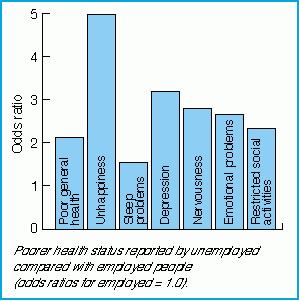
Differences in the presenting health problems of unemployed and
employed people are not subtle. In a GP waiting room survey in outer
Sydney, unemployed people were significantly more likely than
employed people to report poorer health, depression, anxiety,
insomnia and limitations to their social activities due to physical
and mental health problems, after adjusting for age, sex and
English-speaking or non-English-speaking background3 (Figure, below). There is also evidence
that people who are unemployed have, or develop, chronic health
problems that act as barriers to a return to work.1,4,5
Differences in management by GPs have been found between employed and unemployed people; people who are unemployed are more likely to be prescribed medication for depression and anxiety by GPs, and to be less frequently referred to self-help groups.6 |
Opportunities for action |
Despite all the evidence of an association between unemployment and
health, review of the health research literature revealed few
examples of health service interventions to reduce the impact of
unemployment on health: one described an employment initiative for
mental health service users in Wales, and a second documented health
service providers' views of unemployment and their response to
unemployment issues.7,8
Some studies describe the impact of training programs on health and
employment outcomes.9,10 Thus, up to now, the focus has been on defining the association between unemployment and health and little attention has been paid to developing or evaluating interventions within the healthcare system to prevent or reduce the health impacts of unemployment. We currently have little understanding of what are the most appropriate responses. We need more thorough evaluation of current strategies within the healthcare system for addressing this issue, and opportunities to study successful interventions in similar health-related areas.11,12 Possible strategies are listed in Box 1 and described below. Providing accessible preventive care and management of health problems In the South Western Sydney Area Health Service, we have developed standards for GP management of the health problems of unemployed people. In the process, a high level of agreement was found between unemployed people, community groups and GPs on the possible role for primary care workers. GPs were seen as having a central role in providing comprehensive management of existing health problems and anticipatory care, building the capacity of their patients to solve health-related problems and ensuring referral to relevant services (Box 2). GPs trained in these standards have gained confidence in managing the problems of their unemployed patients, and increased their knowledge of local services.13 Further work on assessing the impact of use of the standards on patient health outcomes is required. Patients with chronic health problems require particular attention, as these problems may lead to unemployment or act as significant barriers to re-employment. The job security of people who are limited by mental or physical conditions is increasingly at risk as the labour force contracts, and stressful working conditions may exacerbate existing disabilities, especially mental disability. Building the capacity of the healthcare system to address unemployment Healthcare services must be accessible and affordable. Medicare has improved access to general practice, but access of unemployed people to healthcare may be limited by the costs of private medical treatment, imaging and prescriptions. For example, people who are unemployed are more likely to experience mental health problems.14,15 The cost of private psychiatric services is high and publicly funded mental health services may give low priority to problems such as anxiety, depression, emotional instability and social isolation, to which unemployed people are more prone. Furthermore, more unemployed people live in geographic areas where public health services are in limited supply (such as the western suburbs of Sydney and Melbourne, and in rural areas). An ever-present problem is that even healthcare workers are not immune to prejudices against unemployed people. This can result in a lack of sensitivity to the range of problems faced by unemployed people and how they can be addressed, different medical treatment being given to unemployed people, and unjust assumptions being made ("all they want is a quick fix"). One way to deal with these prejudices is by providing pre-service educational programs that require medical, nursing and allied health students to undertake case studies of the health and social problems faced by unemployed people. Working with other agencies and departments to reduce the impact of unemployment on health and increase the chances of finding work Many healthcare workers already informally collaborate with other services to address the needs of particular individuals or families. A more formal and systematic collaboration is needed to prevent job loss whenever possible, to reduce the impact of unemployment on health, and to ensure that existing health problems do not become a barrier to returning to work. Establishing better relationships between service providers can prevent the different ways organisations do business from compounding the problems (eg, making arrangements for managing drug or alcohol dependence can improve unemployed people's ability to concentrate on training programs). Action can also be directed at providing skills and resources to other organisations, and supporting them in addressing the needs of their unemployed clients. Skillshares (community-based training providers for unemployed people) provide an important venue for health service providers to make contact with unemployed people. The Division of General Practice Southern Tasmania has developed an innovative program in which GPs regularly provide health education for Skillshare participants.16 At evaluation of this program, both the confidence of participants in dealing with the health system and their knowledge of factors that improve health were increased. Several recent studies have found that introduction of short courses to improve problem-solving skills and reduce negative feelings and beliefs had positive and long-lasting impacts on psychological health, and also increased the number of people who found work.10,17 With experience gained from these projects, the South Western Sydney Area Health Service is working with Skillshares to promote early detection and referral of health problems, to increase the skills and knowledge of participants in making healthy life choices, and to build psychological resilience and coping strategies. Acting as advocates for unemployed people to government and the wider community Health workers have an important role in advocating on behalf of their patients. For people who are unemployed, this may involve intervening in decisions that have been made by government departments (eg, loss of benefits), dealing with other institutions (eg, negotiating for a priority housing listing), or asking for special support and assistance (eg, requesting assistance with paying electricity bills). More generally, the healthcare system can highlight the impact of unemployment on health and challenge stereotyping of unemployed people as lazy or "dole bludgers". It is in this area that the role of the health sector in preventing health problems can be most effective. Because appreciable changes in employment opportunities in Australia require political action, it is important that the contribution is not only in defining the problem but also in providing leadership in directing change. Continuing to research the impact of unemployment on health and to evaluate interventions There is a need for further research to explain the nature of the link between unemployment and ill-health -- the complex interplay of poverty, stress, social support, lifestyle risk factors, pre-existing disease and access to or use of healthcare services. There also needs to be a substantial shift away from defining the problem to developing and evaluating interventions that may reduce the health impact of unemployment. At a policy level the health costs associated with unemployment need to be better documented; in part to justify the reorienting of healthcare services to address the needs of unemployed people, but also to ensure that these costs are added into any evaluation of unemployment costs to the community. Providing training, work experience and employment for unemployed people The healthcare system is one of Australia's largest employers. Many NSW health services have made significant contributions to providing training, work experience and ultimately employment for local unemployed people. The second-largest employer in south-west Sydney, the South Western Sydney Area Health Service (SWSAHS), in collaboration with the federal Department of Employment, Education, Training and Youth Affairs, has established both training programs for long term unemployed, and a routine referral system to the Commonwealth Employment Service for SWSAHS job vacancies in certain areas (eg, clerical and catering, as well as laboratory technicians and ward orderlies). This has resulted in over 100 unemployed people being placed in the Area Health Service. The benefits of such programs lie not only in the employment and training opportunities that they provide, but also in building up organisational commitment to addressing the health problems of unemployed people.18 |
Conclusion | The healthcare system can and should be expected to play a significant role in reducing the impact of unemployment on health and ensuring that health problems do not act as barriers to people returning to work. Unemployment is not a disease and should not be medicalised. However, its impact on health needs to be more formally recognised by the healthcare system in the way we deliver and plan services for individuals and populations. It also needs to be made clear to governments and the community that the long-term solution to these health problems will not be found in hospitals or GP surgeries, but in the creation of employment and training opportunities for all Australians who want to work. The medical profession in this country has provided real leadership on this issue in the past: the AMA organised conferences and seminars in 1995; and both the AMA and the Public Health Association have made submissions to parliamentary committees and attempted to raise community awareness through media publicity. The need to provide leadership has not diminished. |
References |
This is the final article in a series on unemployment and health (see also MJA 1998; 168: 177, 178 and 236) |
Authors' details
South Western Sydney Area Health Service (SWSAHS), Sydney, NSW.Elizabeth Harris, BA, DipSocWk, MPH, Deputy Director, Centre for Health Equity Training Research and Evaluation;
Penelope J Lee, BA, BCA(Hons), Research Officer, Unemployment and Health Project.
School of Community Medicine, University of New South Wales, NSW.
Ian W Webster, MD, FRACP, FAFPHM, Professor of Public Health;
and Director, Division of Population Health, SWSAHS;
Mark F
Harris, MD, FRACGP, Professor of General Practice; and
Director, General Practice Unit, SWSAHS.
Reprints will not be available from the authors.
Correspondence:
Professor M F Harris, General Practice Unit, Fairfield Hospital,
Fairfield, NSW 2165.
E-mail: m.f.harris AT unsw.edu.au
-
Readers may print a single copy for personal use. No further reproduction or distribution of the articles should proceed without the permission of the publisher. For permission, contact the Australasian Medical Publishing Company
Journalists are welcome to write news stories based on what they read here, but should acknowledge their source as "an article published on the Internet by The Medical Journal of Australia <http://www.mja.com.au>".
<URL: http://www.mja.com.au/>
Mending the Road: A Way Forward From Silence and Silencing
Ayman Hamdan, Anisa J. N. Jafar
Seven Vessel Spontaneous Coronary Artery Dissection and Concurrent Transient Global Amnesia After an Emotional Trigger
Michael J. Stewart, Tom R. Sutherland
Seven Vessel Spontaneous Coronary Artery Dissection and Concurrent Transient Global Amnesia After an Emotional Trigger
Virginia Barbour
Research Priority Setting Is Not Research: A Call for Ethical Clarity in Australia
Bec Jenkinson, Gordon McGurk, Jonathan Quicke, Janelle Bowden, Nadine E. Foster
Organ Donation After Oral Ingestion of a Voluntary Assisted Dying Substance
Joanne Kantianis, Helen I. Opdam, Rohit L. D'Costa
Equity, Diversity and Inclusion From the Start: Reforming Australia's Research Infrastructure for Inclusive Participation
Danielle M. Muscat, Kirsten J. McCaffery, Heather L. Shepherd, Marguerite Tracy