




Volume 167 - Issue 1
Australian trends in opioid prescribing for chronic non-cancer pain, 1986-1996
Author: James R Bell
Med J Aust 1997; 167 (1): 26-29.
Published online: 7 July 1997
Published online: 7 July 1997
Australian trends in opioid prescribing for chronic non-cancer pain, 1986-1996
James R Bell
Readers may print a single copy for personal use. No further reproduction or distribution of the articles should proceed without the permission of the publisher. For permission, contact the Australasian Medical Publishing Company
Journalists are welcome to write news stories based on what they read here, but should acknowledge their source as "an article published on the Internet by The Medical Journal of Australia <http://www.mja.com.au/>".
Abstract - Introduction - Methods - Results - Discussion - Acknowledgements - References - Authors' details
-
©MJA1997
The aims of this study were to describe trends in opioid prescribing
for chronic non-cancer pain, to investigate whether a person who
begins taking oral opioids regularly will continue to do so in the
long-term, and to assess the extent to which opioid treatment is
associated with dose escalation over time.
The study was approved by the ethics committee of the South Eastern
Sydney Area Health Service. The collection of data from NSW
Department of Health files was performed by two medical students. No
information identifying patients or prescribing doctors was
available to any clinician who could have been involved in the
patient's care.
The Figure (below) suggests that the advent of slow release morphine in 1990 in
Australia has had a marked effect on prescribing patterns, as the rate
of increase in morphine prescribing accelerated from that point.
However, although some individual opioid drugs have declined in use,
the increase in oral morphine has not been accompanied by a decline in
the use of other opioid drugs.
Figures for NSW parallel the Australian rise. Between the years 1990
and 1995, total oral morphine use in NSW rose from 87 to 209 kg per year (a
140% increase). In the same interval, the consumption of other S8
drugs rose from 42 to 46 kg per year (10% increase). Injectable S8 drugs
rose from 1.2 to 1.3 million ampoules (8% increase).
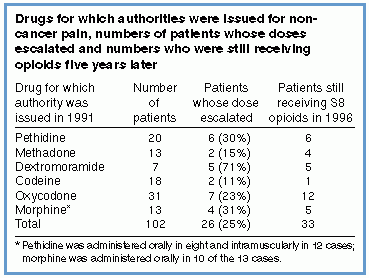
The clinical impression is that dose escalation may be more likely in
patients taking the potent, short-acting drug dextromoramide, and
less likely in those taking low potency codeine or long-acting
methadone. Despite the small numbers (see Box), the difference in the
proportion of patients taking these different drug types whose
opioid dose escalated approached significance (P = 0.053).
Thirty-three patients (32.4%; 95% CI, 23.4%-42.3%) were still
receiving S8 opioids five years later (although many were receiving a
different S8 opioid in 1996).
Twenty-six of the 102 patients (25.5%; 95% CI, 17.4%-35.1%) received
escalating doses of opioids: 21 of the 33 patients who were still
receiving opioids on authority in 1996, and five of the 69 people not
receiving opioids on authority in 1996 (chi-squared = 44.69; 1df; P <
0.005). Patients receiving opioids for the full five years were more
likely to escalate their dose (odds ratio, 22.4; 95% CI, 7.1-71.0). It
is unlikely that escalation was simply a function of patients
beginning with a low initial dose of opioid. Converting initial doses
to equivalents of oral morphine, the group whose doses did not
escalate began with a mean dose of 80 mg of oral morphine per day, while
the group whose doses did escalate began with a mean dose of 87 mg per
day.
The PSB records documented that 14 patients from this cohort died
between 1991 and 1996 (7 men, 7 women; mean age, 70; age range, 42-91).
Most were elderly, with serious underlying disease. It seems that in
many of these patients, prescribing opioids was part of terminal
care. Excluding subjects known to have died, 33 of the remaining 88
subjects (38%) were still receiving opioid drugs on authority five
years later. The 55 no longer receiving opioids on authority had
received opioids for a mean of 19 months.
The comments in the patients' files suggest that in many cases
prescribing opioids is a response to difficult and unmanageable
problems. There is more than a hint of frustration in many of the
comments -- such as the terse letter:
While many of the patients in this study had multiple medical problems
and histories of extensive treatment, often there were strong
intimations of concurrent psychological and adjustment
difficulties. For example, one patient had a history of multiple back
operations, with a background of social problems described as
"marriage collapsing, alcoholic father living with them, and a
history of overdoses on tricyclic antidepressants and on
benzodiazepines".
While some of the patients had clearly defined diseases, and several
were seriously ill, in 62 cases (61%) there were poorly defined
medical problems. In 22 cases there was no clinical information other
than a diagnosis. Among the other 80 files, the presence of social and
emotional problems was noted in 29 cases (36%). The quality and
thoroughness of medical information documented in the health
department files was very limited.
The national data on overall opioid use are an accurate measure of the
quantity of these drugs being prescribed each year. However, there
are limitations on the use of official records in determining how much
of this increase was for terminal care, and how much for chronic pain.
In this study, the increase in authorities current in NSW was about
half as great as the increase in oral morphine use between 1990 and
1995. Given that oral morphine is seldom used in acute pain
management, the disparity between authorities and total amount of
drug used suggests that many patients receive morphine for prolonged
periods without an authority to prescribe having been issued. There
is no way of knowing how many doctors prescribe opioids long-term to
individual patients without ever seeking authority. Furthermore,
it is possible that there is a systematic bias, with doctors
prescribing for terminal care being less likely to apply for an
authority than when prescribing for chronic non-cancer pain.
However, even with these reservations, it seems reasonable to
conclude that the increase in authorities in both categories and the
increase in overall use of morphine indicate a change in attitudes to
opioids, with more liberal use in both terminal care and chronic pain.
Might this more liberal approach contribute to a problem with
iatrogenic drug dependence? The hallmark of opioid dependence is
that it is a chronic, relapsing, long-term problem. Most of the 102
patients who began taking opioid drugs on authority in early 1991 were
no longer doing so five years later. However, some of them may have
continued to receive opioids without an authority. Patients who move
interstate, find a new doctor who does not seek an authority to
prescribe or who "doctor shop" to get prescriptions from multiple
prescribers may not appear in the health department records even
though they continue to receive opioids. Some may have switched to
agents such as combined paracetamol-codeine, a drug containing a
modest dose of opioid, but for which no authority is required. It is
also possible that some patients died without this coming to the
attention of the health department. However, even allowing for these
possibilities, the figures suggest that fewer than half the
surviving patients were still taking opioids regularly five years
after first taking them.
It is difficult to assess the extent of problems of tolerance and
dependence from the incomplete clinical data in official records.
Previous studies on selected groups being treated in specialist
facilities have reported that opioids can be used safely and
effectively,3,4 but these
reports give little indication of the extent to which problems are
likely to arise in more diverse samples of patients treated in a range
of settings.
Dose escalation may not be a reliable indication of dependence, but
may reflect changes in pathology. However, previous reports
indicate that most patients with non-cancer pain do not require
escalating doses over time.6
Clinical experience with cancer pain management indicates that
during the first weeks of dosing with opioids a degree of tolerance is
reached, but this reaches a plateau and thereafter a stable dose can be
beneficial for prolonged periods.7
The system of S8 authorities means that patients have usually
been receiving opioids for a couple of months before authority
application, and by then should usually be receiving a stable and
effective dose. Most patients discontinued opioid use after quite
prolonged periods without dose escalation. It is likely that among
the 25% whose dose escalated there were many patients with problems of
dependence.
The comments and diagnoses in the files indicate that opioids are
often prescribed for patients with social problems, high levels of
emotional distress, and unclear medical diagnoses. It is likely that
many of these subjects have a mixture of somatoform disorders and
diverse medical and psychosocial problems. The benefits and risks of
opioid use in this setting are poorly understood. A supportive
doctor-patient relationship and attention to psychiatric and
medical comorbidity are more important aspects of the management of
somatoform disorders.8 The
value of psychological treatment has been demonstrated in recent
randomised trials.9 The
implication for treating chronic pain states where there appear to be
contributing psychological or social factors is the need for a
comprehensive approach to treatment.
Opioid drugs may have a useful role in such a comprehensive approach.
The risks of opioid dependence, with escalating pain and drug use and
diminished activity, need to be set against the potential benefits in
terms of improved pain control and well being. It has been suggested
that the risks of dependence can be minimised when the drugs are
prescribed by experienced and skilled medical practitioners.3 It is also probable that the
current system of requiring doctors to obtain authorities to
prescribe opioids long term is a valuable restraint on inappropriate
prescribing of these drugs.
No reprints will be available from the author. Correspondence: Dr J R Bell, Drugs and
Alcohol Unit, Prince of Wales Hospital, High Street, Randwick, NSW
2031.
©MJA 1997
<URL: http://www.mja.com.au/>
© 1997 Medical Journal of Australia.
Abstract
Objective: To identify trends in the use of opioid
drugs for chronic non-cancer pain.
Design: Review of three sets of official records --
the record of Schedule 8 (S8) opioid drugs used in Australia,
1984-1995, from the national Department of Health, Housing and
Community Services; New South Wales Department of Health
statistical summaries of the number of authorities to prescribe S8
drugs for cancer pain and non-cancer pain for each June from 1990 to
1996; and NSW Department of Health patient records for a cohort of
patients first prescribed S8 drugs in 1991.
Main outcome measures: Total quantities of opioids
used in Australia; numbers of S8 authorities issued in NSW. Outcome
measures for the cohort study were the proportion of patients
remaining on opioids long-term, the proportion for whom dose
escalated over time, and the diagnoses for which opioids were being
prescribed.
Results: Between 1986 and 1995, the amount of oral
morphine used in Australia rose from 117 to 578 kg. Use of all other oral
S8 opioids combined increased from 93 to 149 kg. In NSW, the number of
authorities to prescribe for non-cancer pain rose from 3326 in June
1990 to 5743 in June 1996 (73% increase), while cancer pain
authorities rose from 2652 to 4831 (82% increase). Sixty-nine of the
102 patients ceased to receive drugs on authority over the five year
follow-up. These subjects received opioids for a mean of 19 months.
Among the remaining 33 subjects, dose escalation was common.
Diagnostic information indicated that many patients had
significant psychological and social problems.
Conclusions: There has been a dramatic increase in
opioid prescribing, a substantial proportion of which is for
non-cancer pain. In a sample of patients being treated for non-cancer
pain, long term use and dose escalation occurred in one third of cases.
Introduction
There is evidence that the use of opioids is increasing worldwide,1 and the increasing use of
slow release morphine in Queensland has recently been reported.2 In recent years there has
been a cautious reappraisal of the role of opioids in chronic
non-cancer pain.3,4 A recent
survey of members of the Australian Pain Society found that 85% of
respondents felt that opioid drugs could be used in patients with
chronic pain.5 However, it is
well recognised that benefits of opioid use in terms of improved pain
control and sense of well-being need to be weighed against the risk of
an increase in drug dependence.
Methods
Three data sources were used:
Results
Opioid consumption
The national consumption of opioids for 1986-1995 is displayed in the
Figure. This illustrates a dramatic increase in the use of oral
morphine, a similar rate of increase in the use of methadone syrup
(employed in the treatment of addiction), and a small increase in
other S8 opioids (primarily oxycodone and codeine). During the same
period, use of injectable opioids also rose, from 4.1 to 7.1 million
ampoules per year.
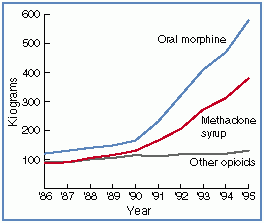
Figure: Australian consumption of opioids, 1986-1995.
Authorities
The number of S8 authorities current each June in NSW rose between 1990
and 1996. In those years, the number of authorities to prescribe for
non-malignant pain rose from 3326 to 5743 (73% increase), while
cancer pain authorities rose from 2652 to 4831 (82% increase).
Follow-up of authority applications
There were 102 patients for whom new authorities to prescribe an S8
opioid for non-malignant pain were sought in February and March,
1991: 54 women (mean age, 57; range, 28-91) and 48 men (mean age, 51;
range, 23-77) (see Box). Although these were new applications, 30
subjects were already receiving other S8 opioid drugs on authority.
Clinical data from authority applications
In 63 applications the primary diagnosis was musculoskeletal pain,
specifically back pain in 48 of these. In five cases the diagnosis was
simply "chronic pain". Several patients had multiple, unrelated
diagnoses -- such as "chronic back pain and gunshot wound", "backache
and migraine", or "myalgic encephalomyelitis and migraine". In 27
cases seemingly unrelated diagnoses were recorded. The presence of
multiple sources of severe pain probably reflects the prevalence in
this population of somatoform disorders (i.e., disorders in which
physical complaints are not fully explained by known medical
conditions, or in which complaints or impairment are in excess of what
would be expected from the patient's medical condition).
The situation is
unchanged. His back feels "like a bag of broken china". I am still at a
loss to know what to do and I have arranged to see him again in six weeks
with further x-ray.
Or a general practitioner's bleak summation:
This
patient has been so adversely affected by her CFS [chronic fatigue
syndrome] and migraine she has been rendered completely
dysfunctional as a human being and mother.
Discussion
There has been a dramatic increase in the prescribing of oral morphine
over the past decade. To put this rise in perspective, it is useful to
compare the increase in prescribed morphine with the increase as a
result of government policy in prescribed methadone syrup. Between
1986 and 1995 there was a marked expansion of the methadone program for
the treatment of addiction, with the number of patients in treatment
Australia-wide rising from around 1000 in 1984 to 13 000 in 1995.
However, the increase in morphine consumption, driven by changes in
clinical practice rather than policy, has been comparable to the
increase in consumption of methadone syrup. Total use of other S8
opioids also increased during this period, suggesting that
morphine consumption has not grown through replacing another
opioid.
Acknowledgements
Data from the NSW Department of Health files were gathered by two
medical students (Amanda Mather and Sarah Baldwin). Mr John Lumby,
Pharmaceutical Services Branch, NSW Department of Health, assisted
with access to Branch files. Ms Cheryl Regan, Treaties and Monitoring
Section, Commonwealth Department of Health and Family Services,
assisted by providing summary data on opioid consumption in
Australia. The federal and State departments do not necessarily
endorse any of the conclusions or opinions drawn from any data.
References
(Received 11 Oct 1996, accepted 6 Mar 1997)
Authors' details
Drugs and Alcohol Unit, Prince of Wales Hospital, Sydney, NSW.
James R Bell, BA, FRACP, Director.
E-mail: james.bell @ unsw.edu.au
Shifting focus to adolescent wellbeing and inclusive participation in the digital age
Allyson R Todd, Elena Wang, Stephanie R Partridge
The clinical presentation, investigation, and management of women diagnosed with endometriosis in Australian general practices, 2011–2021: an open cohort study
Danielle Mazza, Kailash Thapaliya, Sharinne B Crawford, Alissia Hui, Maryam Moradi, Luke E Grzeskowiak
The impact of the Breast Screen NSW transition from film to digital mammography, 2002–2016: a linked population health data analysis
Rachel Farber, Nehmat Houssami, Katy J L Bell
Non‐technical errors associated with deaths in surgical care, Australia, 2012–2019, by surgical specialty (Australian and New Zealand Audit of Surgical Mortality): a retrospective cohort study
Jesse Ey, Victoria Kollias, Octavia Lee, Kelly Hou, Matheesha Herath, John B North, Ellie Treloar, Suzanne Edwards, Martin Bruening, Adam J Wells, Guy J Maddern
The CURE Asthma roadmap
Gary P Anderson, Anthony Flynn, Phil G Bardin, John D Blakey, Shyamali C Dharmage, Paul Foster, Peter G Gibson, Adam Jaffe, Alan James, Christine R Jenkins, Sundram Sivamalai, Peter D Sly, Guy B Marks, Vanessa M McDonald, Judy Wetttenhall
Evidence from Australian cohort studies about asthma trajectories and transitions across the life course: a narrative review
Caroline Lodge, Xin Dai, Ingrid A. Laing, Michael P Menden, Anthony Flynn, Gary P Anderson, Sarath Ranganathan, Shyamali C Dharmage