




Volume 222 - Issue 2
Japanese encephalitis transmission in Australia: challenges and future perspectives
Authors: Caroline K Dowsett, Francesca Frentiu, Gregor J Devine and Wenbiao Hu
Med J Aust 2025 || doi: 10.5694/mja2.52550
Published online: 13 January 2025
Published online: 13 January 2025
Discussion of challenges and recommendations for future Japanese encephalitis scenarios in Australia, including surveillance systems, a national centre for disease control, improved data sharing and increased funding
Japanese encephalitis is caused by the Japanese encephalitis virus (JEV). JEV is the main cause of viral encephalitis in Asia,1 and is endemic in many countries on that continent and islands of the Pacific region. Although only a small percentage of cases are symptomatic, 20–30% are fatal and 30–50% develop significant neurological sequelae.2 Australia has escaped relatively unscathed, with only a few cases detected in the late 1990s, mostly from international travellers, with local transmission limited to the Torres Strait and Cape York.2,3 The last detection of JEV in Cape York was from feral pigs and an isolate of mosquitoes in 2005. Sentinel animal surveillance in Australia was phased out in 2011 due to costs and labour‐intensive maintenance, potential occupational health and safety issues, and concerns about the potential public health risk of using amplifying hosts (pigs), which may contribute to transmission when they become viremic.3 Sentinel animal use was replaced by a general mosquito trap‐based surveillance system.3 The Box provides a timeline of JEV milestones in Australia from the 1990s to 2023, with details on animal and human cases, and corresponding changes in surveillance.
JEV emerged again in 2021 with a fatal case in the Tiwi Islands, and shortly after was detected on an unprecedented scale and geographical spread in 2022: cases in humans and piggeries were detected across four states in south‐eastern Australia (New South Wales, Victoria, Queensland, South Australia). On 4 March 2022, the Australian Government declared the JEV outbreak a communicable disease incident of national significance.4 Over the following months, a total of 46 cases (including 7 deaths) were identified in humans (as of 13 February 2023).5 The end of the JEV emergency response was announced on 16 June 2023,6 although concern remains regarding potential endemicity in Australian waterbird, pig and mosquito populations.
JEV is maintained in an enzootic cycle between wading waterbirds and Culex spp mosquitoes and, in some cases, pigs, with spillover to humans and horses.7 Birds act as maintenance hosts and can harbour the virus without overt signs of disease. Humans and horses are dead‐end hosts and may become infected through the bite of an infectious mosquito. However, dead‐end hosts cannot produce virus levels high enough to infect feeding mosquitoes. In Asia, pigs commonly act as amplifying hosts, rapidly multiplying the virus to high levels that can be passed on to susceptible mosquito species, resulting in spillover to humans. There is no evidence of pigs acting as amplifying hosts during the 2021–2023 outbreak in Australia.
The dominant JEV vector in Australia and parts of the Western Pacific (such as Papua New Guinea) is Culex annulirostris. Although this mosquito is likely the primary vector for the south‐eastern Australian outbreak, several other species (including Culex gelidus and Culex sitiens) were implicated in the north Queensland cases in the 1990s and 2000s.8
Climate change and JEV
Australia is one of the most vulnerable regions to climate change globally,9 with a projected increased frequency of hotter days and extreme weather events.10 A changing climate might further complicate the interactions between JEV vectors, hosts and the environment. Higher rainfall, temperature and levels of evaporation and humidity are risk factors for JEV transmission11 and also affect population dynamics of birds, mosquitoes and feral pigs.12 However, there are still many unknowns in the Australian context. The effects of changing climatic and environmental factors on JEV spread and emergence in novel locations, transmission dynamics and spatiotemporal patterns, the origins and subsequent distribution pathways of the recent outbreak, the potential competence and biology of vector species in different regions, and the role of feral pigs all require further investigation.
In temperate parts of Asia, JEV generally follows an epidemic pattern with outbreaks occurring over the warmer seasons, exacerbated by the wet season and pre‐harvest periods when rice cultivation occurs.1 In Australia, it is expected that JEV will mirror patterns of other endemic encephalitic flaviviruses, particularly the Murray Valley encephalitis virus (MVEV), which is found in northern parts of Australia and has occasional yet substantial outbreaks in temperate Australia over the wet, summer season, coinciding with flooding events around the Murray–Darling Basin.13 Published research on JEV in Australia after the 2021–2023 outbreak primarily focuses on identifying potential transmission dynamics, routes of introduction and risk factors12,14,15,16 (Supporting Information). However, these research efforts suffer from a significant lack of empirical data. Despite these limitations, studies unanimously call for further research and highlight the urgent need for improved surveillance.
Current JEV surveillance in Australia and the One Health approach
At the time of the 2021–2023 outbreak, the prevailing, passive surveillance system proved futile in detecting JEV circulation in Australia, resulting in cases being detected in pigs and humans at a similar time. The failure put response efforts at a disadvantage and highlighted limitations of surveillance in Australia, which remains fragmented, with only animal health data publicly available with regards to geographic incidence, and human case distribution only detectable by searching the media.12 Surveillance is led by a subcommittee of the Communicable Disease Network Australia: the National Arbovirus and Malaria Advisory Committee.17 Surveillance is monitored by state and territory, and federal agency members of this committee, along with the Zoonotic Flavivirus Diagnostics Committee (established by the Public Health Network of Australia). JEV surveillance is managed by the different states and territories, with arbovirus and mosquito monitoring reports typically released weekly. These reports include a range of indicators, such as human cases (notified/confirmed and predicted cases), mosquito trapping, serosurveys and, following the onset of the recent outbreak, from 2022 sentinel chicken surveillance was expanded to include JEV.18,19,20 It is expected that most of these surveillance committees will be integrated into the Australian Centre of Disease Control (Australian CDC).
There is a global movement towards a One Health approach for preparing and responding to zoonotic diseases such as JEV. The One Health approach recognises the interdependent and closely connected health of humans, animals and the environment and uses links between these fields to develop new disease control strategies — from prevention to detection, preparedness, response and management.21 Australia has only recently embraced the One Health concept, largely spurred by the recent JEV outbreak.4 JEV and other zoonotic diseases are inherently One Health issues, yet existing surveillance systems do not explicitly account for this. The West Nile virus (Kunjin virus subtype) and Ross River virus outbreaks in 201118,19 demonstrate the need for improved interdisciplinary collaboration. Encouragingly, there is a growing recognition of a One Health approach in Australia,22 with the interim Australian CDC and JEV‐focused committees and researchers acknowledging this,23 and prioritising the approach in the development of the interim Australian CDC and the Australian response to JEV infection and mpox (caused by the monkeypox virus).23
There is a pressing need to shift from a reactive “surveillance and response” approach to a more proactive, comprehensive “predict and prevent” strategy, particularly in regional areas of Australia where populations are at greater risk. As Japanese encephalitis is a vaccine‐preventable disease, enhanced surveillance could have potentially prevented the deaths during recent outbreaks.12,24 Given the extensive geographical spread of the JEV outbreak, the high fatality in the MVEV outbreak in recent years in Australia, and the relatively sparse population in these areas posing challenges to surveillance, developing accurate and robust predictive tools based on real‐world data is crucial. These tools can streamline preventive public health efforts, especially in regions with limited resources. For example, an early warning system that predicts high risk areas for JEV transmission, incorporating climate and weather, vector, vertebrate and human density and distribution could help initiate and direct targeted interventions such as vaccination campaigns and enhanced surveillance in vulnerable regions.
Recommendations for the future of JEV control in Australia
The future direction of JEV in Australia can only be speculated, with current research limited by a fragmented surveillance strategy and significant empirical research gaps with regards to transmission, such as the role of feral pigs, bird ecology and infection, and reservoir immunity. The closely linked nature of JEV, MVEV and West Nile virus (Kunjin virus subtype) in Australia, including shared vectors, avian hosts and suitable transmission conditions, as well as limitations in diagnostic testing (particularly in the context of previous infection by one or more of the viruses)22 has hindered our understanding of the epidemiology and ecology of these viruses. For example, in 2023, the largest outbreak of MVEV occurred in the Murray–Darling Basin since 1974 with a fatality rate higher than previous outbreaks, but curiously this occurred in the absence of any sign of JEV.18,19 However, the overlap in ecology and transmission of these viruses might provide an opportunity for a more comprehensive surveillance system targeting multiple diseases.
A thorough surveillance system built on a One Health, multidisciplinary approach that provides high quality, robust data is vital to the containment of outbreaks and rapid initiation of appropriate responses. The proposal and subsequent development of the interim Australian CDC23 with a central focus on One Health is welcomed. This is further supported by experts’ calls for a central repository, unified reporting and data linkage system,2 and a national agency for coordinating surveillance efforts across Australia. The Australian CDC could provide a key role in facilitating a multidisciplinary data‐based central repository as a governing body, steering coordinated surveillance — potentially with a dedicated department for infectious disease surveillance and response.
A central data repository could further address challenges of fragmentation in available data (including surveillance data), and issues with its organisation across agencies and disciplines in each state and territory. The recent JEV outbreak highlighted the need for improved data sharing agreements and data governance principles, which will provide a platform for rapid, timely risk assessments to inform national outbreak responses, and for use in translational research activities such as real‐time, real‐world, big data‐driven early warning systems.
There is an urgent need for research in JEV epidemiology and virus transmission dynamics in temporal climates such as south‐eastern Australia, particularly for studies demonstrating mosquito–vertebrate host–mosquito transmission to identify and define vertebrate hosts; and to develop long term projections for decision and policy makers. A recent review on early warning systems25 proposed the integration of data from other nations to enhance predictive models, which might simultaneously grow research capacity through collaborations with experts and research groups. The review discussed a network for early warning between Australia and China for influenza;25 however, in the context of vector‐borne diseases such as Japanese encephalitis, the concept could be extended to neighbouring countries, for example Indonesia and Papua New Guinea where potential routes of introduction exist, to broaden surveillance and complement early warning. Although this is not an easy task, it is possible with fruitful collaborations between human and animal health researchers, entomologists, meteorologists, agricultural departments, and other industry agencies associated with JEV.
A One Health approach centred around interdisciplinary collaboration, with input from practitioners with different yet complementary roles, diverse skills and expertise could optimise outcomes and outbreak preparedness strategies. Some strategies include potential implementation of new innovations and technology such as the development of an Australian xenomonitoring system,26 or introducing Wolbachia‐based technology27 for mosquito control, or further developing sentinel animal programs to improve early detection.
A pivotal aspect for effective JEV management in Australia is enhancing research capacity for vector‐borne diseases. The capacity must be adaptable to the diverse range of vector‐borne diseases present in Australia and in neighbouring regions, particularly as climate change increases the suitability of new areas for disease spread. Building research teams that include early and mid‐career researchers is essential for ensuring long term sustainability and skill development for future disease management and control. Despite the current challenge of declining research capacity, collaborative efforts across disciplines, possibly facilitated by the CDC as functions and responsibilities shift, could reduce duplication and streamline outcomes and resources. Additionally, the training of early and mid‐career researchers in priority areas might be beneficial through establishing CDC‐affiliated academic institutions that can fill research gaps and enhance capacity in these critical fields.
Further investment and funding are key to undertaking research, developing skilled researchers, and ensuring sustainable, productive research outputs, particularly of translational research efforts that promote preparedness and prevention of outbreaks. The Healthy Environments and Lives (HEAL) Network was launched in 2021 after receiving a $10 million grant over five years from the National Health and Medical Research Council Special Initiative in Human Health and Environmental Change, with a major theme of biosecurity and emerging infections addressing multidimensional determinants of infectious diseases and approaches to managing these into the future.28 However, considerable and sustained funding is crucial to long term research in climate and environmental change and human health, particularly in infectious diseases. Hopefully, interdisciplinary collaboration and integrated management of JEV will be more efficient and cost‐effective, while providing opportunities for joint funding for JEV control and management going forward.
A large component of the appropriate management of JEV will rely on growing awareness of the virus and educating stakeholders and the public about its transmission dynamics and risk factors. Clear responsibilities for different government departments need to be outlined for effectual policy arrangement and response coordination. Farmers and livestock producers play a key role in disease surveillance and clinical case detection, particularly in pigs, which might facilitate appropriately targeted public health responses. Additionally, general population awareness of risk factors and developing health literacy will position Australia well in responding positively to outbreaks.
Improving current approaches to surveillance and disease preparedness should build on the strengths of existing systems and infrastructure rather than discarding progress and achievements. Instead, new systems should aim to enhance current models and address their limitations. Australia is in a fortunate position to have the opportunity to learn from international practice in surveillance and disease preparedness as discussions around CDC development progress and should seize this opportunity given the ongoing threat posed by emerging infectious diseases.
Despite the shortfalls of Australia's response to the recent JEV outbreak, the future of JEV prevention and control in Australia is hopeful, but there is significant work to be done. The need for improved knowledge of JEV transmission dynamics and quality surveillance data cannot be overlooked in developing current preparedness strategies for JEV. Australia is in a particularly opportune position to rethink and restructure current approaches to current disease preparedness strategies, with the development of the Australian CDC — an opportunity that cannot be missed. The recent outbreak of JEV is a clear demonstration of the need for this, especially given that Japanese encephalitis is vaccine preventable, and with timely intervention, such as vaccination, no deaths need occur.
Box – Summary of Japanese encephalitis virus activity in Australia from 1990s to 2023, with human and animal cases and the corresponding changes in surveillance
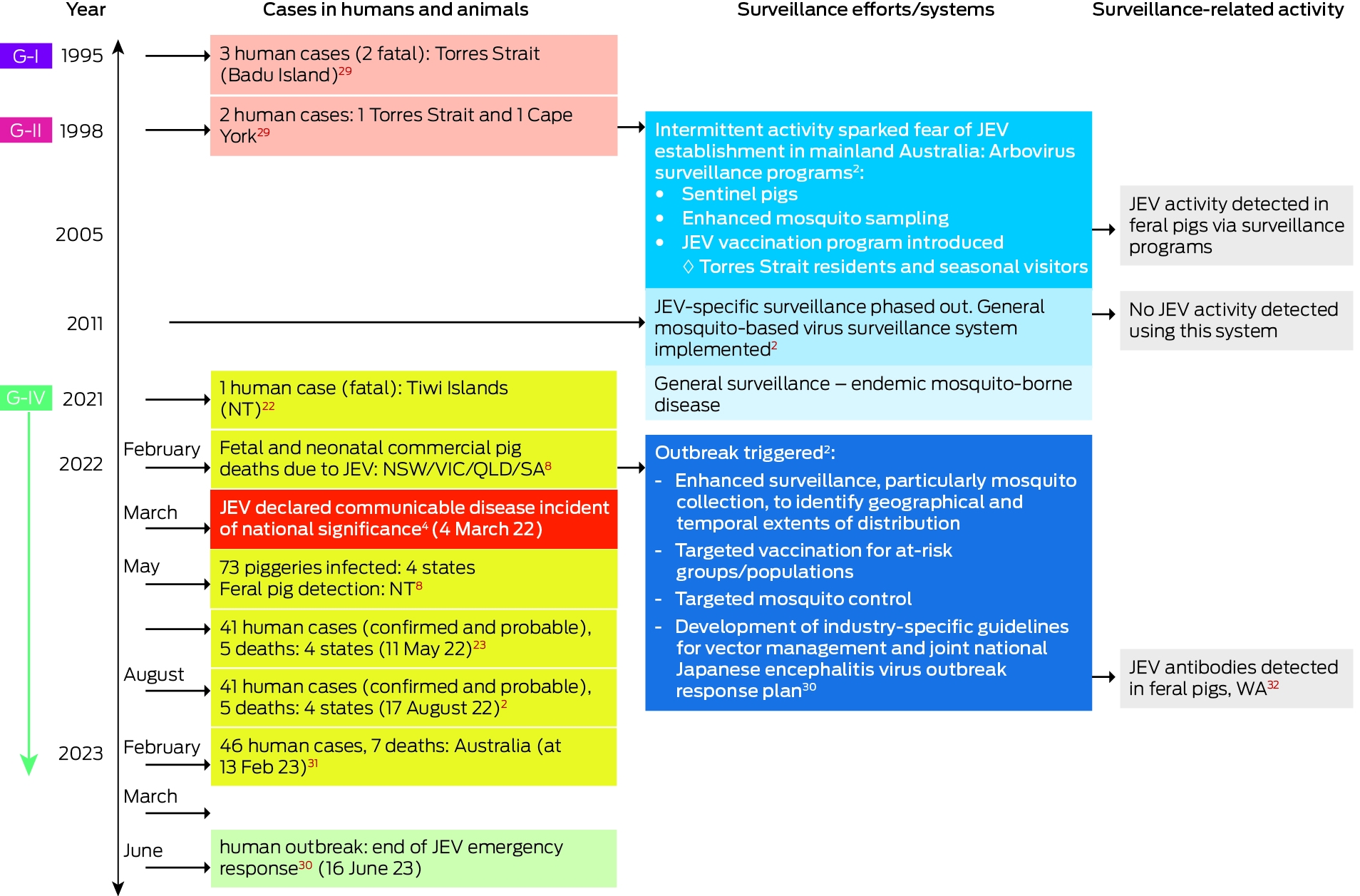
G‐I = JEV Genotype I; G‐II = JEV Genotype II; G‐IV = JEV Genotype IV; JEV = Japanese encephalitis virus; NSW = New South Wales; NT = Northern Territory; QLD = Queensland; SA = South Australia; VIC = Victoria; WA = Western Australia.
Competing interests
No relevant disclosures.
Acknowledgements
We acknowledge the HEAL (Healthy Environments And Lives) National Research Network, which receives funding from the National Health and Medical Research Council (NHMRC) Special Initiative in Human Health and Environmental Change Initiative (Grant No. 2008937). Caroline Dowsett is funded by a Queensland University of Technology Post‐graduate Research Award (QUTPRA). We also acknowledge the National Foundation for Australia‐China Relations (Grant No. 220011), the Australian Department of Foreign Affairs and Trade.
References
- World Health Organization. Japanese encephalitis [fact sheet]. Geneva: WHO, 2024. https://www.who.int/news‐room/fact‐sheets/detail/japanese‐encephalitis (viewed Mar 2024).
- Williams CR, Webb CE, Higgs S, Van Den Hurk AF. Japanese encephalitis virus emergence in Australia: public health importance and implications for future surveillance. Vector Borne Zoonotic Dis 2022; 22: 529‐534.
- Van Den Hurk AF, Pyke AT, Mackenzie JS, et al. Japanese encephalitis virus in Australia: from known known to known unknown. Trop Med Infect Dis 2019; 4: 38.
- Australian Government Department of Health and Aged Care. Japanese encephalitis. Canberra: Australian Government, 2023. https://www.health.gov.au/diseases/japanese‐encephalitis (viewed Apr 2024).
- Winkler NE, Koirala A, Kaur G, et al. Seroprevalence of Japanese encephalitis virus‐specific antibodies in Australia following novel epidemic spread: protocol for a national cross‐sectional study. BMJ Open 2024; 14: e075569.
- Australian Government Department of Health and Aged Care. Statement on the end of Japanese encephalitis virus emergency response [media statement]. Canberra: Australian Government, 16 June 2023. https://www.health.gov.au/news/statement‐on‐the‐end‐of‐japanese‐encephalitis‐virus‐emergency‐response (viewed June 2023).
- van den Hurk AF, Ritchie SA, Mackenzie JS. Ecology and geographical expansion of Japanese encephalitis virus. Annu Rev Entomol 2008; 54: 17‐35.
- van den Hurk AF, Skinner E, Ritchie SA, Mackenzie JS. The emergence of Japanese encephalitis virus in Australia in 2022: existing knowledge of mosquito vectors. Viruses 2022; 14: 1208.
- Magori K. Japanese encephalitis makes its way south in Australia driven by extreme flooding due to climate change. BugBitten, BMC, 2022. https://blogs.biomedcentral.com/bugbitten/2022/04/22/japanese‐encephalitis‐makes‐its‐way‐south‐in‐australia‐driven‐by‐extreme‐flooding‐due‐to‐climate‐change/ (viewed Apr 2022).
- Brinkhoff MN. Comment on van den Hurk et al. The emergence of Japanese encephalitis virus in Australia in 2022: existing knowledge of mosquito vectors. Viruses 2023; 15: 270.
- Nogrady B. Australian floods lead to spread of mosquito‐borne disease. Lancet Infect Dis 2022; 22: 771.
- Yakob L, Hu W, Frentiu FD, et al. Japanese encephalitis emergence in Australia: the potential population at risk. Clin Infect Dis 2022; 76: 335‐337.
- NSW Health. Murray Valley encephalitis (MVE) fact sheet. NSW Government, 2022. https://www.health.nsw.gov.au/Infectious/factsheets/Pages/murray‐valley‐encephalitis.aspx (viewed Apr 2024).
- Flores Lima M, Cotton J, Marais M, Faggian R. Modelling the risk of Japanese encephalitis virus in Victoria, Australia, using an expert‐systems approach. BMC Infect Dis 2024; 24: 60.
- Furlong M, Adamu A, Hickson RI, et al. Estimating the distribution of Japanese encephalitis vectors in Australia using ecological niche modelling. Trop Med Infect Dis 2022; 7: 393.
- Walsh MG, Webb C, Brookes V. An evaluation of the landscape structure and La Niña climatic anomalies associated with Japanese encephalitis virus outbreaks reported in Australian piggeries in 2022. One Health 2023; 16: 100566.
- Australian Government Department of Health and Aged Care. National arbovirus and malaria advisory committee. Canberra: Australian Government, 2024. https://www.health.gov.au/committees‐and‐groups/national‐arbovirus‐and‐malaria‐advisory‐committee (viewed July 2024).
- NSW Health. Mosquito‐borne disease surveillance. NSW Government, 2023. https://www.health.nsw.gov.au/Infectious/mosquito‐borne/Pages/surveillance.aspx (viewed July 2024).
- Victoria Department of Health. Mosquito surveillance report. Victorian Government, 2024. https://www.health.vic.gov.au/infectious‐diseases/mosquito‐surveillance‐report (viewed July 2024).
- Animal Health Australia. Maintaining access to arbovirus sensitive markets. Animal Health Australia. https://animalhealthaustralia.com.au/maintaining‐access‐to‐arbovirus‐sensitive‐markets/ (viewed July 2024).
- One Health High‐Level Expert Panel, Adisasmito WB, Almuhairi S, et al. One Health: a new definition for a sustainable and healthy future. PLoS Pathog 2022; 18: e1010537.
- McGuinness SL, Lau CL, Leder K. The evolving Japanese encephalitis situation in Australia and implications for travel medicine. J Travel Med 2023; 30: taad029.
- Australian Government Department of Health and Aged Care. Role and functions of an Australian Centre for Disease Control: Prevention – Promotion – Protection: Consultation paper. Canberra: Department of Health and Aged Care, 2022. https://www.cdc.gov.au/sites/default/files/2023‐12/role‐and‐functions‐of‐an‐australian‐centre‐for‐disease‐control.pdf (viewed Apr 2024).
- Furuya‐Kanamori L, Gyawali N, Mills DJ, et al. The emergence of Japanese encephalitis in Australia and the implications for a vaccination strategy. Trop Med Infect Dis 2022; 7: 85.
- Lu C, Wang L, Barr I, et al. Developing a research network of early warning systems for infectious diseases transmission between China and Australia. China CDC Wkly 2024; 6: 740‐753.
- Cameron MM, Ramesh A. The use of molecular xenomonitoring for surveillance of mosquito‐borne diseases. Philos Trans R Soc Lon B Biol Sci 2021; 376: 20190816.
- Madhav M, Blasdell KR, Trewin B, et al. Culex‐transmitted diseases: mechanisms, impact, and future control strategies using Wolbachia. Viruses 2024; 16: 1134.
- Australian Government Department of Health and Aged Care. $10 million national network to build resilience to environmental change [media release]. Canberra, Australian Government, 16 November 2021. https://www.health.gov.au/ministers/the‐hon‐greg‐hunt‐mp/media/10‐million‐national‐network‐to‐build‐resilience‐to‐environmental‐change (viewed July 2024).
- CSIRO. Expert commentary: Japanese encephalitis [news release]. Victoria, CSIRO, 14 March 2022. https://www.csiro.au/en/news/All/News/2022/March/Expert‐commentary‐Japanese‐encephalitis (viewed Mar 2024).
- Australian Government. Joint national Japanese encephalitis virus outbreak response plan. Canberra: Department of Health and Aged Care, Department of Agriculture, Fisheries, and Forestry, 2023. https://www.health.gov.au/sites/default/files/2023‐06/joint‐national‐japanese‐encephalitis‐virus‐outbreak‐response‐plan.pdf (viewed Apr 2024).
- Khan S, Patil R, Das NK, et al. The emerging threat of Japanese encephalitis in Australia: is it the time to worry? J Med Microbiol 2023; 72(7).
- Hurd H. An arbovirus new to Australia. BugBitten, BMC, 2024. https://blogs.biomedcentral.com/bugbitten/2024/03/01/an‐arbovirus‐new‐to‐australia/ (viewed Mar 2024).
Provenance: Not commissioned; externally peer reviewed.
Designing Housing to Reduce Overcrowding-Related Harms: Rheumatic Heart Disease as the Canary in the Coal Mine
Simon Quilty, Veronica Matthews, Angus Baumann, James Marangou, Bo Remenyi, Gavin Wheaton, Serena Morton Nabanunga, Norman Frank Jupurrurla, Simon Robinson, Steve Mintern, Cary Duffield, Joshua R. Francis, Paul C. Memmott
Australian Climate Leadership in 2026: COP-Out or Step-Up for Health?
Catherine G. A. Pendrey, Angie Bone, Aletha Ward, Francis Nona, Michelle Isles, Paul M. Kelly, Nicholas J. Talley
The impact of the Breast Screen NSW transition from film to digital mammography, 2002–2016: a linked population health data analysis
Rachel Farber, Nehmat Houssami, Katy J L Bell
Shifting focus to adolescent wellbeing and inclusive participation in the digital age
Allyson R Todd, Elena Wang, Stephanie R Partridge
The CURE Asthma roadmap
Gary P Anderson, Anthony Flynn, Phil G Bardin, John D Blakey, Shyamali C Dharmage, Paul Foster, Peter G Gibson, Adam Jaffe, Alan James, Christine R Jenkins, Sundram Sivamalai, Peter D Sly, Guy B Marks, Vanessa M McDonald, Judy Wetttenhall
Protecting public interest journalism as a public health good
Bronwyn Fredericks, Neha Lalchandani, Melissa A Sweet, Alex Cramb, Carmel Williams