




Medical education
Lessons from practice
Volume 221 - Issue 3
Asbestosis in an Australian brake mechanic
Authors: Aruvi Thiruvarudchelvan, Elizabeth Silverstone and Deborah Yates
Med J Aust 2024; 221 (3): 145-146. || doi: 10.5694/mja2.52371
Published online: 5 August 2024
Published online: 5 August 2024
A 76-year-old man presented with progressive breathlessness and dry cough
Clinical record
A 76‐year‐old man presented with progressive breathlessness and dry cough. He was an ex‐smoker (ten pack‐years) and had worked as a motor mechanic for over 40 years. Detailed occupational history revealed exposure to asbestos between 1969 and 2011, primarily while grinding and cutting asbestos brake linings and clutch plates. He used a compressed air hose to clean off the brake shoes once old linings had been removed, generating clouds of fine respirable asbestos dust. Examination revealed no fingernail clubbing, and oxygen saturation was 96% on room air. Bilateral persistent late inspiratory crackles were audible at the lung bases, with normal cardiovascular examination. Breathlessness was first noticed in 2007, with lower zone interstitial pulmonary fibrosis described on imaging then.
High resolution computed tomography (CT) scan showed usual interstitial pneumonia (UIP) type pattern fibrosis, with areas of confluence at the right base (Box). Small pleural plaques were observed. Lung function showed a restrictive pattern with forced vital capacity (FVC) 2.45L (55% predicted) and total lung capacity (TLC) 4.23L (60% predicted). Gas transfer was 10.8 (38% predicted).
Discussion
Asbestos‐related disease includes interstitial pulmonary fibrosis arising from asbestos exposure (asbestosis), pleural plaques and diffuse pleural thickening, benign pleural effusion, mesothelioma and lung cancer. Asbestosis and idiopathic pulmonary fibrosis are radiologically similar, with imaging showing a UIP pattern fibrosis, and diagnosis relies on a detailed occupational history, with supportive radiological findings such as pleural plaques (although these are not always present). Asbestos‐related disease in brake workers has been much debated.1 Car mechanics working from the 1970s to the 1990s were frequently exposed to chrysotile asbestos from grinding brake linings and replacing clutches while servicing cars and trucks. Asbestos exposure is well documented in car mechanics both in Australia and internationally,2,3,4,5 but levels were thought too low for the development of asbestosis. In addition, chrysotile is altered in the braking environment, converting it to forsterite, decreasing toxicity of the inhaled dust. Relative toxicity is probably also changed by physical factors such as binding of resin matrix to the fibre surface.6 Use of asbestos in brake and clutch components was prohibited from 1999 in Australia, with a full ban in 2003. Thus, vehicles manufactured before then may still have asbestos‐containing brake shoes.
Reports have described asbestosis in mechanics,7 but, to our knowledge, not in the Australian medical literature. Several international case series1 and larger studies6,8 described interstitial abnormalities in brake mechanics.1 The incidence of asbestosis was not raised in motor mechanics in early studies;9 these are now historical and did not employ sensitive techniques such CT scans, which are now the standard investigation for asbestos‐related disease.
Several recent studies confirm that chrysotile can be released from brake maintenance activities in levels exceeding occupational exposure limits.1,6,8,10 Car mechanics have also been documented to have increased asbestos lung fibre concentrations compared with controls. Long term follow‐up studies confirm that asbestosis can indeed occasionally occur in car mechanics.6 Over the years, new cohort studies and re‐analyses of old studies have demonstrated a decrease in estimated cumulative exposure, but also that such exposures are capable of causing asbestosis, with a cohort study of asbestos cement workers finding a few asbestosis‐related deaths at cumulative exposure levels below five fibres per cm3 per year.8
Recently, a 45‐year nationwide Danish cohort study6 has shed further light on this debate. The study used population‐based databases with access to all people who were skilled workers and apprentices in Denmark in the 1970s. The study used prospectively collected medical data, including all hospital contacts, development of malignancy, and deaths, aiming to examine the incidence of mesothelioma and asbestosis in brake mechanics. The study compared 138589 motor vehicle mechanics with over one million matched control workers, and potential confounding factors were carefully controlled for including smoking and disease latency. It found an increased risk of asbestosis (hazard ratio, 1.79; 95% confidence interval, 1.10–2.92), with no increased risk of mesothelioma. Forty‐seven cases of asbestosis were observed in vehicle mechanics. The Danish study stated that “The 1970 vehicle mechanics cohort showed an excess of inpatient asbestosis beginning in the mid‐1980s and an abrupt increase in outpatient asbestosis beginning in the mid‐2000s. There was no similar pattern for other outcomes (mesothelioma, lung cancer, lung disease due to other external agents and [chronic obstructive pulmonary disease])”.6 This is the largest and most robust epidemiological study on asbestos‐related diseases in motor mechanics. Despite some unexpected discrepancies in results, it confirms that although rare, asbestosis can result from such exposure. The latency of exposure in this study is almost identical to that of our patient. We believe that our patient developed asbestosis from exposure to chrysotile brake linings, representing, to our knowledge, the first documented Australian case.
Lessons from practice
- Brake mechanics were formerly exposed to variable levels of chrysotile asbestos. In Australia, despite a ban on asbestos‐containing brake components in the late 1990s, a full ban was not introduced until 2003.
- Asbestosis (diffuse interstitial pulmonary fibrosis due to asbestos inhalation) may be clinically indistinguishable from idiopathic pulmonary fibrosis, and requires relatively heavy exposure to asbestos compared with other types of asbestos‐related disorders.
- Asbestosis is rare in brake mechanics, but a recent study has confirmed that this can rarely occur in motor vehicle repairers exposed between the 1970s and early 2000s.
- Although such cases should occur in reducing frequency, physicians should be aware of the possibility of asbestos‐related diseases in motor mechanics exposed before the early 2000s. A detailed occupational history is essential to identifying potential causative factors in patients presenting with pulmonary fibrosis.
Box – Axial sections of high resolution computed tomography scans from the patient
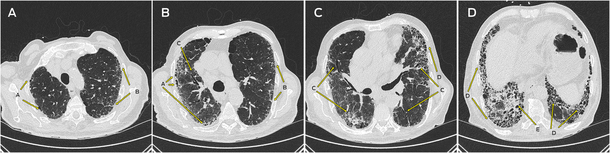
Panels A, B, C and D demonstrate axial slices in an apicobasal progression. As we progress from panel A where there are predominantly subpleural cysts (a) and subpleural septal thickening (b), we note the development of traction bronchiectasis (c), fibrosis with subpleural cystic spaces and probable honeycombing (d), and areas of confluent opacity/fibrosis (e). At the apices in panel A, the findings are milder than at the costophrenic angles in panel D, where there are extensive honeycombing changes with areas of confluent fibrosis. Within these panels, the arrows denote findings (a) subpleural cysts, (b) subpleural septal thickening, (c) traction bronchiectasis, (d) fibrosis with subpleural cystic spaces and probable honeycombing, and (e) confluent fibrosis.
Competing interests
No relevant disclosures.
Acknowledgements
We thank Louise Hart‐Brown (Study Coordinator, Holdsworth House) for her assistance in coordinating with the patient.
References
- Ameille J, Rosenberg N, Matrat M, et al. Asbestos‐related diseases in automobile mechanics. Ann Occup Hyg 2012; 56: 55‐60.
- Rohl AN, Langer AM, Wolff MS, Weisman I. Asbestos exposure during brake lining maintenance and repair. Environ Res 1976; 12: 110‐128.
- Cheng VK, O'Kelly FJ. Asbestos exposure in the motor vehicle repair and servicing industry in Hong Kong. J Soc Occup Med 1986; 36: 104‐106.
- Kauppinen T, Korhonen K. Exposure to asbestos during brake maintenance of automotive vehicles by different methods. Am Ind Hyg Assoc J 1987; 48: 499‐504.
- Finley BL, Richter RO, Mowat FS, et al. Cumulative asbestos exposure for US automobile mechanics involved in brake repair (circa 1950s–2000). J Expo Sci Environ Epidemiol 2007; 17: 644‐655.
- Thomsen RW, Riis AH, Flachs EM, et al. Risk of asbestosis, mesothelioma, other lung disease or death among motor vehicle mechanics: a 45‐year Danish cohort study. Thorax 2022; 77: 477‐485.
- Dahlqvist MR, Alexandersson R, Hedenstierna G. Lung function and exposure to asbestos among vehicle mechanics. Am J Ind Med 1992; 22: 59‐68.
- Burdorf A, Swuste P. An expert system for the evaluation of historical asbestos exposure as diagnostic criterion in asbestos‐related diseases. Ann Occup Hyg 1999; 43: 57‐66.
- Erdinç M, Erdinç E, Cok G, Polatli M. Respiratory impairment due to asbestos exposure in brake‐lining workers. Environ Res 2003; 91: 151‐156.
- Finkelstein MM. Asbestos fibre concentrations in the lungs of brake workers: another look. Ann Occup Hyg 2008; 52: 455‐461.
Provenance: Not commissioned; externally peer reviewed.
Designing Housing to Reduce Overcrowding-Related Harms: Rheumatic Heart Disease as the Canary in the Coal Mine
Simon Quilty, Veronica Matthews, Angus Baumann, James Marangou, Bo Remenyi, Gavin Wheaton, Serena Morton Nabanunga, Norman Frank Jupurrurla, Simon Robinson, Steve Mintern, Cary Duffield, Joshua R. Francis, Paul C. Memmott
Australian Climate Leadership in 2026: COP-Out or Step-Up for Health?
Catherine G. A. Pendrey, Angie Bone, Aletha Ward, Francis Nona, Michelle Isles, Paul M. Kelly, Nicholas J. Talley
The impact of the Breast Screen NSW transition from film to digital mammography, 2002–2016: a linked population health data analysis
Rachel Farber, Nehmat Houssami, Katy J L Bell
Shifting focus to adolescent wellbeing and inclusive participation in the digital age
Allyson R Todd, Elena Wang, Stephanie R Partridge
The CURE Asthma roadmap
Gary P Anderson, Anthony Flynn, Phil G Bardin, John D Blakey, Shyamali C Dharmage, Paul Foster, Peter G Gibson, Adam Jaffe, Alan James, Christine R Jenkins, Sundram Sivamalai, Peter D Sly, Guy B Marks, Vanessa M McDonald, Judy Wetttenhall
Protecting public interest journalism as a public health good
Bronwyn Fredericks, Neha Lalchandani, Melissa A Sweet, Alex Cramb, Carmel Williams