




Volume 219 - Issue 8
Japanese encephalitis virus: changing the clinical landscape of encephalitis in Australia
Authors: Guy D Eslick, Suzy M Teutsch and Elizabeth J Elliott
Med J Aust 2023; 219 (8): 393-393. || doi: 10.5694/mja2.52090
Published online: 16 October 2023
Published online: 16 October 2023
Comment
To the Editor: We write in response to the excellent review by Allen and colleagues1 and to highlight the recent introduction of national surveillance for Japanese encephalitis by the Australian Paediatric Surveillance Unit (APSU) (www.apsu.org.au).
Japanese encephalitis virus (JEV) is a mosquito‐borne flavivirus that is endemic in South‐East Asia and may cause severe encephalitis. In March 2022, Australian health authorities notified the World Health Organization of a JEV outbreak on the east coast of Australia, which included 37 human cases of JEV infection in New South Wales, Victoria, South Australia, and Queensland and represented the first locally acquired JEV infections since 1998.2
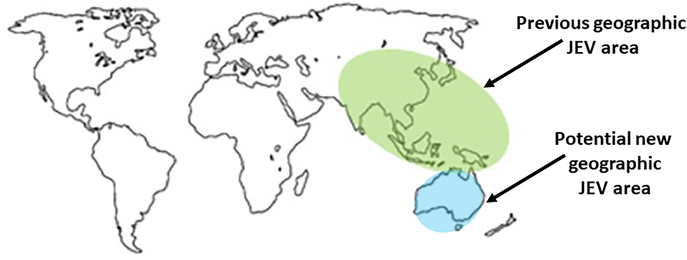
As of 14 August 2023, there have been 45 cases reported with JEV infection (14 in NSW, 14 in Victoria, ten in SA, five in Queensland, and two in the Northern Territory) and seven deaths.3 The JEV variant identified in all cases was genotype 4 (GIV), which has been only previously isolated in Indonesia and Papua New Guinea4 (Box), and very little is known about its virulence or pathogenesis. In most endemic countries, 75% of Japanese encephalitis cases occur in children aged zero to 14 years. In the current Australian outbreak, of the JEV infection cases reported since 2022, 10% of patients (all male) were aged 19 years or younger.
It is speculated that JEV may become endemic in Australia, and modelling suggests that about 3% (~750000) of the Australian human population is at risk of JEV infection due to their proximity to piggeries.5,6,7
Allen and colleagues1 mentioned the importance of adequate surveillance platforms, highlighting that notification systems are more efficient in identifying laboratory‐confirmed diseases.7 In response to the emergence of JEV in Australia, the APSU commenced national active surveillance in May 2023 to identify cases of Japanese encephalitis in children aged 17 years or younger, and to describe the demographic characteristics, clinical features, treatment, and short term outcomes.
We urge paediatricians to report to the APSU any newly diagnosed case of Japanese encephalitis defined as:- acute symptoms (eg, high fever, rigors, headache, vomiting, seizures, rash); or
- later stage symptoms/signs (eg, altered level of consciousness, seizures, parkinsonian‐like symptoms, paralysis, cranial nerve palsies); and
- laboratory confirmation of acute JEV infection — detection of JEV IgM (serum and/or cerebrospinal fluid), and/or IgG seroconversion (serum), and/or positive JEV polymerase chain reaction (cerebrospinal fluid, blood, urine).1
Please email
Competing interests
No relevant disclosures.
Acknowledgements
The Australian Paediatric Surveillance Unit (APSU) is funded by the Australian Government Department of Health and Aged Care, Communicable Disease Epidemiology and Surveillance Section (CDESS). Elizabeth Elliott is supported by a Medical Research Future Fund of Australia Next Generation Fellowship (#1135959). The funders of the study had no role in study design, data collection, data analysis, data interpretation, or writing of the manuscript.
References
- Allen S, Cooper CM, Taranath A, et al. Japanese encephalitis virus: changing the clinical landscape of encephalitis in Australia. Med J Aust 2023; 218: 344‐347. https://www.mja.com.au/journal/2023/218/8/japanese‐encephalitis‐virus‐changing‐clinical‐landscape‐encephalitis‐australia
- World Health Organization. Japanese encephalitis — Australia. Geneva: WHO, 2022. https://www.who.int/emergencies/disease‐outbreak‐news/item/2022‐DON365 (viewed Aug 2023).
- Australian Government, Department of Health and Aged Care. Japanese encephalitis. Canberra: Commonwealth of Australia, 2023. https://www.health.gov.au/diseases/japanese‐encephalitis (viewed Aug 2023).
- Mackenzie JS, Williams DT, van den Hurk AF, et al. Japanese encephalitis virus: the emergence of genotype IV in Australia and its potential endemicity. Viruses 2022; 14: 2480.
- Furlong M, Adamu AM, Hoskins A, et al. Japanese encephalitis enzootic and epidemic risks across Australia. Viruses 2023; 15: 450.
- Yakob L, Hu W, Frentiu FD, et al. Japanese encephalitis emergence in Australia: the potential population at risk. Clin Infect Dis 2023; 76: 335‐337.
- Mackenzie JS, Smith DW, Speers DJ. Japanese encephalitis disease: overview of the virus, its risk to Australia and the need for better surveillance. Intern Med J 2022; 52: 2029‐2033.
Costs of Delivering the Hep B PAST Model of Care in Remote Australia: A Retrospective Pre–Post Study
Hoa Nguyen, Anh Le Tuan Nguyen, Paula Binks, Melita McKinnon, Emily Vintour-Cesar, Karen Wills, Nicola Stephens, Benjamin Cowie, Joshua S. Davis, Yuejen Zhao, Peter Nihill, Julie A. Campbell, Andrew J. Palmer, Jane Davies, Barbara de Graaff
Buruli Ulcer Acquired From Ringtail Possum Rescue
Daniel P. O'Brien, Naomi Clarke, Sara Bonnici, Mohammad A. Hussain
Q Fever Visceral Abscesses After Contact With Native Australian Marsupials
Samantha J. Laws, Enzo Binotto, James Stewart, Jennifer Ho, Trent Yarwood, Josh Hanson, Simon Smith
Hospital-Admitted Injection-Related Infections Among Incarcerated People Who Inject Drugs in Australia: A Retrospective Cohort Study
Andrew Palmer, Matthew Carter, Jeremy Yeo, Cecilia Shim, Jason Connor, Jeremy Hayllar, Gerald Holtmann, Naomi Moy, Elliott G. Playford, Naomi Runnegar, Paul J. Clark
The Live Attenuated Influenza Vaccine in Australia: An Additional Tool for Influenza Prevention
Cyra Patel, Alexis Pillsbury, Tran Nguyen, Xia Wang, Helen E. Quinn, Clayton K. Chiu, Allen C. Cheng, Katie L. Flanagan, Zhicheng Wang
Reflex Testing for Hepatitis D Infection: A Unique Opportunity to Reduce Hepatitis D-Related Chronic Liver Disease Deaths in Australia
Jessica Howell, Lauren Andersson, Miriam T. Levy, James O'Beirne, Leon Adams, Katharine Irvine, Avik Majumdar, Golo Ahlenstiel, Kathy Jackson, Krispin Hajkowicz, Joseph Doyle, Jane Davies, Sarah Cherian, Wayne Dimech, Alexander J. Thompson