




Medical education
Lessons from practice
Volume 219 - Issue 8
Human Clostridium chauvoei necrotising enterocolitis
Authors: Myung Seo Ko, Trine Gulholm and Konstantin Yastrebov
Med J Aust 2023 || doi: 10.5694/mja2.52078
Published online: 25 September 2023
Published online: 25 September 2023
A 48-year-old woman presented with three days of nausea and vomiting and two days of worsening right-sided lower abdominal pain
Clinical record
A 48‐year‐old woman presented with three days of nausea and vomiting and two days of worsening right‐sided lower abdominal pain. Diarrhoea developed soon after presentation. She denied sick contacts and recent overseas travels but recalled a prolonged handling of gardening soil with bare hands while having multiple superficial skin lacerations acquired from a domestic cat.
Vital signs were normal, abdomen was soft without peritonism, but extremely tender on palpation in the right iliac fossa. Initial blood tests revealed profound hepatic and renal failure with lactic acidosis. Computed tomography (CT) scan of the abdomen without contrast showed normal bowel and trace free fluid in the pelvis without signs of intraperitoneal fat stranding or pneumoperitoneum. She was commenced on intravenous piperacillin–tazobactam for presumed infective enterocolitis. Due to the severity of the abdominal pain, a repeat CT scan of the abdomen was performed five hours later, demonstrating new mild fat stranding around the ascending colon and caecum.
She was admitted to the intensive care unit for close monitoring and supportive therapy. On day 2 of admission, her blood cultures returned positive for gram‐positive bacilli (Box, A), which was identified on Matrix‐assisted laser desorption ionisation–time of flight (MALDI‐TOF) mass spectrometry as Clostridium chauvoei (MALDI Biotyper, Bruker; score>2.0 [scores ≥2.0 were accepted for species assignment and scores ≥1.7 but <2.0 for identification to the genus level; scores below 1.7 were considered unreliable]).1 The organism failed to grow on agar plates for sensitivity testing. Intravenous clindamycin was added for Clostridial toxin inhibition. For treatment of a possible Clostridial necrotising enterocolitis, she was referred for locally available hyperbaric oxygen therapy (HBOT). An exploratory laparotomy was considered but not performed without evidence for bowel perforation on CT scan. She received two sessions of HBOT on days 2 and 3. Hepatic and renal function improved, and the lactic acidosis resolved before she was discharged to the general ward on day 4. On day 5, she developed functional ileus, which was conservatively managed. Total parenteral nutrition was commenced on day 6. For the subsequent three days, her abdominal pain improved but diarrhoea recommenced.
She developed an acute, severe lower abdominal pain on day 9. CT scan of the abdomen demonstrated extensive pneumoperitoneum with free intra‐abdominal fluid, consistent with bowel perforation (Box, B), and an urgent laparotomy was performed. Intra‐operative findings included perforation of the anterior caecal wall with extensive, transmural necrosis of the anterior colonic wall extending from the caecum to the distal ascending colon (Box, C and D). Right hemicolectomy and end ileostomy formation were performed. She continued to improve clinically after the operation. Paeniclostridium sordellii bacteraemia was detected on day 11, likely as a result of intra‐operative translocation. She was discharged from the hospital 2.5 weeks after the surgery and an elective reversal of end‐ileostomy was performed successfully three months after discharge.
Discussion
Clostridium chauvoei is a gram‐positive bacillus that is well described in the veterinary literature as a leading cause of fatal myonecrosis in cattle and sheep, commonly known as “blackleg”.2 The organism produces a rapid and aggressive infection in the host, and death is described as the commonest presenting symptom. The main reservoir of the organism is in the soil, where it may persist in the form of spores. Once ingested or inhaled, the spores enter the bloodstream and migrate to muscle tissues, where they remain dormant until the anaerobic trigger for germination occurs. Germination of the spores then leads to the production of virulence factors — C. chauvoei toxin A, which causes strong haemolysis, and mycolytic enzymes, such as deoxyribonuclease (DNAse) and hyaluronidase.3,4 Culturing this organism for sensitivity testing can often be challenging, as it does not survive well in the atmosphere. It is usually susceptible to penicillins and metronidazole.2,3 In our patient, we used piperacillin–tazobactam to cover for other gastrointestinal pathogens in the context of suspected enterocolitis.
We could identify only two human cases of C. chauvoei infection reported in the literature: a case of necrotising enterocolitis in an immunocompromised host and a case of gas gangrene in a trauma patient. Both cases resulted in fatality during the index admission.5,6 We suspect that, in our patient, the spores of C. chauvoei in the garden soil entered the bloodstream through the lacerations on her hands. Compared with the two reported fatal human cases, our patient did not have any significant comorbid conditions and received early antibiotic therapy, haemodynamic resuscitation, and HBOT. We advocated for a trial of HBOT based on evidence describing its efficacy in the early stages of Clostridial myonecrosis. The high concentration of oxygen inhibits bacterial growth as well as C. chauvoei toxin A production, slowing down the progression of necrosis.7 The scientific evidence specific to HBOT efficacy in C. chauvoei necrotising colitis is lacking, as is certainty regarding its contribution to the successful outcome of our patient.
The lessons from our case are centred around early diagnosis and a prompt multidisciplinary approach to the treatment. The lack of clear radiological evidence of bowel wall necrosis and perforation delayed surgical intervention in our patient. Presumably, early CT scan was unable to demonstrate mucosal bowel damage until the onset of transmural necrosis.
In conclusion, C. chauvoei is an aggressive pathogen that had been considered lethal until now. However, successful treatment is possible through a combination of appropriate surgical, resuscitative and antibiotic treatment with possible contribution from HBOT.
Lessons from practice
- Clostridium chauvoei is a lethal pathogen prevalent in the animal world. Rarely, it can cause fatal human necrotising enterocolitis.
- C. chauvoei is transmitted by direct skin inoculation or inhalation of spores in contaminated soil.
- Main virulence factor of C. chauvoei is C. chauvoei toxin A, which causes strong haemolysis.
- Early identification of the causative organism allows initiation of appropriate antibacterial therapy, which is crucial for the outcome. The organism is usually susceptible to penicillin.
- A multidisciplinary approach combining appropriate antibiotics, surgery, hyperbaric oxygen therapy, and haemodynamic resuscitation may present a survival chance for human patients with C. chauvoei necrotising enterocolitis.
Box – Clostridium chauvoei bacteraemia and necrotising colitis: (A) Gram stain of blood culture showing gram‐positive bacilli (× 100); (B) computed tomography scan of the abdomen demonstrating caecal perforation; (C) macroscopic appearance of necrotising colitis;* (D) microscopic appearance of necrotising colitis†
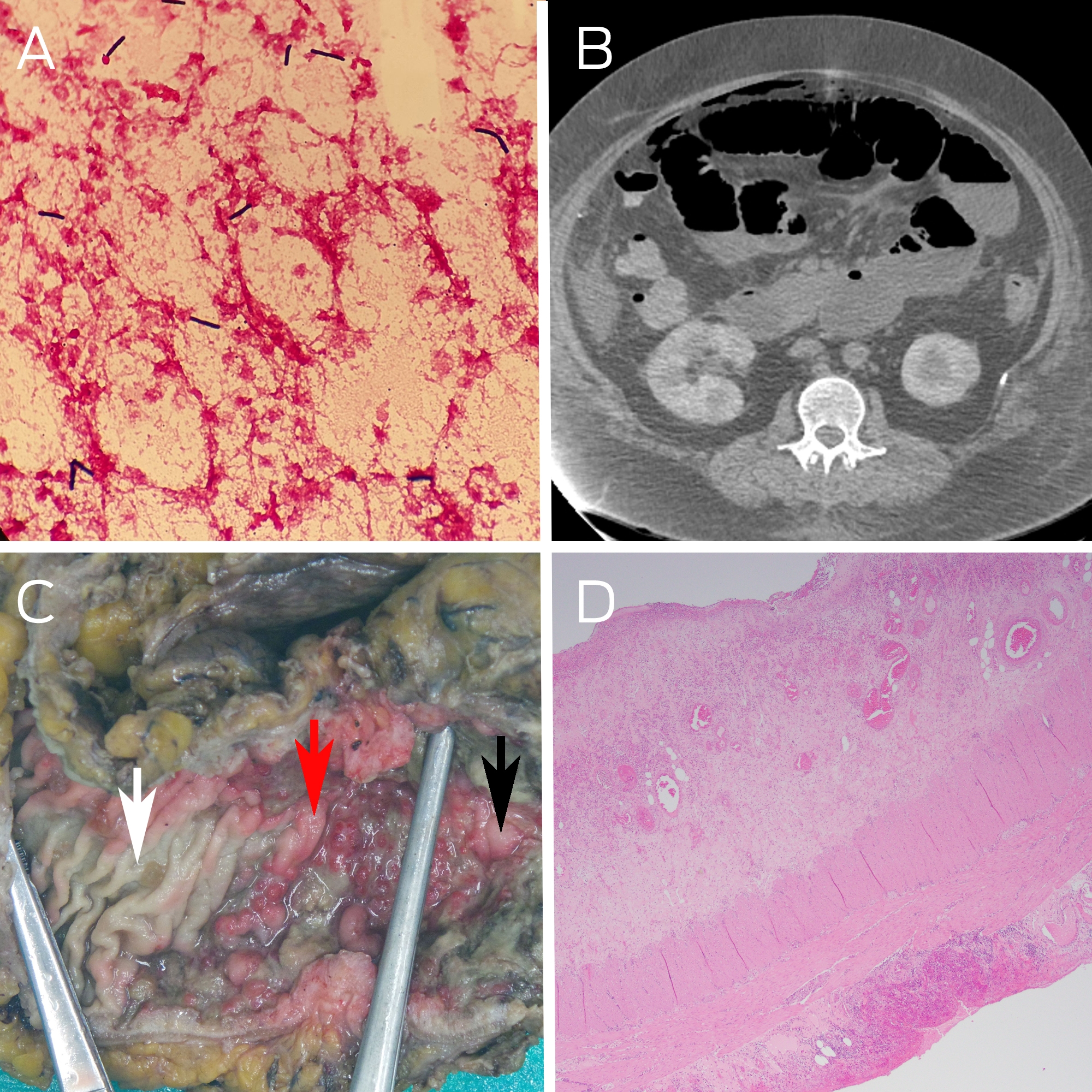
* White arrowhead = normal mucosa; red arrowhead = haemorrhagic mucosa; black arrowhead = necrotic mucosa. † × 40 section of the ascending colon demonstrating transmural ulceration.
Competing interests
No relevant disclosures.
Acknowledgements
We thank Felicity Sinclair from the department of anatomical pathology, Prince of Wales Hospital for providing the images of the bowel specimen.
References
- Tsuchida S, Umemura H, Nakayama T. Current status of matrix‐assisted laser desorption/ionization–time‐of‐flight mass spectrometry (MALDI‐TOF MS) in clinical diagnostic microbiology. Molecules 2020; 25: 4775.
- Ziech RE, Siqueira FM, Cibulski S, et al. Genomic comparison of Clostridium chauvoei isolates from classical and visceral clinical manifestation. Braz J Microbiol 2020; 51: 1327‐1332.
- Frey J, Falquet L. Patho‐genetics of Clostridium chauvoei. Res Microbiol 2015; 166: 384‐392.
- Rychener L, In‐Albon S, Djordjevic SP, et al. Clostridium chauvoei, an evolutionary dead‐end pathogen. Front Microbiol 2017; 8: 1054.
- Nagano N, Isomine S, Kato H, Sasaki Y, Takahashi M, Sakaida K, et al. Human fulminant gas gangrene caused by Clostridium chauvoei. J Clin Microbiol 2008; 46: 1545‐1547.
- Weatherhead JE, Tweardy DJ. Lethal human neutropenic enterocolitis caused by Clostridium chauvoei in the United States: tip of the iceberg? J Infect 2012; 64: 225‐227.
- Ortega MA, Fraile‐Martinez O, García‐Montero C, et al. A general overview on the hyperbaric oxygen therapy: applications, mechanisms and translational opportunities. Medicina (Kaunas) 2021; 57: 864.
Provenance: Not commissioned; externally peer reviewed.
Costs of Delivering the Hep B PAST Model of Care in Remote Australia: A Retrospective Pre–Post Study
Hoa Nguyen, Anh Le Tuan Nguyen, Paula Binks, Melita McKinnon, Emily Vintour-Cesar, Karen Wills, Nicola Stephens, Benjamin Cowie, Joshua S. Davis, Yuejen Zhao, Peter Nihill, Julie A. Campbell, Andrew J. Palmer, Jane Davies, Barbara de Graaff
Buruli Ulcer Acquired From Ringtail Possum Rescue
Daniel P. O'Brien, Naomi Clarke, Sara Bonnici, Mohammad A. Hussain
Q Fever Visceral Abscesses After Contact With Native Australian Marsupials
Samantha J. Laws, Enzo Binotto, James Stewart, Jennifer Ho, Trent Yarwood, Josh Hanson, Simon Smith
Hospital-Admitted Injection-Related Infections Among Incarcerated People Who Inject Drugs in Australia: A Retrospective Cohort Study
Andrew Palmer, Matthew Carter, Jeremy Yeo, Cecilia Shim, Jason Connor, Jeremy Hayllar, Gerald Holtmann, Naomi Moy, Elliott G. Playford, Naomi Runnegar, Paul J. Clark
The Live Attenuated Influenza Vaccine in Australia: An Additional Tool for Influenza Prevention
Cyra Patel, Alexis Pillsbury, Tran Nguyen, Xia Wang, Helen E. Quinn, Clayton K. Chiu, Allen C. Cheng, Katie L. Flanagan, Zhicheng Wang
Reflex Testing for Hepatitis D Infection: A Unique Opportunity to Reduce Hepatitis D-Related Chronic Liver Disease Deaths in Australia
Jessica Howell, Lauren Andersson, Miriam T. Levy, James O'Beirne, Leon Adams, Katharine Irvine, Avik Majumdar, Golo Ahlenstiel, Kathy Jackson, Krispin Hajkowicz, Joseph Doyle, Jane Davies, Sarah Cherian, Wayne Dimech, Alexander J. Thompson