




Medical education
Lessons from practice
Volume 216 - Issue 6
Streptococcus gallolyticus bacteraemia and colorectal neoplasia: an old association with a new name
Authors: Claudine Banal, Steve Lau, Sonalmeet Nagra and David AK Watters
Med J Aust 2022; 216 (6): 281-282. || doi: 10.5694/mja2.51447
Published online: 4 April 2022
Published online: 4 April 2022
A 63-year-old man presented with headache, fever and decreased conscious state
Clinical record
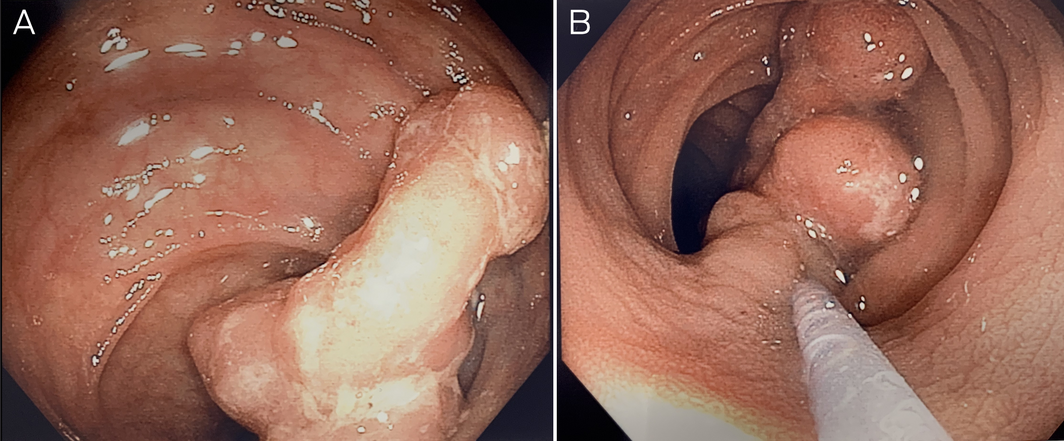
A 63‐year‐old man presented with headache, fever and decreased conscious state. He was initially treated for bacterial meningitis with intravenous antibiotics. His cerebrospinal fluid culture was negative. However, his blood culture isolated Streptococcus gallolyticus (previously: Streptococcus bovis) identified by mass spectrometry. The patient was referred for a colonoscopy, which showed a 3 cm pedunculated polyp in the sigmoid colon (Box 1, A). This advanced polyp was snared (Box 1, B) and, on histology, revealed a tubulovillous adenoma with high grade dysplasia but clear margins. The patient was subsequently booked for a repeat colonoscopy in 3 years as per the recommendations of Cancer Council Australia.1
Discussion
Colorectal cancer development is influenced by both genetic and environmental factors. Among environmental risk factors, there is increasing recognition on the role of intestinal microbiota in colorectal cancer. One microorganism associated with colonic neoplasia is S. bovis, a group D streptococcus that is found throughout the gastrointestinal tract, particularly the colon, in 2.5–15% of asymptomatic individuals.2 It is associated with other gastrointestinal malignancies, including the oral cavity, duodenum, gallbladder and pancreas.2 It is an opportunistic pathogen that can cause bacteraemia and infective endocarditis in adults.2 Since the first description of the association between S. bovis and colorectal neoplasia in 1951, multiple studies have been published supporting this relationship.3,4,5 There are varying reports on the frequency of colorectal tumours, ranging from 25–80% in patients with S. bovis bacteraemia to 18–62% of patients with S. bovis endocarditis.3 With the introduction of taxonomic changes in 2003 to the S. bovis group (Box 2),6 it was found that not all subspecies of S. bovis have a strong association with colonic neoplasia.3 A meta‐analysis reported that patients with S. bovis biotype I (S. gallolyticus subsp gallolyticus [SGG]) bacteraemia and infective endocarditis have a statistically significant increase in the risk of colorectal cancer compared with patients with S. bovis biotype II.3 In contrast, the incidence of colorectal cancer among patients with S. bovis biotype II does not appear higher than the general population.3 Interestingly, patients with SGG bacteraemia have a stronger association with villous or tubulovillous adenomas than carcinomas.3,4 The lesion appears to be mostly located in the distal colon.2
Whether this association represents cause or effect is uncertain. The “driver–passenger” theory2 was proposed to explain the role of microbiota in colorectal carcinogenesis. This model describes the “driver” bacteria causing mutations by inducing DNA damage with genotoxins, while the “passenger” bacteria have mechanisms providing them growth advantage in tumour environments. SGG possesses collagen‐binding proteins and pili that preferentially adhere to colorectal mucosa and endocardium.2,4 Studies show SGG selectively colonises tissue in colorectal cancer, and the organism has been identified inside tumours rather than on mucosal surfaces.2 Animal models have shown that SGG may play a role in the adenoma–carcinoma sequence by acting as a driver of early paraneoplastic lesions.2,4 SGG secretes a specific bacteriocin that enhances colonisation by killing other commensals.2 Moreover, new lesions develop in the colon within 2–4 years after SGG infection. These findings suggest that SGG has a driver and passenger role in colorectal cancer carcinogenesis.2 This mechanism has also been shown in bacterial species such as Fusobacterium nucleatum, Enterococcus faecalis and colibactin‐producing Escherichia coli, which are also implicated in colorectal cancer.2 Surface proteins by F. nucleatum allows adherence and invasion to cells, whereas colorectal cancer‐causing E. coli produces colibactin causing epithelial damage.2
It is important to note that the lack of uniform nomenclature and genotyping of SGG limits its characterisation and role in the development of colorectal cancer. More detailed analysis in clarifying subtypes of SGG is required to further understand their malignant potential. There needs to be greater awareness from clinicians and researchers about these taxonomic changes and use this nomenclature consistently in clinical practice and research publications.
Clinicians need to appreciate the strong association of SGG infection and colorectal cancer. The finding of this organism in blood cultures should prompt a colonoscopy for early diagnosis of colorectal cancer. However, if tumours are not found in the first instance, patients should be scheduled for endoscopic surveillance, as colonic tumours may develop several years later. Presently, there are no current guidelines on the follow‐up interval, but patients should be treated as high risk cases (eg, colonoscopy within 3 years).
Lessons from practice
- • Clinicians should be aware of the revised taxonomic nomenclature for Streptococcus bovis. There is strong evidence that Streptococcus gallolyticus subsp gallolyticus (SGG; previously: S. bovis biotype I) has a stronger association with colorectal cancer or advanced adenomas than other subtypes.
- • The finding of SGG in blood cultures should prompt a colonoscopy for early diagnosis of colorectal cancer.
- • Despite a normal colonoscopy, new lesions may develop in the colon within 2–4 years after SGG infection. A surveillance colonoscopy within this period is strongly recommended.
Box 1 – Colonoscopic image of the sigmoid colon demonstrating the 3 cm pedunculated polyp (A) and the sigmoid polyp snared at the base (B)
Box 2 – Nomenclature for Streptococcus bovis/Streptococcus equinus complex based on molecular characteristics5
|
Old nomenclature |
Current nomenclature |
||||||||||||||
|
|
|||||||||||||||
|
S. bovis biotype I |
S. gallolyticus subsp gallolyticus |
||||||||||||||
|
S. bovis biotype II/1 |
S. infantarius subsp infantarius |
||||||||||||||
|
S. lutetiensis |
|||||||||||||||
|
S. bovis biotype II/2 |
S. gallolyticus subsp pasteurianus |
||||||||||||||
|
S. gallolyticus subsp macedonicus |
|||||||||||||||
|
|
|||||||||||||||
|
|
|||||||||||||||
Competing interests
No relevant disclosures.
References
- Surveillance Colonoscopy Guidelines Working Party. Clinical practice guidelines for surveillance colonoscopy [website]. Sydney: Cancer Council Australia, 2019. https://wiki.cancer.org.au/australia/Guidelines:Colorectal_cancer/Colonoscopy_surveillance (viewed Apr 2021).
- Pasquereau‐Kotula E, Martins M, Aymeric L, Dramsi S. Significance of Streptococcus gallolyticus subsp. gallolyticus association with colorectal cancer. Front Microbiol 2018; 9: 614.
- Boleij A, van Gelder MMHJ, Swinkels DW, Tjalsma H. Clinical importance of Streptococcus gallolyticus infection among colorectal cancer patients: systematic review and meta‐analysis. Clin Infect Dis 2011; 53: 870–878.
- Abdulamir AS, Hafidh RR, Abu Bakar F. The association of Streptococcus bovis/gallolyticus with colorectal tumors: the nature and the underlying mechanisms of its etiological role. J Exp Clin Cancer Res 2011; 30: 11.
- McCoy W, Mason JM. Enterococcal endocarditis associated with carcinoma of the sigmoid; report of a case. J Med Assoc State Ala 1951; 21: 162–166.
- Schlegel L, Grimont F, Ageron E, et al. Reappraisal of the taxonomy of the Streptococcus bovis/Streptococcus equinus complex and related species: description of Streptococcus gallolyticus subsp. gallolyticus subsp. nov., S. gallolyticus subsp. macedonicus subsp. nov. and S. gallolyticus subsp. pasteurianus subsp. nov. Int J Syst Evol Microbiol 2003; 53: 631–645.
Provenance: Not commissioned; externally peer reviewed.
Early-Onset Colorectal Cancer With Liver-Only Metastases: A Retrospective Cohort Study Integrating Prospectively Collected Real-World Clinical and Molecular Data From an Australian National Database (2009–2024) to Guide Treatment Planning
Savio G. Barreto, Christos S. Karapetis, Shahid Ullah, Matthew Burge, Susan Caird, Angus Campbell, Azim Jalali, Ross Jennens, Muhammad A. Khattak, Belinda Lee, Stephanie H. Lim, Shehara Mendis, Louise Nott, Timothy J. Price, Jeremy D. Shapiro, Jeanne Tie, Javier Torres, Colin Williams, Rachel Wong, Vanessa Wong, Peter Gibbs
Australian Pathways for Specialist Pain Management and Early Palliative Care for People With Pancreatic Cancer: Developed Using a Community Consensus Approach
Jennifer Philip, Melanie R. Lovell, Kylee Bellingham, Gail Garvey, Gregory B. Crawford, Nicole M. Rankin, Kara Burns, Isabel Young, Vivienne Milch, Dorothy Keefe, Katrina Anderson, James Lawson, Meinir Krishnasamy
Cause‐specific mortality among Queensland people with cirrhosis, by cirrhosis aetiology and decompensation status, 2007–22: a retrospective cohort study
Vikas Bhasker, Jessica R Fong, Paul J Clark, Gunter F Hartel, Richard Skoien, James O’Beirne, Elizabeth E Powell, Patricia C Valery
Clinical practice guidelines for hepatocellular carcinoma surveillance for people at high risk in Australia: summary of recommendations
Jacob George, Nicole L Allard, Stuart K Roberts, Leon A Adams, Jane Davies, Behzad Hajarizadeh, Jennifer H MacLachlan, Suzanne E Mahady, Rosalie Altus, Catherine Brown, David C Fry, Belinda Greenwood‐Smith, Natali Smud, Patricia C Valery, Nafisa Yussf, Kate Broun, Denise Campbell, Karen Canfell, Chelsea Carle Harrison, Victoria Freeman, Paul Grogan, Catherine Holliday, Suzanne Hughes, Anna Kelly, Cathelijne Kemenade, Claire Latumahina, Amanda McAtamney, Megan Varlow, Joachim Worthington, Susan Yuill, Eleonora Feletto
Assessment of metabolic dysfunction‐associated fatty liver disease in primary care: a consensus statement summary
Leon A Adams, William W Kemp, Kate R Muller, Elizabeth E Powell, Stuart K Roberts, Luis Calzadilla Bertot, Stephanie Best, Gary Deed, Jon D Emery, Samantha L Hocking, Graham R Jones, John S Lubel, Sinead Sheils, Stephen M Twigg, Gerald F Watts, Jacob George
Treatment outcomes for people with hepatitis C referred to tertiary care in Victoria, 2021–22: a retrospective observational study
Elly Layton, Nicole Matthews, Brendan Quinn, Nasra Higgins, Gabrielle Lindeman, Mielle Abbott, Jennifer MacLachlan, Elizabeth Birbilis, Margaret E Hellard, Joseph Doyle, Benjamin C Cowie, Mark Stoové