




Volume 214 - Issue 8
Implementing voluntary assisted dying in a major public health service
Authors: Sarah Booth, Paul Eleftheriou and Claire Moody
Med J Aust 2021; 214 (8): 343-346.e1. || doi: 10.5694/mja2.50982
Published online: 15 March 2021
Published online: 15 March 2021
Implementing voluntary assisted dying legislation demands respectful communication and collaboration between health professionals and community
The Voluntary Assisted Dying Act 2017 (Vic) (VAD Act) was passed by the Victorian Parliament in November 2017 and came into effect on 19 June 2019.1 The VAD Act is the only legislation of its kind implemented in Australia, but there are several other international jurisdictions where comparable legislations apply.2,3,4
Victoria is the first state in Australia to implement voluntary assisted dying (VAD). There is a dearth of local evidence available which explores the implementation of assisted dying services into a hospital setting, although potential ethical challenges have been identified.2,5,6 This article aims to outline the experience of a tertiary public health service in Melbourne’s western suburbs which implemented VAD in 2019 and the resultant policies and procedures.
With the enactment of the VAD Act, Victorian public health services were expected to develop policies and procedures which apply when a patient requests VAD or related information.7 As a tertiary public health service in Victoria, the health service used policies and guidelines suggested by the Department of Health and Human Services (DHHS) and shared documents from other metropolitan tertiary hospitals as a basis for developing local policies and procedures.7,8 The Victorian legislation provided the eligibility criteria and necessary steps required to access VAD, including timing of requests, medical assessments, medication prescription, reporting and professional requirements.1 In mid‐2018, the health service established a VAD Working Group with senior professional and executive representation, including the Chief Medical Officer; the General Counsel; the Executive Director, Nursing and Midwifery; relevant medical heads of units, senior nurses, allied health representatives, and the Senior Clinical Communications Advisor. The Clinical Communications Advisor conducted 1:1 consultations with the 25 Working Group members to explore the impact of VAD legislation on their professional group and clinical practice between September and December 2018. The outcomes of these consultations highlighted the systemic and ethical complexities inherent in implementing VAD and informed the next steps, including the need to engage with a range of appropriately skilled and experienced clinicians throughout the implementation phase.4
A key consideration during the implementation phase was balancing staff members’ right to conscientiously object to supporting patients when the assistance was related to VAD, with the expectation that health professionals would continue to provide care unrelated to VAD.5 Capacity for moral injury for staff for whom their beliefs and values were at odds with the employing organisation’s approach to VAD needed to be recognised and addressed throughout the implementation process.5,9
To assist with planning, the health service had to decide which VAD model of care pathway would be provided — either A, B or C10 (Supporting Information, appendix 1). The pathway selected by the health service was dependent on the number of suitably qualified medical professionals willing to perform VAD coordination and/or consultation roles, in line with VAD legislation requirements. In 2019, the hospital’s medical professionals were invited to complete an anonymous survey asking them to indicate their willingness to participate in VAD. This survey achieved 208 responses (a 17% response rate), 106 of those were from senior medical staff, with 72% of respondents supporting a patient’s access to VAD at the health service. In addition, eight senior medical staff members expressed a willingness to be involved in the facilitation of VAD. The survey results guided the health service’s management to determine Pathway A as the appropriate model of care for this health service.
In parallel with this survey, training for VAD was provided by the DHHS‐led VAD Implementation Taskforce. During these sessions, the need for local VAD procedures were identified, as staff members required further guidance to navigate patients’ requests for VAD and to ensure the health service adhered to legislative requirements. Importantly, the procedures needed to support the right of staff to conscientiously object to VAD while fulfilling lawful access to care.5
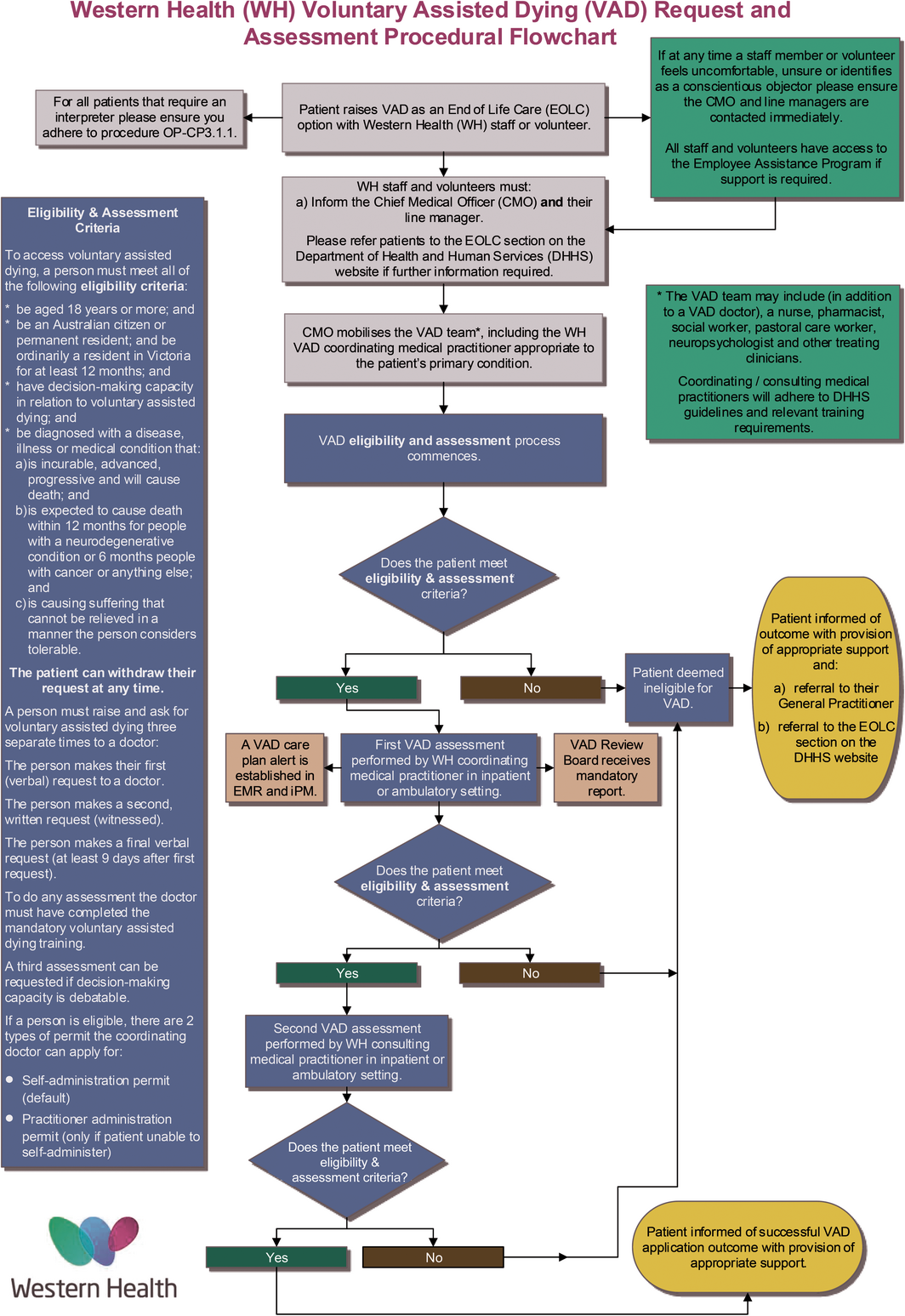
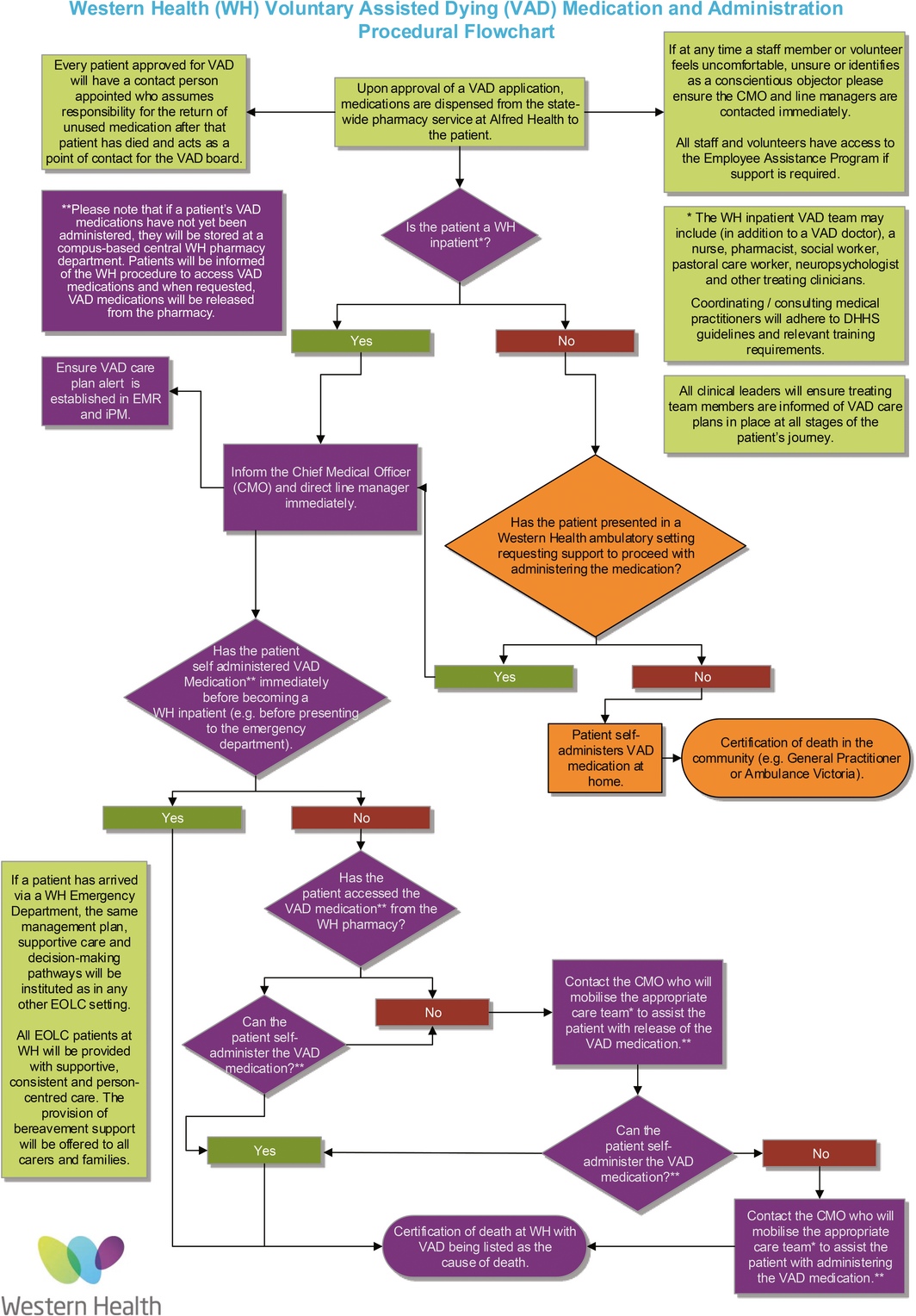
The multidisciplinary Working Group met 12 times over an 8‐month period, with the first meeting occurring in November 2018. As implementation drew closer, the Working Group focused on a number of actions to operationalise the legislation, including the development of two VAD procedural flow charts for requesting and assessing VAD (Box 1) and for VAD medication and administration (Box 2).
These procedural flow charts, as well as the organisation‐wide VAD policy and procedures and the DHHS guidelines, were distributed to all staff electronically and made available on the organisation’s intranet. The procedures developed applied to all staff, including agency and contract staff.
Two open‐forums (“grand rounds”) were held to educate staff on VAD legislation, inform staff of the Pathway A model of care, and launch the hospital’s VAD policy and procedures (Supporting Information, appendices 2 and 3). All clinical staff were invited to attend. These forums attracted more than 500 participants and were part didactic and part panel‐led, with interactive audience discussion. Over 50 questions were received through the anonymous electronic tool Mentimeter (www.mentimeter.com) and verbal contributions were documented. A broad range of perspectives, concerns and clinical scenarios posed throughout these sessions prompted the development of a comprehensive frequently asked questions document, which provided further guidance regarding the integration of VAD into clinical practice.
Despite the VAD Act coming into effect from June 2019, the health service wanted to provide adequate VAD advice and training before it became an option for patients. The health service thus determined that the VAD policy, procedures and flow charts would be enacted in July 2019.
Challenges implementing voluntary assisted dying
There were a number of challenges during the planning phase. Primarily, the health service needing to balance the guiding principles of the legislation, which focused on patient‐centred decisions, while embedding practices to mitigate organisational risk. One example surfaced when the Working Group were deciding where VAD medication would be stored during an inpatient stay. The patient’s autonomy was core, but other safety issues were factored in. In this instance, the decision was made to store the patient’s VAD medication box securely within the central pharmacy rather than on the ward or at the patient’s bedside.
Perhaps the largest challenge was fulfilling the responsibility of a Pathway A public health service to provide VAD as an option while respecting the staff member’s decision to conscientiously object to facilitating or being involved in VAD. The need to consider each case individually was highlighted, as it was recognised that there is a spectrum of views in relation to conscientiously objecting. Broad consultation enabled a sensitive and considerate implementation plan, including the addition of known conscientious objectors in the Working Group. Processes were embedded to allow conscientious objectors to distance themselves when patients request VAD, including the provision of informed agency nursing staff to replace potential conscientious objectors on a shift, and the broad promotion of a single contact phone number, to which conscientious objectors could anonymously call and hand over this responsibility.
Without comparable local evidence, the expected demand for VAD was inferred from international evidence, which predicted that a low number of people would request VAD.2,3 Over a 14‐month period (June 2019 to September 2020), the health service received 42 patient requests for VAD, with four patients progressing to a prescription of VAD medications and dying as a result. Three of these four patients died after receiving VAD as inpatients and one died at home after being discharged from the health service. Patients who requested VAD were cared for across a number of services and received concurrent palliative care as part of appropriate end‐of‐life care management. The patients who died after receiving VAD were cared for in the ward that was most familiar and suited to their needs; palliative care was provided by the treating team, with specialist input as required.
Most VAD requests were from patients in the final weeks of their lives, who therefore did not survive the full length of the VAD assessment process. This observation made it imperative that VAD processes complemented end‐of‐life care, thus not denying the patient and their loved ones appropriate palliative and bereavement care respectively. Indeed, a core tenet of staff education was that progression of VAD may occur during end‐of‐life care; therefore, palliative and comfort care must continue concurrently with VAD processes.
Implementing VAD in a hospital setting demanded sensitive, honest and respectful communication between multiple health professional groups and the community, particularly between individuals with opposing views. A significant amount of time was spent engaging with and listening to staff with a myriad of perspectives. The framework provided by the VAD legislation and the DHHS VAD Implementation Taskforce enabled the health service to develop local policy, procedures and resources that most appropriately serve the community. The multidisciplinary Working Group proved a useful forum to deal with the complex issues inherent in implementing a progressive legislation into a large health service. Since the implementation of VAD, statewide monitoring and surveillance of VAD has occurred through multisite data collection and mandated reporting. Locally, discussion of case studies, engagement in multisite research and staff consultation will continue to provide vital guidance to the health service when delivering VAD, improving its processes and responding to the needs of patients and staff.

Competing interests
No relevant disclosures.
References
- Voluntary Assisted Dying Act 2017 (Vic). https://www.legislation.vic.gov.au/in-force/acts/voluntary-assisted-dying-act-2017/004 (viewed July 2019)
- Loggers ET, Starks H, Shannon-Dudley M, et al. Implementing a Death with Dignity program at a comprehensive cancer center. N Engl J Med 2013; 368: 1417–1424.
- Johnston C, Cameron J. Discussing voluntary assisted dying. J Law Med. 2018; 26: 454–463.
- Department of Health and Human Services. Ministerial Advisory Panel on Voluntary Assisted Dying: final report. Melbourne: Victoria State Government, 2017. https://www2.health.vic.gov.au/about/publications/researchandreports/ministerial-advisory-panel-on-voluntary-assisted-dying-final-report (viewed July 2019).
- White B, Willmott L, Close E. Victoria’s voluntary assisted dying law: clinical implementation as the next challenge. Med J Aust 2019; 210: 207–209. https://www.mja.com.au/journal/2019/210/5/victorias-voluntary-assisted-dying-law-clinical-implementation-next-challenge
- Winkler E. The ethics of policy writing: how should hospitals deal with moral disagreement about controversial medical practices? J Med Ethics 2005; 31: 559–566.
- Department of Health and Human Services. Health services information [website]. Melbourne: Victoria State Government. https://www2.health.vic.gov.au/hospitals-and-health-services/patient-care/end-of-life-care/voluntary-assisted-dying/health-services-information (viewed July 2019).
- Department of Health and Human Services. Voluntary assisted dying: guidance for health practitioners. Melbourne: Victoria State Government, 2019. https://www2.health.vic.gov.au/about/publications/policiesandguidelines/voluntary-assisted-dying-guidance-for-health-practitioners (viewed Sept 2020).
- Waran E, William L. Navigating the complexities of voluntary assisted dying in palliative care. Med J Aust 2020; 213: 204–206. https://www.mja.com.au/journal/2020/213/5/navigating-complexities-voluntary-assisted-dying-palliative-care
- Department of Health and Human Services. Voluntary assisted dying model of care pathways. Melbourne: Victoria State Government, 2019. https://www2.health.vic.gov.au/Api/downloadmedia/%7B38D6AD67-02C1-4A97-A240-9D726C5D9D6A%7D (viewed Sept 2019).
Provenance: Not commissioned; externally peer reviewed.
A future for the hospital‐in‐the‐home (HITH) deteriorating patient: shifting the paradigm
Aaron BO Wong, Brian H Le
Models of care across settings supporting ageing in place: a narrative review
Maria C Inacio, Stephanie Harrison, Johannes Schwabe, Maria Crotty, Gillian E Caughey
Implementing voluntary assisted dying in New South Wales correctional settings
Diya Ahluwalia, Leigh Haysom
Improving palliative care for people who use alcohol and other drugs
Grace FitzGerald, Jon Cook, Peter Higgs, Charles Henderson, Sione Crawford, Thileepan Naren
Inequity of access to voluntary assisted dying for New Zealand citizens residing permanently in Australia
Christopher J Barlow
Dying of heart failure: how do we improve the experience?
Dominica Zentner, Vithoosharan Sivanathan, Jennifer Philip, Natasha Smallwood