




Volume 210 - Issue 5
Victoria's voluntary assisted dying law: clinical implementation as the next challenge
Authors: Ben P White, Lindy Willmott and Eliana Close
Med J Aust 2019; 210 (5): 207-209. || doi: 10.5694/mja2.50043
Published online: 25 February 2019
Published online: 25 February 2019
Victoria's voluntary assisted dying law will soon come into effect; a remaining challenge is effective clinical implementation
Victoria's voluntary assisted dying law will soon come into effect; a remaining challenge is effective clinical implementation
The Voluntary Assisted Dying Act 2017 (Vic) (VAD Act) will become operational on 19 June 2019. A designated 18‐month implementation period has seen an Implementation Taskforce appointed, and work is underway on projects including developing clinical guidance, models of care, medication protocols and training for doctors participating in voluntary assisted dying (VAD).1 While some have written on the scope of, and reaction to, the VAD legislation,2,3,4 there has been very little commentary on its implementation. Yet, important choices must be made about translating these laws into clinical practice. These choices have major implications for doctors and other health professionals (including those who choose not to facilitate VAD), patients, hospitals and other health providers. This article considers some key challenges in implementing Victoria's VAD legislation.
Overview of the Voluntary Assisted Dying Act 2017 (Vic)
The VAD Act allows adults with decision‐making capacity resident in Victoria to seek assistance to die. To be eligible, they must have an incurable disease, illness or medical condition that is advanced, progressive and expected to cause death within 6 months (or 12 months for neurodegenerative conditions). That condition must also be causing suffering that cannot be relieved in a manner that the person considers tolerable. The Act further requires that the person is seeking VAD voluntarily and without coercion. Eligible people can be prescribed a VAD substance to take themselves, or if they are physically incapable of doing so, a doctor can administer this substance.
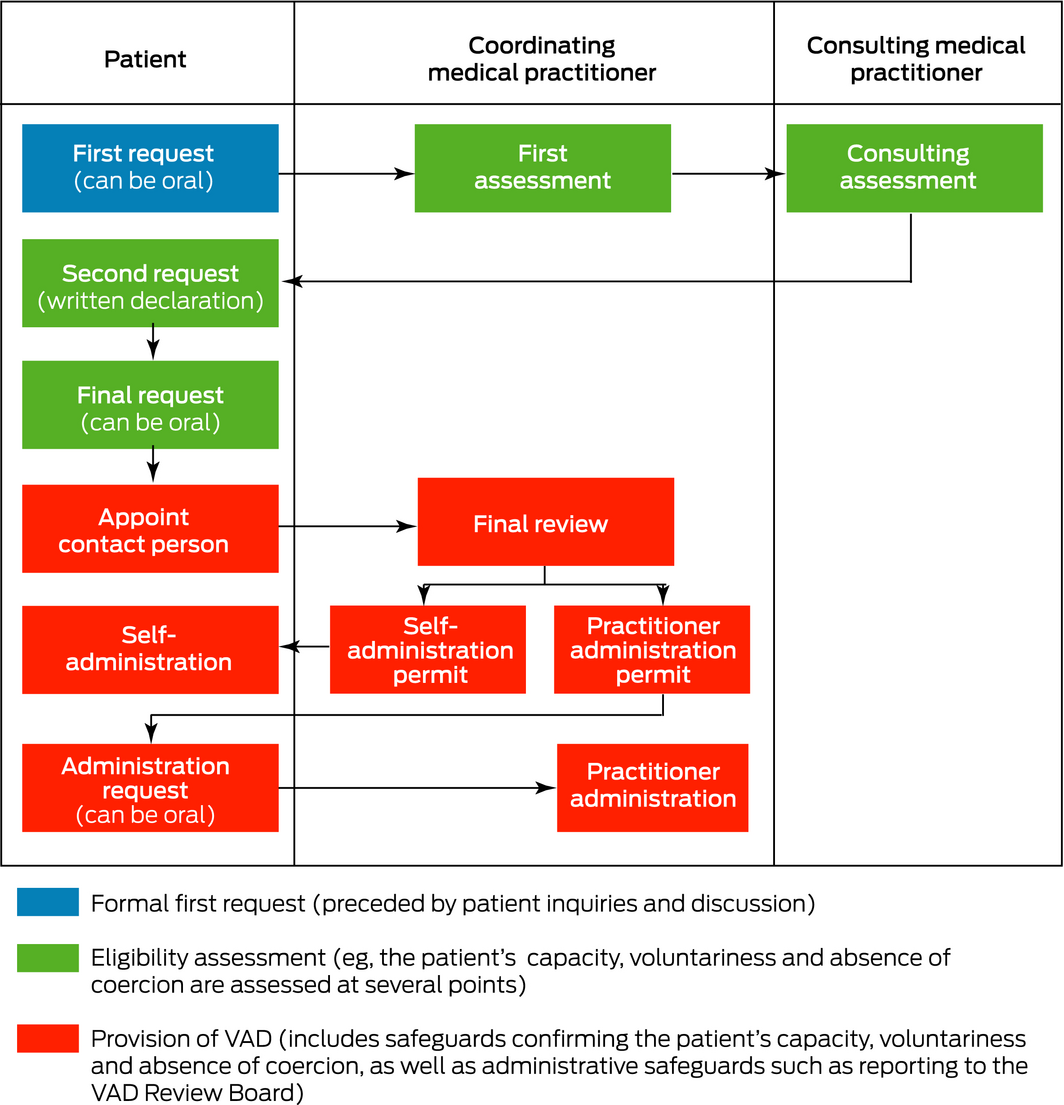
The VAD regime has been described by the Victorian Government as the “safest, and most conservative model in the world” with 68 safeguards.5 Many of these safeguards relate to the process of accessing VAD. This process is complex with detailed procedures outlined in the legislation (Box). It includes the involvement of at least two doctors, tightly prescribed procedural steps and progressive reporting to the new VAD Review Board.
Implementing VAD in clinical practice
Implementation of the VAD legislation into clinical practice must balance two important policy goals. It must facilitate access to VAD, but restrict that access to only those who are eligible under the legislation. Designing implementation processes to achieve both goals will be challenging given the law's complexity. This complexity was by design, with the rigorous and prescriptive VAD process aiming to attract political support for a conservative model. The principal implementation challenge is ensuring that this complexity functions protectively, as intended, and does not unfairly prevent eligible people from accessing VAD.
Effective implementation of the VAD law requires stepping past the tension between these policy goals to advance both aims. System design is the key so that complexity is “internally facing” and not experienced by people seeking VAD and doctors assisting them. This embeds rigour and safety in the system to exclude ineligible people but streamlines appropriate access to VAD for terminally ill people who are suffering. An example is a centralised system of information and process management, with well designed forms and processes which guide doctors and patients to ensure compliance. This would address complexity and also support those practising in areas where local or institutional resources about VAD are limited.
A second related implementation challenge is to translate prescriptive legislative processes into appropriate clinical practice across the variety of settings and disease contexts where VAD could arise. The effective conversion of legal standards into medicine is a known challenge in health law and regulation.6 This is particularly so here because the VAD legislation mandates detailed intervention into clinical practice — indeed it arguably creates a new area of clinical practice. The engagement of key health and medical stakeholders, as well as people likely to seek VAD, in designing how the regime operates will be critical.
An example of this is the prohibition on doctors and other health professionals initiating VAD discussions with patients (section 8, VAD Act). Clear guidance is needed on how to clinically implement this legal prohibition yet maintain meaningful end‐of‐life discussions with patients. Expertise from health professionals who regularly engage in these conversations will be important when designing how this aspect of the law is implemented. Another example is regulating the VAD medication. The implementation process will need to determine not only which medication to use and in what doses, but also address the logistics for meeting detailed legal requirements of how the substance is to be prescribed, handled, stored and (unused portions) returned.
An opportunity to translate the VAD law into practice is through a clinical network with expertise in facilitating and educating about VAD. While its long term success would depend on clinical leadership, the implementation process could “seed” development of a network of VAD doctors who would then support other clinicians. Such clinical networks exist in different forms in other countries where VAD is legal, such as SCEN (Support and Consultation on Euthanasia in the Netherlands) and LEIF (Life End Information Forum) in Belgium.7 Such networks develop clinical expertise and guidance that not only promotes high quality, patient‐centred care but also outlines medically appropriate processes that comply with the VAD law.
A third implementation challenge is supporting and managing conscientious objection. Some doctors will make a global decision about providing VAD and others will make case‐by‐case decisions depending, for example, on the patient or level of involvement sought. The legal right to conscientiously object is clearly stated (section 7, VAD Act) but the VAD law does not establish a framework for respecting conscience. This will need to be decided in the implementation process. While there is no duty in the VAD law to refer a patient whose health service, doctor or other health professional does not want to be involved, the implementation framework must not impede the policy goal of providing eligible patients with access to VAD. Respecting conscience while facilitating access to lawful care is regarded as an appropriate balance in medicine.8 There are models addressing conscience in other settings that can inform design of this framework. Attention must also be paid to relationships between doctors (and other health professionals) and supports made available to navigate differences that can arise between clinicians in relation to VAD.
The designated 18‐month VAD implementation period provides scope to address these challenges and create the necessary clinical, legal and administrative infrastructure. This can be contrasted with Canada, where political delays led to their medical assistance in dying law coming into effect without an extended opportunity to prepare.9 The Victorian implementation process also has the benefit of being well resourced, including in relation to expertise. The Implementation Taskforce comprises individuals with extensive clinical, legal and policy experience, with many also being members of the earlier Ministerial Advisory Panel (which provided detailed recommendations informing the draft legislation). The government‐sponsored process also has a high level of support from the Victorian Department of Health and Human Services to facilitate effective implementation. Finally, the process can draw on the experience of implementing VAD (both positive and negative) in other jurisdictions, including the recent Canadian experience.
Implementation is an ongoing process
Implementation of VAD must continue after the law commences. Systems level scrutiny is a common feature of VAD regimes and Victoria is no exception. The VAD Review Board is charged with oversight of the system and individual cases. Continuous monitoring and improvement will be important once the regime is in operation.
Three types of evidence can support this continuous improvement: real‐time “on‐the‐ground” feedback about how the VAD law is working in practice; data generated within the VAD system; and empirical research undertaken from outside the system. Evaluating how this evidence should refine implementation will require careful thought. At one end of the spectrum, real‐time feedback from practice is by definition timely but can be anecdotal and lack reliability. At the other end of the spectrum, empirical research can provide rigorous and evidence‐based recommendations but usually takes time to produce. A combination of all three forms of evidence will be important to inform implementation as an ongoing process.
The implementation of Victoria's VAD law is critical for whether it achieves the dual policy goals of facilitating access to VAD by eligible people, while ensuring this access is limited only to this cohort. Translating this complex law into appropriate clinical practice will be challenging. Victoria has strategically designated both time and resources to a period of planned implementation. That planning needs to address the challenges raised in this article, but implementation is also an ongoing process that must continue after the VAD law begins.
Competing interests
Ben White and Lindy Willmott have been engaged by the Victorian Government to design and provide the legislatively mandated training for doctors involved in voluntary assisted dying. Lindy Willmott is also a member of the board of Palliative Care Australia, but this article only represents her views.
References
- Victorian Government Department of Health and Human Services. Implementation Taskforce. https://www2.health.vic.gov.au/hospitals-and-health-services/patient-care/end-of-life-care/voluntary-assisted-dying/vad-implementation-taskforce (viewed Sept 2018).
- Yoong J, Franco M, William L, Poon P. Perspectives of cancer treatment providers regarding voluntary assisted dying in Victoria. Intern Med J 2018; 48: 770–773.
- Beardsley C, Brown K, Sandroussi C. Euthanasia and surgeons: An overview of the Victorian Voluntary Assisted Dying Act 2017 and its relevance to surgical practice in Australia. ANZ J Surg 2018; 88: 956–958.
- Karapetis CS, Stein B, Koczwara B, et al. Medical Oncology Group of Australia position statement and membership survey on voluntary assisted dying. Intern Med J 2018; 48: 774–779.
- Premier Daniel Andrews. Voluntary assisted dying model established ahead of vote in Parliament [media release]. https://www.premier.vic.gov.au/voluntary-assisted-dying-model-established-ahead-of-vote-in-parliament/ (viewed Sept 2018).
- White BP, Willmott L, Cartwright C, et al. Comparing doctors’ legal compliance across three Australian states for decisions whether to withhold or withdraw life‐sustaining medical treatment: does different law lead to different decisions? BMC Palliat Care 2017; 16: 63.
- Van Wesemael Y, Cohen J, Onwuteaka‐Philipsen BD, et al. Establishing specialized health services for professional consultation in euthanasia: experiences in the Netherlands and Belgium. BMC Health Serv Res 2009; 9: 220.
- Australian Medical Association. AMA Code of Ethics 2004; editorially revised 2006; revised 2016: para 2.1.13. https://ama.com.au/system/tdf/documents/AMA%20Code%20of%20Ethics%202004.%20Editorially%20Revised%202006.%20Revised%202016.pdf?file=1&type=node&id=46014 (viewed Sept 2018).
- Downie J. Medical assistance in dying: lessons for Australia from Canada. QUT Law Review 2016; 17: 127–146.
Linked content
-
MJA Podcast: Professor Ben White
-
InSight+: Voluntary assisted dying: turning law into clinical practice
Provenance: Not commissioned; externally peer reviewed.
Mending the Road: A Way Forward From Silence and Silencing
Ayman Hamdan, Anisa J. N. Jafar
Seven Vessel Spontaneous Coronary Artery Dissection and Concurrent Transient Global Amnesia After an Emotional Trigger
Michael J. Stewart, Tom R. Sutherland
Seven Vessel Spontaneous Coronary Artery Dissection and Concurrent Transient Global Amnesia After an Emotional Trigger
Virginia Barbour
Research Priority Setting Is Not Research: A Call for Ethical Clarity in Australia
Bec Jenkinson, Gordon McGurk, Jonathan Quicke, Janelle Bowden, Nadine E. Foster
Organ Donation After Oral Ingestion of a Voluntary Assisted Dying Substance
Joanne Kantianis, Helen I. Opdam, Rohit L. D'Costa
Equity, Diversity and Inclusion From the Start: Reforming Australia's Research Infrastructure for Inclusive Participation
Danielle M. Muscat, Kirsten J. McCaffery, Heather L. Shepherd, Marguerite Tracy