




Volume 214 - Issue 10
Addressing the urban–rural health gap through a northern research collaboration
Authors: Kevin Williams, Sean Rung and Bart J Currie
Med J Aust 2021; 214 (10): 484-484.e1. || doi: 10.5694/mja2.51076
Published online: 7 June 2021
Published online: 7 June 2021
To the Editor: The article by Giuseppin,1 Chair of the Australian Medical Association Council of Rural Doctors, published in MJA InSight+, on ending geographic narcissism, overcoming metro‐based policy making, and instituting health self‐determination by rural practitioners and communities echoes the feedback we have received from health practitioners and consumers attending our workshops throughout northern Australia.
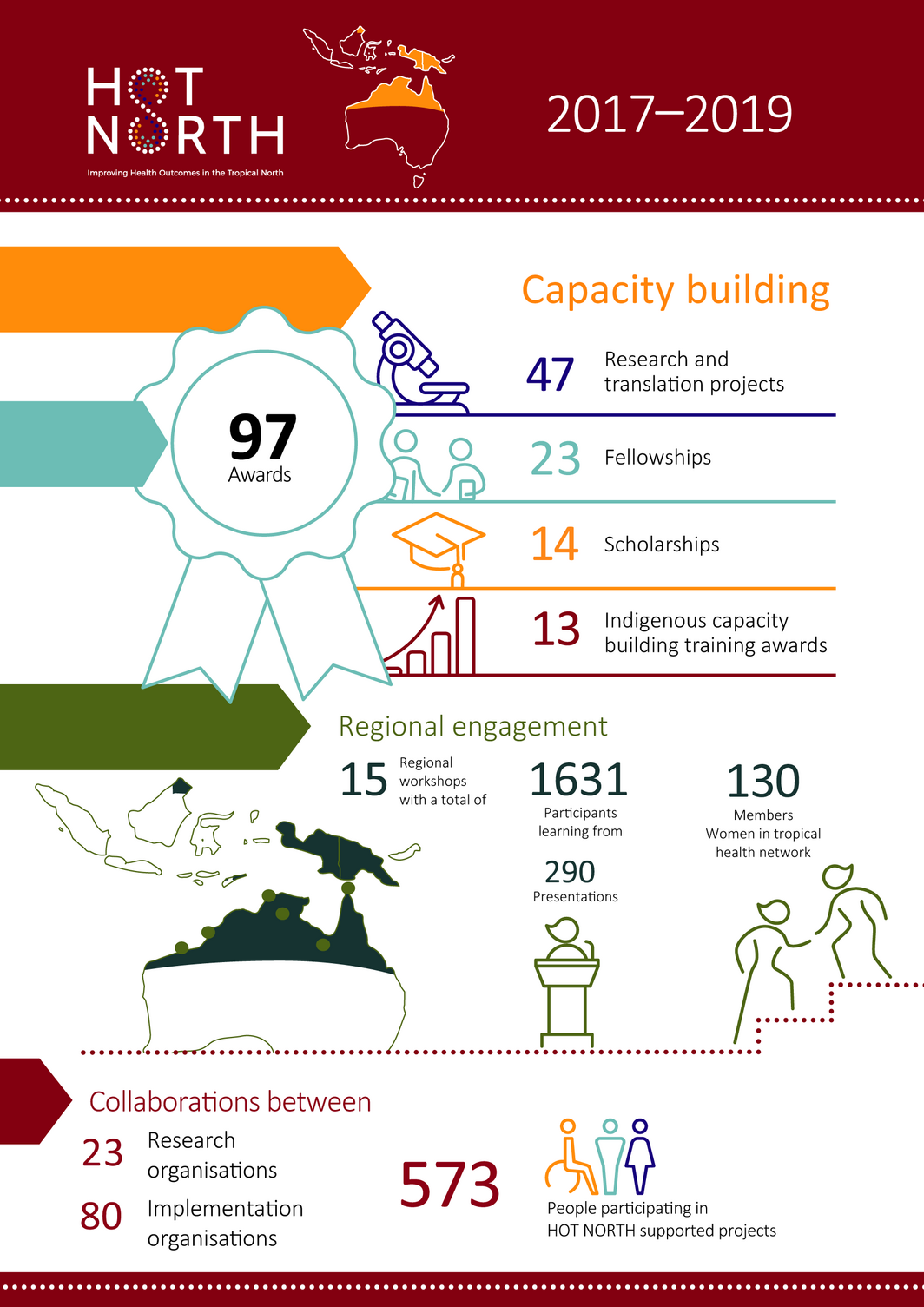
The HOT NORTH (Improving Health Outcomes in the Tropical North) program (Box), funded by the National Health and Medical Research Council, aims to address inequitable health coverage across northern Australia through more widespread implementation of locally designed research and practice. Epidemiological and health service data indicate a higher disease burden and risk profile in northern Australia compared with the rest of the country, with health disparity increasing with age and remoteness and Indigenous Australians living in the north having worse health outcomes than the non‐Indigenous population.2
At 15 HOT NORTH forums held over the past 3 years, attended by over 1600 participants in locations from South Hedland to Thursday Island, we provided an opportunity for communities and local health staff to take control over the agenda, presentations and input to discussions. Participation increased, discussions became more interactive, and pride in the achievements of local health practitioners and researchers replaced the deficit data and focus of many previous presentations. The wider benefits of a consultative, locally designed and led health research and capacity‐building program are captured in the recent HOT NORTH impact report.3
While several initiatives have addressed regional and remote health care (eg, the Centre for Research Excellence in Rural and Remote Primary Healthcare, the Advanced Health Research and Translation Centre in Alice Springs, and Centres for Innovation in Regional Health in north Queensland and in regional New South Wales), we agree with Giuseppin that fundamental shifts in the rusted‐on core–periphery relationships are required to address the inequity of health coverage across Australia. However, in Australia (and its universities), this requires recognition of the pervasive dogma of “winner‐takes‐all” urbanism of “superstar cities”4 with their “creative class”,5 which arguably militates against an appetite and capacity for sustainably reshaping the service delivery and research landscape in response to the remoteness, cultures, power relations, social ties and other dynamics in rural and remote settings.
Competing interests
No relevant disclosures.
Acknowledgements
The HOT NORTH program is supported by the Australian National Health and Medical Research Council (NHMRC) (Grant No. 1131932). The content of this article is solely the responsibility of the authors and does not reflect the views of the NHMRC. The funders had no role in planning or writing this article.
References
- Giuseppin M. Rural health: time to end geographic narcissism [Internet]. InSight+ 2020; 21 Sept. https://insightplus.mja.com.au/2020/37/rural-health-time-to-end-geographic-narcissism/ (viewed Nov 2020).
- Edelman A, Grundy J, Moodley N, et al. Northern Australia health service delivery situational analysis. Townsville: Cooperative Research Centre for Northern Australia, 2020: https://www.crcna.com.au/resources/publications/northern-australia-health-service-delivery-situational-analysis (viewed Nov 2020).
- HOT NORTH; Menzies School of Health Research. HOT NORTH impact report. https://www.hotnorth.org.au/wp-content/uploads/2020/09/HOT-NORTH-2020-Impact-Report.pdf (viewed Nov 2020).
- Gyourko J, Mayer C, Sinai T. Superstar cities. Am Econ J 2013; 5: 167–199.
- Florida R. The rise of the creative class — and how it’s transforming work, leisure, community and everyday life. New York: Basic Books, 2019.
Medical Colleges Have an Obligation to Ensure Full Participation in Clinical Quality Registries
Thomas J. Hugh
Getting on the Same Page: Why Australia Needs a National Maternity Early Warning System (MEWS) Chart
Briony A. Cutts, Lucy Bowyer, Nisha Khot, Sandra Lowe, Stefan C. Kane
Data for Equity: Can Linked Administrative Data Inform Pathways to More Equitable Child Health?
Sarah Gray, Shuaijun Guo, Meredith O'Connor, Elodie O'Connor, Katrina Williams, Hannah Badland, Susan Woolfenden, Josie Dickerson, Gerry Redmond, Marnie Downes, Sharon R. Goldfeld
Specialty College Selection: Why Change is Critical to Support a Future Rural Workforce
Matthew R. McGrail, Jenny May AM, Katherine Logan
Differentiated and simplified oral HIV pre‐exposure prophylaxis (PrEP) models hold the key to virtually eliminating HIV transmission in Australia by 2030
Tyson Arapali, Sarah Warzywoda, Anthony K J Smith, Curtis Chan, Timothy R Broady, Erin Sullivan, Catherine MacPhail, Mohamed A Hammoud, Alexander Dowell‐Day, Benjamin R Bavinton
The number of cancer‐related deaths that could be attributable to spatial disparities in survival in Australia, 2010–2019: a retrospective population‐based cohort study
Charlotte K Bainomugisa, Jessica Cameron, Paramita Dasgupta, Peter Baade