




Volume 213 - Issue 6
Teletrials: implementation of a new paradigm for clinical trials
Authors: Ian M Collins, Kate Burbury and Craig R Underhill
Med J Aust 2020; 213 (6): 263-265.e1. || doi: 10.5694/mja2.50741
Published online: 31 August 2020
Published online: 31 August 2020
Telehealth can be used to deliver clinical trials, improve access to novel therapies and develop clinical networks
Australia is a vast country. Nearly 32% of Australians reside outside the major capital cities, while 95% of medical specialists practise in cities.1 People living in rural and regional areas consistently experience poorer health outcomes.2
Cancer is a considerable health issue, with 395 new cancer diagnoses per day.3 The regional mortality gap in cancer remains.4 Between 2000 and 2010, patients in regional and rural Australia had a 7% higher cancer mortality compared with those in metropolitan centres, equating to 9000 additional regional and rural cancer deaths.3,5 Barriers to better regional cancer care include travel requirements to metropolitan centres, limited access to expert diagnostics and therapeutics, and less access to clinical trials.6
As well as geographical issues, recruitment and retention of qualified health professionals in regional areas can be difficult, due to professional isolation and a perceived or actual lack of career opportunities.7 These issues relate not only to regional Australia but to many regional populations worldwide.4,8
In the past decade, there has been considerable investment by federal and state governments in the development of regional cancer centres, enabling increased research opportunities.9 Clinical trials remain a gateway to accessing cutting edge therapies and technology. Currently, less than 5% of regional cancer patients participate in any clinical trial; barriers include travel distance to a metropolitan site, a lack of trials available locally, and costs involved for patients and carers such as travel and accommodation and loss of earnings.10 While there are no set targets for participation rates, there has been a correlation between trial participation rates and improved cancer survival, such that a higher rate is desirable.11
In 2017, there were 432 actively recruiting cancer clinical trials in Victoria, totalling 1605 participants. Of these, 426 participants were living in a regional or rural area (27%); however, most participants were enrolled at a metropolitan site, with just 81 (5% of all trial participants) recruited to local clinical trials (personal communication, Christie Allan, Cancer Trials Management Scheme, Cancer Council Victoria, April 2019).
Telehealth strategies
Telehealth strategies have gained acceptance across many aspects of health care to enable delivery for patients closer to home, including anti‐cancer therapies.12 A logical extension is integration into clinical trial models. Such an approach has many benefits for patients, their families, regional health care, as well as potential economic savings by reducing the need to travel for care. Although this model is a change from usual care, patient safety and quality of care is maintained.
The Victorian Comprehensive Cancer Centre (VCCC) is an alliance of ten leading research, clinical and academic institutions in Victoria. The VCCC established a teletrials program to build relationships between regional/rural Victoria and metropolitan centres, using telehealth to provide patients with the opportunity to access clinical trials closer to home.
Teletrial framework development
In developing a teletrial implementation framework, it was important to consider patient safety, ethical and regulatory requirements. In addition, so that the model would allow for differences across clinical trial requirements and capabilities at individual trial sites, we scoped potential barriers and enablers, to ensure its success.
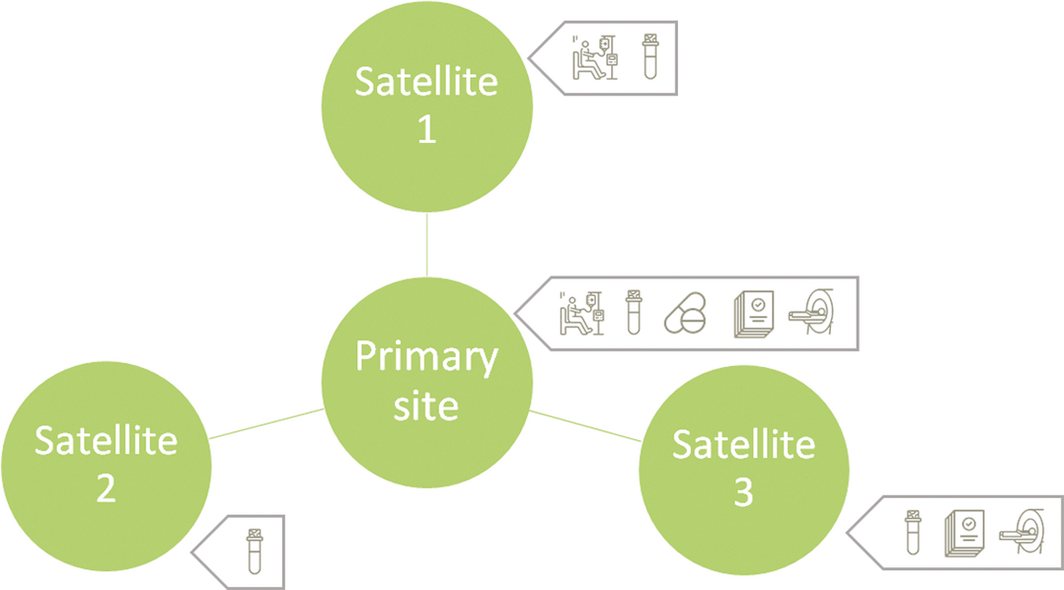
The Clinical Oncology Society of Australia model10 was used as a foundation template for the structure and relational concepts (Box). Importantly, the model recognises the potential for heterogeneity across trials and sites, rather than taking a one‐size‐fits‐all approach. Different sites may perform different roles in different trials; for example, taking blood samples, delivering chemotherapy or medication, trial documentation, or imaging. The model has been used in several teletrials enrolling across Australia.13
An important element was the development of standard operating procedures. Initially developed by Queensland Health, these were modified not only for use in Victoria but for consideration as the basis for national standard operating procedures for teletrials.
In developing the teletrial framework, input and feedback were sought from stakeholders in cancer clinical trials. These included contract research organisations; the biopharmaceutical industry; principal investigators; Victorian regional sites through the Regional Trials Network; Human Research Ethics Committees (HRECs); local government through the Victorian Department of Health and Human Services; funding bodies; and consumers.
Teletrial supervision plan
The teletrial supervision plan (https://www.viccompcancerctr.org/what-we-do/clinical-trials-expansion/teletrials/resources/) contains detailed documentation regarding specific trial conduct and responsibilities, in particular the specific responsibilities of investigators at each site within the trial cluster, and which elements of the trial, imaging and drug delivery are performed at each site. Some trials may have all elements delivered at the local site, others may have most delivered locally but specialist services (eg, radionuclide therapy) at the central site. The supervision plan is site‐, trial‐ and time‐specific. It also includes standard operating procedures, Good Clinical Practice training, monitoring, HREC submissions and oversight, trial‐specific indemnity and contracts, plans for safety reporting, investigational product storage and delivery logistics, and details on joint consultations using telehealth, payments, data entry and document management. The supervision plan is generated in agreement with the principal investigators at the metropolitan and regional sites before the study, but with regular review and modifications as required to allow refinement as needed.
Indemnity and legal coverage
Teletrial indemnity and legal coverage for trial activities are frequently raised concerns. This can be documented in detail in the supervision plan but is no different for a teletrial over other models. The VCCC commissioned a draft clinical trial activity agreement for investigator‐initiated studies including a teletrial component (https://www.viccompcancerctr.org/what-we-do/clinical-trials-expansion/teletrials/resources/).
Governance and ethics approval
As with any clinical trial, ethics approval is required, usually through a human research ethics application. Local research governance office requirements will not vary, with local assessment of trial capability, including managing potential toxicities. The principal investigator remains responsible for ethics submissions and communication with HRECs. Each site will obtain local governance approval and be listed on the clinical trial notification form. The process for reporting on safety events remains as per standard of care.
Proof of concept
Using the framework described, a teletrial has commenced between a metropolitan site and two regional sites in Victoria. The first teletrial site patient was recruited in November 2018 and at 24 July 2020, 91 patients had been successfully recruited in regional centres, with all their trial activity delivered locally. Metropolitan and teletrial sites have successfully undergone study monitoring and further model evaluation is underway.
Model evaluation
Although the teletrial model is not an intervention in itself, merely a method of trial delivery, it is important to its widespread adoption at a new standard of care that there are benefits to all stakeholders. An ongoing health economic evaluation will evaluate costs associated with the teletrial (and potential savings), patient time and travel estimates, and qualitative assessment of patient and clinician participation in a teletrial to detail possible benefits. In addition, consumer and clinician perspectives studies are planned.
A leading contract research organisation was commissioned to undertake an independent process review of the first teletrial to evaluate the model. No major protocol deviations were found in comparison to a conventional site in this pilot study.
Potential benefits of a teletrial
Teletrials provide a mechanism to enable disadvantaged patients to participate in clinical trials. They may also provide wider benefits14 beyond those experienced by individual participants, including:
- improved recruitment: as trials have a wider reach, they may recruit faster, translating new interventions to patients faster in a real‐world setting;
- improved retention: making trial access easier may improve participant retention, reduce missing data and accelerate trial objectives;
- increased diversity: teletrials may allow for easier access to the increasingly specific and rare subsets of cancer trial populations;
- professional development: partnerships developed from the trial network may translate into improved routine clinical care delivery and opportunities; and
- trial cost‐savings: while teletrial costs will be evaluated, the resources required to open a teletrial may be reduced, as much of the trial data will be retained at the primary site.
Potential or perceived risks
Some of the possible risks raised with the authors by stakeholders have been addressed above, including indemnity, legal and governance issues. Others may include:
- Clinical safety of new treatments in a regional setting: while a trial may involve a novel therapy, toxicities are often managed on a patient's return home to their regional site. Involving local clinicians in the trial may actually reduce this risk through better education regarding managing novel therapies.
- Clinical trial expertise: most regional sites already have extensive experience in clinical trials, and Good Clinical Practice training is standard.
- Trial monitoring challenges: with rapidly increased use of secure digital platforms, monitoring is increasingly becoming a remote activity, so location is not a barrier.
We acknowledge that this model represents a change to usual process and therefore requires assessment, transparency and strong support and advocacy to overcome barriers to clinical trial participation.15
Teletrials do more than just meet trial metrics. They develop synchronous partnering between regional and metropolitan centres, allowing regional equity of access to cutting edge diagnostics and therapeutics while maintaining patients’ care delivery closer to home, thereby avoiding disruption to family, work and social interactions.
Competing interests
No relevant disclosures.
Acknowledgements
We acknowledge the input of Hannah Cross, Alana Donaldson, Dish Herath, Kathleen Wilkins, Paul Baden and Sabe Sabesan in the development and implementation of the teletrials framework.
References
- Australian Bureau of Statistics. 4102.0 ‐ Australian Social Trends, April 2013. The ‘average’ Australian. https://www.abs.gov.au/AUSSTATS/abs@.nsf/Lookup/4102.0Main+Features30April+2013 (viewed July 2020).
- Australian Institute of Health and Welfare. Australia's health 2018 (Australia's Health Series No. 16; Cat No. AUS 221). Canberra: AIHW, 2018. https://www.aihw.gov.au/getmedia/7c42913d-295f-4bc9-9c24-4e44eff4a04a/aihw-aus-221.pdf.aspx?inline=true (viewed July 2020).
- Australian Institute of Health and Welfare. Cancer in Australia 2019 (Cancer Series No. 119). Canberra: AIHW; 2019. https://www.aihw.gov.au/getmedia/8c9fcf52-0055-41a0-96d9-f81b0feb98cf/aihw-can-123.pdf.aspx?inline=true (viewed July 2020).
- Fox P, Boyce A. Cancer health inequality persists in regional and remote Australia. Med J Aust 2014; 201: 445–446. https://www.mja.com.au/journal/2014/201/8/cancer-health-inequality-persists-regional-and-remote-australia
- Coory MD, Ho T, Jordan SJ. Australia is continuing to make progress against cancer, but the regional and remote disadvantage remains. Med J Aust 2013; 199: 605–608. https://www.mja.com.au/journal/2013/199/9/australia-continuing-make-progress-against-cancer-regional-and-remote
- Grimison P, Phillips F, Butow P, et al. Are visiting oncologists enough? A qualitative study of the needs of Australian rural and regional cancer patients, carers and health professionals. Asia Pac J Clin Oncol 2013; 9: 226–238.
- Francis HM, Clarke KA, Steer CB, et al. Attitudes of advanced Australian medical oncology trainees to rural practice. Asia Pac J Clin Oncol 2008; 4: 34–41.
- Coleman MP, Quaresma M, Berrino F, et al. Cancer survival in five continents: a worldwide population‐based study (CONCORD). Lancet Oncol 2008; 9: 730–756.
- Murphy C, Sabesan S, Steer C, et al. Oncology service initiatives and research in regional Australia. Aust J Rural Health 2015; 23: 40–48.
- Sabesan S, Zalcberg J. Telehealth models could be extended to conducting clinical trials—a teletrial approach. Eur J Cancer Care 2018; 27: e12587.
- Unger JM, Cook E, Tai E, et al. The role of clinical trial participation in cancer research: barriers, evidence, and strategies. Am Soc Clin Oncol Educ Book 2016; 35: 185–198.
- Sabesan S, Zalcberg J. Telehealth. N Engl J Med 2018; 378: 402.
- Sabesan S, Zalcberg J, Underhill C, et al. Implementation of the Australasian Teletrial Model: lessons from practice. Asia Pac J Clin Oncol 2019; 15 (Suppl 8): 3–14.
- Clinical Trials Transformation Initiative. Decentralized clinical trials. https://www.ctti-clinicaltrials.org/projects/decentralized-clinical-trials (viewed July 2020).
- Unger JM, Vaidya R, Hershman DL, et al. Systematic review and meta‐analysis of the magnitude of structural, clinical, and physician and patient barriers to cancer clinical trial participation. J Nat Cancer Inst 2019; 111: 245–255.
Linked content
-
MJA Podcast: Associate Professor Ian Collins
-
InSight+: Teletrials closing the geographic gap in cancer mortality
Provenance: Not commissioned; externally peer reviewed.
Interpreting Australian Stillbirth Rate Trends: Implications for Surveillance and Continuous Quality Improvement
Aleena M. Wojcieszek, Kirstine Sketcher-Baker, Christine Andrews, Michael Coory, Imogen Kettle, Melissa Malivoire, David Ellwood, Vicki Flenady
Paracetamol in Pregnancy: Uncertain Evidence, Certain Consequences
David J. Tunnicliffe, Miranda Cumpston, Debra Kennedy, Margie Danchin, Armando Teixeira-Pinto
Fatty Liver Disease in Australia: A Narrative Review on the Epidemiology, Natural History, Prognostication and Management in People With Metabolic Dysfunction
Karl Vaz, Daniel Clayton-Chubb, William W. Kemp, Stuart K. Roberts, Ammar Majeed
Birth prevalence, clinical sequelae, and management of congenital cytomegalovirus infections in Australia, 1999–2023: a national prospective study
Ece Egilmezer, Suzy M Teutsch, Carlos Nunez, Stuart T Hamilton, Adam W Bartlett, Pamela Palasanthiran, Elizabeth J Elliott, William D Rawlinson
The number of cancer‐related deaths that could be attributable to spatial disparities in survival in Australia, 2010–2019: a retrospective population‐based cohort study
Charlotte K Bainomugisa, Jessica Cameron, Paramita Dasgupta, Peter Baade
Mandatory research projects during medical specialist training in Australia and New Zealand
Paulina Stehlik, Caitlin Brandenburg, David A Henry