




Volume 213 - Issue 6
Paediatric facial burns from oleander leaves
Authors: Sarah Oudtshoorn, Sanchita Gera and Parshotam Gera
Med J Aust 2020; 213 (6): 265-265.e1. || doi: 10.5694/mja2.50746
Published online: 21 September 2020
Published online: 21 September 2020
A 5-year-old girl sustained
partial thickness facial burns
from oleander leaves that she applied as pretend make-up
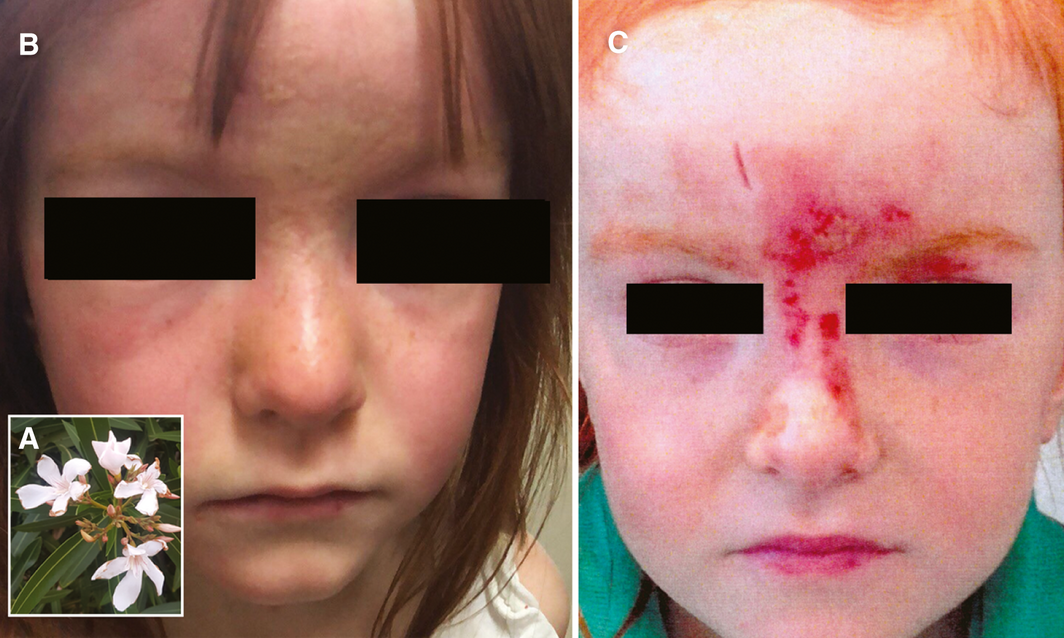
A 5‐year‐old girl sustained partial thickness facial burns from oleander leaves (Nerium oleander) (Figure, A) that she applied as pretend make‐up. Oleander causes cardiac toxicity when ingested, but the documentation of chemical burns has been rare.1,2
In this case, skin erythema occurred initially (Figure, B). The next morning, blistering and swelling developed (Figure, C). In the emergency department, her vitals and electrocardiogram were normal.
Her burns care included saline gauze compresses followed by emollient, and a daily soapy wash. Her recovery was excellent, with no infection or surgical intervention required.
Oleander can be found throughout Australia. If skin contact occurs, the area should be washed promptly.
Competing interests
No relevant disclosures.
Acknowledgements
We thank Tania McWilliams (Burns Clinical Nurse Consultant, Perth Children's Hospital) for assisting in collecting the clinical photography for this article.
References
- Bakkali H, Ababou M, Nassim Sabah T, et al. Les brulures chimiques par le laurier rose. Ann Burns Fire Disasters 2010; 23: 128–130.
- Taskin O, Belli F, Acikalin A, Rana Disel N. Add oleander to your list of corrosives. Turk J Emerg Med 2019; 19: 115–116.
‘Once Bitten’: A Case of Tetanus Following Snakebite in Australia
Adrian A. S. Doherty, Naomi N. E. Clarke, Sarah Fletcher, Sarah Huffam, Camille V. Awburn, Eugene Athan
Epidemiology and Quality of Care for Aboriginal and Torres Strait Islander Peoples Treated by Emergency Medical Services for Stroke in Victoria, Australia: Retrospective Analysis of Linked Data
Candice Menezes, Ziad Nehme, Luke J. Burchill, Tegwyn McManamny, Angela Dos Santos, Michelle Crilly, Luke P. Dawson, Benjamin Clissold, David Anderson, Emily Nehme
Intranasal Adrenaline Use for the Management of Insect Venom-Induced Anaphylaxis
Thomas J. Young, Wilhelmina R. F. Johnson, Braydon L. Pennington, Troy Wanandy, Wun Y. Lau, Thanh-Thao A. Le
Gabapentinoid Poisoning Presentations to Victorian Emergency Departments: A 15-Year Trend Analysis
Bishaal Tej Gurung, Amy McNeilage, Angus Skeen, Tina Lam, Joanna F. Dipnall, Jane Hayman, Suzanne Nielsen, Ting Xia
They Brought the Hospital to Me
Hugh N. Burrill
Predictors of Ambulance Transport to Hospital for Older People Living in Tasmanian Aged Care Facilities: A Retrospective Cohort Study
Sharon Andrews, Pieter F. Fouche, Belinda Flanagan, Michael McDermott, Melanie Greenwood