




Volume 213 - Issue 5
Citation metrics for appraising scientists: misuse, gaming and proper use
Authors: Hamidreza Karimi‐Sari and Mohammad Saeid Rezaee‐Zavareh
Med J Aust 2020; 213 (5): 238-239.e1. || doi: 10.5694/mja2.50739
Published online: 7 September 2020
Published online: 7 September 2020
To the editor: Ioannidis and Boyack discussed misuse of and gaming mechanisms for citation metrics in the publication records of scientists.1 Studies have suggested some other limitations regarding citation‐based bibliometric indices in the evaluation of articles2 or journals.3 A recent study showed the confounding effect of highly cited items on impact factor calculation.3 Previously, we measured a considerable effect for a series of highly cited articles affiliated with the Institute for Health Metrics and Evaluations (IHME; University of Washington, Seattle) on the impact factor of The Lancet.4 Here, we evaluate the impact of these articles on the researchers’ quantitative bibliometric indices.
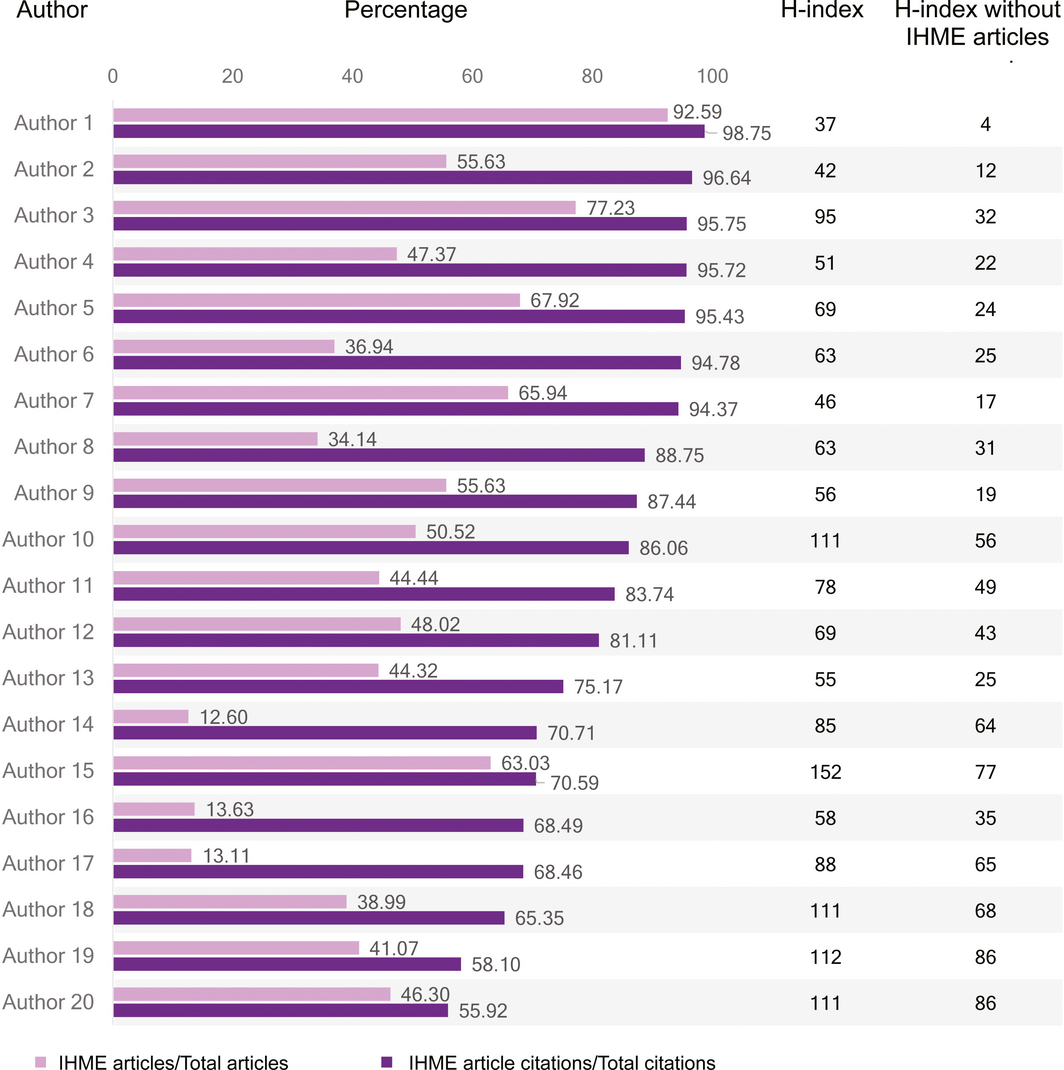
Using the Scopus (Elsevier) database, we identified the 20 authors with the greatest involvement in IHME‐affiliated articles. We then extracted and calculated the scientometric indices (H‐index, total number of published items, and citations) of these authors, with and without their IHME‐affiliated articles.
The mean (standard deviation) percentage of IHME‐affiliated papers for the authors was 47.5% (20.6%) of their total publications, leading to 81.6% (13.9%) of their total citations. Further, 49.6% (18.3%) of all authors’ H‐indices were related to IHME‐affiliated papers (Box). Accordingly, collaboration in HME‐affiliated articles can easily provide a large number of citations for authors and increase their H‐index.
We believe that scientometric indices based on the citation count may require correction to avoid the confounding effect of such highly cited items. Further investigations considering all IHME collaborators are needed for a better understanding of the IHME effect on scientometric indices. We recognise that IHME‐affiliated papers are but a sample; the effect of other similar series of highly cited articles on bibliometric indices requires further evaluation.
Competing interests
Hamidreza Karimi‐Sari has participated in IHME‐affiliated articles as a collaborator.
References
- Ioannidis JPA, Boyack KW. Citation metrics for appraising scientists: misuse, gaming and proper use. Med J Aust 2020; 212: 247–249. https://www.mja.com.au/journal/2020/212/6/citation-metrics-appraising-scientists-misuse-gaming-and-proper-use
- Aroeira RI, M ARBC. Can citation metrics predict the true impact of scientific papers? FEBS J 2020; 287: 2440–2448.
- Lei L, Sun Y. Should highly cited items be excluded in impact factor calculation? The effect of review articles on journal impact factor. Scientometrics 2020; 122: 1697–1706.
- Rezaee‐Zavareh MS, Karimi‐Sari H. Effect of published papers by the Institute for Health Metrics and Evaluation on the impact factor of The Lancet journal. J Investig Med 2020; 68: 1203–1204
Linked content
-
MJA Perspective: Citation metrics for appraising scientists: misuse, gaming and proper use
Interpreting Australian Stillbirth Rate Trends: Implications for Surveillance and Continuous Quality Improvement
Aleena M. Wojcieszek, Kirstine Sketcher-Baker, Christine Andrews, Michael Coory, Imogen Kettle, Melissa Malivoire, David Ellwood, Vicki Flenady
Paracetamol in Pregnancy: Uncertain Evidence, Certain Consequences
David J. Tunnicliffe, Miranda Cumpston, Debra Kennedy, Margie Danchin, Armando Teixeira-Pinto
Fatty Liver Disease in Australia: A Narrative Review on the Epidemiology, Natural History, Prognostication and Management in People With Metabolic Dysfunction
Karl Vaz, Daniel Clayton-Chubb, William W. Kemp, Stuart K. Roberts, Ammar Majeed
Birth prevalence, clinical sequelae, and management of congenital cytomegalovirus infections in Australia, 1999–2023: a national prospective study
Ece Egilmezer, Suzy M Teutsch, Carlos Nunez, Stuart T Hamilton, Adam W Bartlett, Pamela Palasanthiran, Elizabeth J Elliott, William D Rawlinson
The number of cancer‐related deaths that could be attributable to spatial disparities in survival in Australia, 2010–2019: a retrospective population‐based cohort study
Charlotte K Bainomugisa, Jessica Cameron, Paramita Dasgupta, Peter Baade
Mandatory research projects during medical specialist training in Australia and New Zealand
Paulina Stehlik, Caitlin Brandenburg, David A Henry