




Volume 212 - Issue 4
Advancing women in medical leadership
Authors: Mariam Mousa, Jacqueline A Boyle and Helena J Teede
Med J Aust 2020; 212 (4): 190-190.e1. || doi: 10.5694/mja2.50475
Published online: 2 March 2020
Published online: 2 March 2020
In reply
In reply: We support the need for action to enable women to attain their career goals in medical leadership and agree with the observations of Learoyd and Holmes‐Walker. Research is providing emerging insights into the drivers of inequity, including challenges in capacity and perceived capability and credibility that continue to hinder women's career progression, even in largely female fields such as endocrinology.1,2
Unconscious or implicit bias is proposed as a contributor to inequity in health care leadership. While we acknowledge Keane's comments on the lack of formal evidence regarding implicit bias, based on research,2,3,4,5 personal and shared experiences of hundreds of women through our leadership programs and from cross‐sector reports,2 unconscious or implicit bias appears to permeate the lived experiences of women in many fields including medicine. Here, we firmly agree and indeed propose that more research is needed to understand the extent, nature and impact of this bias.3,4
Learoyd and Holmes‐Walker refer to the feminisation of the endocrinology workforce in Australia, with 80% of advanced trainees but only 20% of department heads being female. The Endocrine Society of Australia has made efforts to promote equity in leadership — 40% of councillors are now women, and after intervention strategies, numbers of female speakers at its seminars have increased. However, for effective change, systems and processes are needed alongside individual champions to raise awareness, build capacity and support perceived capability and credibility for leadership.1
Overall, these issues strengthen the importance of evidence‐based research to further understand the extent and nature of bias, including the underlying beliefs and determinants and how best to address these at individual and organisational and systems levels to support equity for all (as noted by Keane).3,5 As we outlined in our original article,1 the Athena SWAN (Scientific Women's Academic Network) charter6 has shown that organisational and systems level change, along with measurement and transparent reporting, is necessary for progress towards equity in academia. A similar initiative in health and medicine is needed to determine comparable strategies effective in enabling equity, including in areas such as access to parental leave for all parents.
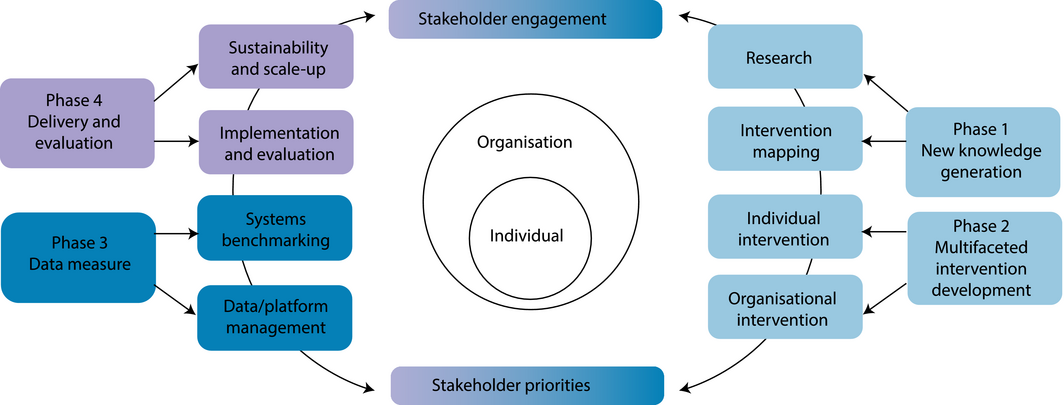
We are leading a Monash Partners initiative to advance women in health care leadership, leveraging expertise across health professionals, health services, professional colleges and governments. With strong governance, a focus on co‐design, implementation research and translation (Box), we can expand knowledge and deliver on the joint vision of our partnership to optimise gender equity in medicine and health care.
Competing interests
No relevant disclosures.
Acknowledgements
Mariam Mousa is funded by a Graduate Research Industry Partners scholarship from Monash University in partnership with Epworth Health. Helena Teede is a Fellow of the National Health and Medical Research Council of Australia.
References
- Teede HJ. Advancing women in medical leadership. Med J Aust 2019; 211: 392–394. https://www.mja.com.au/journal/2019/211/9/advancing-women-medical-leadership
- Bohnet I. What works: gender equality by design. Cambridge, MA: Harvard University Press, 2018.
- Madsen SR, Andrade MS. Unconscious gender bias: implications for women's leadership development. J Leadership Studies 2018; 12: 62–67.
- Warning R, Buchanan FR. An exploration of unspoken bias: women who work for women. Gender Manage 2009; 24: 131–145.
- Pritlove CJ, Juando‐Prats C, Ala‐leppilampi K, Parsons JA. The good, the bad, and the ugly of implicit bias. Lancet 2019; 393: 502–504.
- Ovseiko PV, Chapple A, Edmunds LD, Ziebland S. Advancing gender equality through the Athena SWAN Charter for Women in Science: an exploratory study of women's and men's perceptions. Health Res Policy Syst 2017; 15: 12.
Capturing the Benefits of Clinical Quality Registries
Taryn Bessen, Stephen McDonald
Medical Colleges Have an Obligation to Ensure Full Participation in Clinical Quality Registries
Thomas J. Hugh
Getting on the Same Page: Why Australia Needs a National Maternity Early Warning System (MEWS) Chart
Briony A. Cutts, Lucy Bowyer, Nisha Khot, Sandra Lowe, Stefan C. Kane
Data for Equity: Can Linked Administrative Data Inform Pathways to More Equitable Child Health?
Sarah Gray, Shuaijun Guo, Meredith O'Connor, Elodie O'Connor, Katrina Williams, Hannah Badland, Susan Woolfenden, Josie Dickerson, Gerry Redmond, Marnie Downes, Sharon R. Goldfeld
Specialty College Selection: Why Change is Critical to Support a Future Rural Workforce
Matthew R. McGrail, Jenny May AM, Katherine Logan
Differentiated and simplified oral HIV pre‐exposure prophylaxis (PrEP) models hold the key to virtually eliminating HIV transmission in Australia by 2030
Tyson Arapali, Sarah Warzywoda, Anthony K J Smith, Curtis Chan, Timothy R Broady, Erin Sullivan, Catherine MacPhail, Mohamed A Hammoud, Alexander Dowell‐Day, Benjamin R Bavinton