




Volume 212 - Issue 10
One disease, two vaccines: challenges in prevention of meningococcal disease
Authors: Cyra Patel, Clayton K Chiu, Frank H Beard, Nigel W Crawford and Kristine Macartney
Med J Aust 2020; 212 (10): 453-456.e1. || doi: 10.5694/mja2.50567
Published online: 13 April 2020
Published online: 13 April 2020
Correction(s) for this article:
Erratum | Published online: 21 September 2020
Gaps in availability of both meningococcal ACWY and B vaccines exist for high risk groups
Invasive meningococcal disease (IMD) is a serious disease and an emotive public health issue in Australia. In the early 2000s, IMD case numbers declined nationally by about 80%, from 688 in 2002 to 149 in 2013,1 due to a drop in serogroup C and B disease. The decline in serogroup C disease followed the comprehensive childhood meningococcal C vaccination program — free vaccination was available up to age 19 years — introduced in 2003.2 Simultaneously, but without clear cause in the absence of vaccination, meningococcal B (MenB) disease declined slowly from 1.49 cases per 100 000 population in 2003 to 0.47 in 2015 (293 and 112 cases respectively).3 Overall, the IMD incidence rose again after 2014, driven mainly by the emergence of serogroup W and, to a lesser extent, serogroup Y.1,4 Most serogroup W strains are close variants of the virulent ST‐11 clone initially identified in the United Kingdom and South America in 2009, which was associated with more frequent atypical clinical presentations, greater severity and increased mortality.1 Although the emergence of serogroups W and Y was a game changer, serogroup B still accounted for about half of all IMD cases in Australia between 2016 and 2018.4
Compared with some other vaccine‐preventable diseases, IMD is relatively rare, affecting about one in every 100 000 Australians, equating to an average of 250 cases per year between 2014 and 2018.1,4 However, the case fatality rate is high, and around 10–30% of survivors experience long term sequelae.3,5 Although IMD can occur at any age, it is more common in children aged less than 2 years (especially those aged < 12 months) and older adolescents (Box 1). Aboriginal and Torres Strait Islander (hereafter respectfully referred to as Indigenous) children aged up to 14 years are also disproportionately affected compared with non‐Indigenous children (Box 2). For example, rates of serogroup W IMD in Indigenous children were more than 30‐fold higher compared with non‐Indigenous children of the same age during 2016–2018 (Box 2). People with certain medical conditions also have a high risk of IMD.6 These conditions include asplenia; complement deficiency, which in some types the risk is up to 10 000 times greater than in the general population;7 and use of eculizumab, which is a monoclonal antibody directed against complement and is used for treating paroxysmal nocturnal haemoglobinuria and atypical haemolytic uraemic syndrome.
Increased use of quadrivalent meningococcal conjugate vaccines
Three brands of quadrivalent meningococcal conjugate (MenACWY) vaccines are available in Australia: Menactra (Sanofi), Menveo (GlaxoSmithKline) and Nimenrix (Pfizer). These quadrivalent vaccines include a capsular polysaccharide from each ACWY serogroup conjugated to a carrier protein, superseding the less immunogenic polysaccharide‐only vaccines previously used. The rapid rise of serogroups W and Y disease prompted all states and territories to fund MenACWY vaccination programs in 2017 and 2018 as an outbreak response.8 These programs varied but predominantly targeted adolescents aged 15–19 years, aiming to both directly prevent disease and to interrupt community transmission of meningococci through reduced acquisition of nasopharyngeal carriage, which is most prevalent in this age group.9,10 Some jurisdictions also implemented time‐limited vaccination programs covering select age groups, from infancy up to older adolescence, to control serogroup W outbreaks. The most notable of these outbreaks began in September 2017 in the Northern Territory and spread to nearby communities in central Australia, including regions in Western Australia, Queensland and South Australia. Indigenous children aged less than 10 years living in remote communities were primarily affected, with 19 cases within a few months.11
Meningococcal B vaccine use in Australia
The modes of transmission, pathogenesis and treatment of serogroup B IMD are the same as for IMD caused by other serogroups, although the case fatality rate appears lower for serogroup B (6.9%) than for serogroups W, C and Y (12.8%, 12.0% and 10.8% respectively).12 However, the development of a vaccine against serogroup B disease was problematic for decades because serogroup B capsular polysaccharide is cross‐reactive with human tissues (an autoantigen) and thus poorly immunogenic.13 Two MenB vaccines, developed using novel recombinantly derived protein antigens common to many serogroup B strains, are now available in Australia: Bexsero (GlaxoSmithKline), since 2013, and Trumenba (Pfizer), since 2017. Trumenba is only registered for use from 10 years of age, whereas Bexsero can be used from 6 weeks of age. Both MenB vaccines have a high cost (around $100 per dose) and require multiple doses. Bexsero also causes higher rates of fever in young children than other vaccines included in the National Immunisation Program (NIP), necessitating the use of prophylactic paracetamol around the time of immunisation.6
Data on the benefits of MenB vaccine use are gradually accumulating, predominantly from the UK, which is the only country to have formally evaluated an ongoing funded population‐based program. Infants in the UK have been offered a three‐dose course of Bexsero (scheduled at ages 2, 4 and 12 months) since 2015. New data from the UK over 3 years estimate vaccine effectiveness against serogroup B IMD to be 52.7% (95% CI, −33.5 to 83.2) for a two‐dose primary schedule for infants, and 59.1% (95% CI, −31.1 to 87.2) for a two‐dose primary schedule followed by a booster dose at one year.14 However, Bexsero does not appear to have an impact on nasopharyngeal carriage of serogroup B,9 which implies that herd immunity (indirect protection in unvaccinated individuals) would be limited or absent despite population‐based vaccination.9 In addition, for both vaccines, protection against only around three‐quarters of all circulating MenB strains is predicted, based on in vitro assays.15
To date, the use of MenB vaccines in Australia has been limited in the absence of NIP funding. In October 2018, in the context of higher serogroup B IMD incidence rates compared with other parts of Australia, the South Australian government introduced the only state‐funded MenB vaccination program for young children, expanding to adolescents in February 2019.8 In 2020, a population‐level study of adolescent MenB vaccination in the Northern Territory will commence to explore its impact on gonorrhoea — a high incidence sexually transmitted disease caused by the related organism Neisseria gonorrhoea — as well as on serogroup B IMD (Helen Marshall, Professor in Vaccinology and National Health and Medical Research Council Practitioner Fellow, Robinson Research Institute, University of Adelaide, Australia, personal communication, January 2020).
Assessment and introduction of meningococcal vaccines to Australia's National Immunisation Program
Both equity and cost‐effectiveness are important considerations when approaching decision making regarding vaccine incorporation into immunisation programs. To be added to the Australian NIP, vaccines require a comprehensive assessment and must be recommended as cost‐effective by the Pharmaceutical Benefits Advisory Committee (PBAC); this is based on economic modelling, typically undertaken by the vaccine manufacturer.16 With a low IMD incidence (one per 100 000), relatively small numbers of deaths, and trends in serogroup incidence being difficult to predict, the accurate assessment of the cost‐effectiveness of both types of meningococcal vaccines (MenACWY and MenB) has been challenging. Low incidence rates have meant reliance on immunologic correlates of protection to predict vaccine impact (randomised placebo‐controlled efficacy studies are not feasible for such rare outcomes) and a limited number of post‐market vaccine effectiveness estimates. Other key uncertainties include the duration of protection and the magnitude of any herd protection effect, particularly for MenB vaccines, for which evidence is showing that there is no effect on nasopharyngeal meningococcal carriage.9 These uncertainties, together with the high cost of the MenB vaccines in particular, provide challenges for the value for money assessment necessary to underpin vaccine introduction into long term programs.
In 2018, the MenACWY vaccine Nimenrix replaced the meningococcal serogroup C vaccine on the NIP at 12 months of age, and was also added to the NIP for use in a single birth cohort of adolescents aged 14–16 years from early 2019, replacing jurisdictionally funded programs.8 This is expected to provide direct protection to vaccinated individuals as well as some indirect protection to unvaccinated people over time.17 The potential to fund the MenACWY vaccine for certain high risk groups with underlying medical conditions through the NIP has also been flagged in a recent positive PBAC recommendation,18 which is under active consideration by the Australian Government.
The Bexsero MenB vaccine was assessed by the PBAC on three occasions between 2013 and 2015, but was deemed as not being cost‐effective at the manufacturer's proposed price.19 In November 2019, following another manufacturer application, the PBAC recommended the NIP inclusion of Bexsero for Indigenous infants (with a catch‐up to 2 years of age) and for anyone with certain medical conditions (asplenia, complement deficiency, and eculizumab treatment). However, once again, the use of the vaccine in a broader population‐based program for infants and adolescents was not considered cost‐effective.20 The implementation of these recommendations is under active consideration by the Australian Government.
Gaps in the prevention of meningococcal disease in Australia
The Australian immunisation handbook recommends that any person who wants to protect themselves against invasive meningococcal disease can receive MenACWY and MenB vaccines from as early as 6 weeks of age.6 Box 3 shows groups particularly recommended for vaccination based on their higher risk of disease, compared with current and anticipated funded meningococcal vaccine programs.
New proposed and existing funded programs are a substantial achievement and will provide protection to many individuals most at risk from vaccine‐preventable meningococcal strains. However, some equity gaps remain. It will take time to accrue the benefits of reduced MenACWY disease incidence and disease transmission across the population when vaccinating only at ages one and 15 years, especially without including all infants in the NIP‐funded program. It is possible that the disparity in IMD rates between Indigenous and non‐Indigenous children may persist for years, particularly for serogroup B disease, in the absence of herd immunity and of an adolescent program funded by the NIP. Assessing program impact on disease, particularly in jurisdictions where wider populations did, or continue to, receive state‐funded vaccines (against MenACWY or MenB disease), such as Western Australia, Tasmania and South Australia,8 is essential to evaluate evidence of benefit. The remaining access gaps are very challenging to address for high cost vaccines that are not offered at cost‐effective prices by the manufacturer. Other initiatives, such as ensuring that health services fund vaccination of persons living with human immunodeficiency virus and of at‐risk laboratory workers (two groups not included in the NIP), and addressing the social determinants of health that underpin high rates of meningococcal disease (and other vaccine‐preventable diseases), are also important.21
Conclusion
Australia has progressively implemented funded vaccination programs for various high risk groups using MenACWY and MenB vaccines over the past 5 years. The anticipated expansion of NIP funding to include medical at‐risk groups for both vaccines and to include young Indigenous children for MenB vaccine, in addition to established MenACWY programs, should be effective over time to protect those most at risk of disease. Close monitoring of emerging data on the duration of vaccine protection from Australia and internationally is needed, particularly for individuals with underlying medical conditions whose risk is enduring. It remains challenging that for one disease, IMD, we must use two vaccines; while at least one pentavalent vaccine (MenABCWY) is under development, it is years away from use, and the assessment of cost‐effectiveness is equally uncertain. This rare but deadly disease will continue to challenge; clinicians should remain aware and discuss vaccination options against both MenB and MenACWY disease with their patients.
Box 1 – Invasive meningococcal disease (IMD) notification rates by serogroup and age group (Australia, 2016–2018)
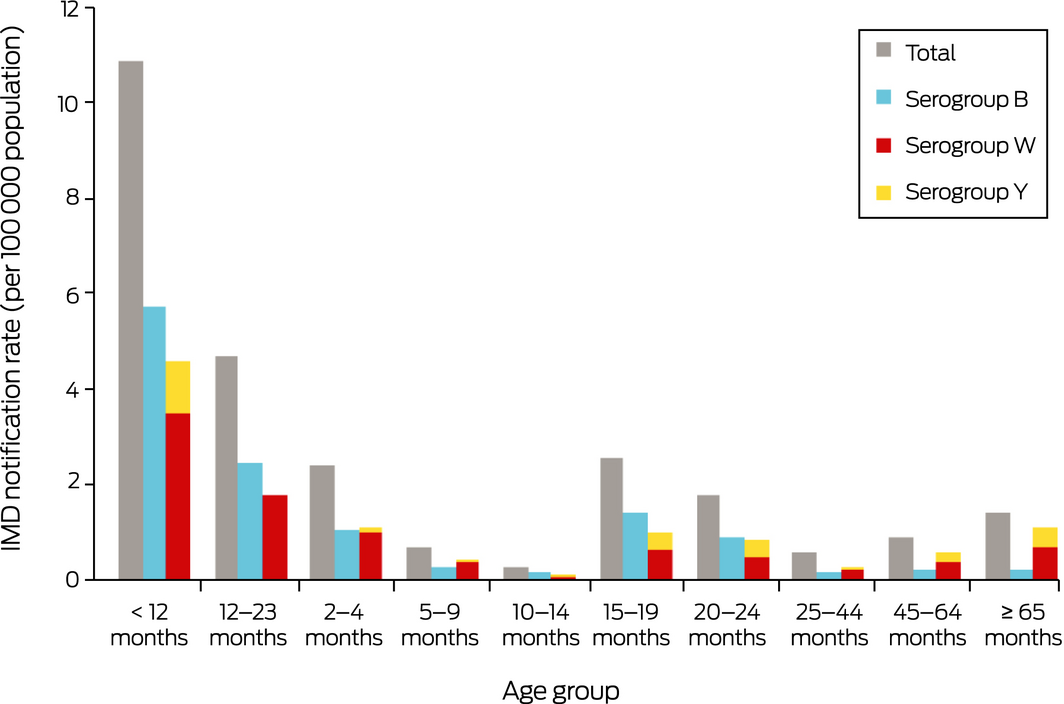
The graph shows the rate of cases of IMD notified to the National Notifiable Diseases Surveillance System between 1 January 2016 and 31 December 2018. The total cases include all notified cases of IMD, including serogroups B, C, E, W, Y and unknown serogroup. There were no cases of serogroup A in this period.
Box 2 – Average annual notification rates of invasive meningococcal disease (IMD) for Aboriginal and Torres Strait Islander people compared with non‐Indigenous people, by age group and serogroup (Australia, 2016–2018)
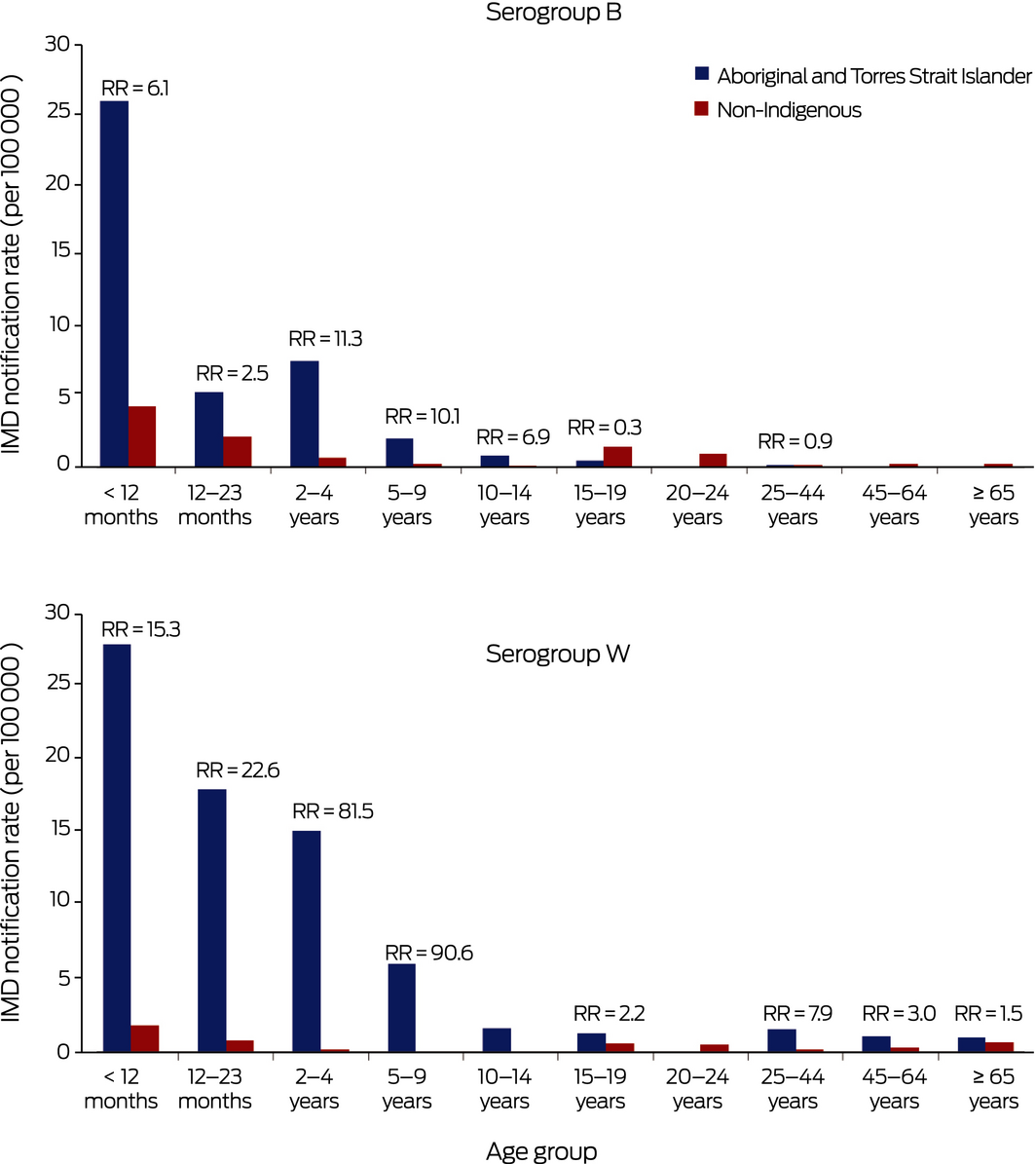
RR = rate ratio. The graph shows the rate of cases of serogroup B and W IMD notified to the National Notifiable Diseases Surveillance System between 1 January 2016 and 31 December 2018.
Box 3 – Australian recommendations for meningococcal vaccination and funded programs*†
|
Recommendations |
Funded programs for MenB vaccines‡ |
Funded programs for MenACWY vaccines‡ |
|||||||||||||
|
|
|||||||||||||||
|
Overall AIH recommendation |
|
|
|||||||||||||
|
Any person who wants to protect themselves against invasive meningococcal disease can receive MenACWY and MenB vaccines from as early as 6 weeks of age |
|
|
|||||||||||||
|
Specific AIH recommendations for high risk groups§ |
|
|
|||||||||||||
|
All individuals in particular age groups (6 weeks to 4 years and 15–19 years) |
State/territory:
|
NIP:
|
|||||||||||||
State/territory:
|
|||||||||||||||
|
Aboriginal and Torres Strait Islander people (6 weeks to 19 years of age) |
NIP:
|
NIP:
|
|||||||||||||
State/territory:
|
State/territory:
|
||||||||||||||
|
High risk due to medical condition (asplenia/hyposplenia, complement deficiency, eculizumab use, HIV, post‐HSCT; all people aged ≥ 6 weeks) |
NIP:
|
NIP:
|
|||||||||||||
Other:
|
Other:
|
||||||||||||||
|
Other risk factors (young adults aged 20–24 years who smoke or live in close quarters; eg, military barracks or university residential accommodation) |
Nil (self‐funded) |
Nil (self‐funded) |
|||||||||||||
|
Laboratory workers at risk |
Nil (may be employer‐funded) |
Nil (may be employer‐funded) |
|||||||||||||
|
Travellers to endemic areas |
Nil (self‐funded) |
Nil (self‐funded) |
|||||||||||||
|
|
|||||||||||||||
|
AIH = Australian immunisation handbook; HIV = human immunodeficiency virus; HSCT = haematopoietic stem cell transplant; NHMRC = National Health and Medical Research Council; MenACWY = serogroups A, C, W and Y meningococci; MenB = serogroup B meningococcus; NIP = National Immunisation Program. * Adapted from the AIH6 and other referenced sources. † Note that the number of doses recommended varies by specific group — refer to the AIH for details. ‡ As of 17 January 2020. § Recommendations are for both MenACWY and MenB vaccines. ¶ Helen Marshall, Professor in Vaccinology and NHMRC Practitioner Fellow, Robinson Research Institute, University of Adelaide, Australia, personal communication, January 2020. |
|||||||||||||||
Competing interests
Cyra Patel, Clayton Chiu, Frank Beard and Kristine Macartney are employed at the National Centre for Immunisation Research and Surveillance, which receives funding from the Australian Government Department of Health for contracted work to support ATAGI. No specific funding was provided for the drafting or publication of this manuscript.
Acknowledgements
We thank Katrina Clark for her review and input into the article. The authors received no financial support specifically for the authorship and/or publication of this article. The views expressed in this article are those of the individual authors, and are not necessarily the views of the Australian Technical Advisory Group on Immunisation (ATAGI), the Department of Health, or the National Immunisation Program. For information from the ATAGI, please see the meningococcal chapter in the Australian immunisation handbook.
References
- Martin NV, Ong KS, Howden BP, et al. Rise in invasive serogroup W meningococcal disease in Australia 2013–2015. Commun Dis Intell Q Rep 2016; 40: E454–E459.
- Lawrence GL, Wang H, Lahra M, et al. Meningococcal disease epidemiology in Australia 10 years after implementation of a national conjugate meningococcal C immunization programme. Epidemiol Infect 2016; 144: 2382–2391.
- Archer BN, Chiu CK, Jayasinghe SH, et al. Epidemiology of invasive meningococcal B disease in Australia, 1999–2015: priority populations for vaccination. Med J Aust 2017; 207: 382–387. https://www.mja.com.au/journal/2017/207/9/epidemiology-invasive-meningococcal-b-disease-australia-1999-2015-priority
- Australian Government, Department of Health. Invasive meningococcal disease national surveillance quarterly report; quarter 4, 2018. https://www.health.gov.au/internet/main/publishing.nsf/Content/5FEABC4B495BDEC1CA25807D001327FA/$File/1Oct-31Dec19-qrt3-IMD.pdf (viewed June 2019).
- Wang B, Clarke M, Thomas N, et al. The clinical burden and predictors of sequelae following invasive meningococcal disease in Australian children. Pediatr Infect Dis J 2014; 33: 316–318.
- Australian Technical Advisory Group on Immunisation. The Australian immunisation handbook: meningococcal disease. Canberra: Australian Government, Department of Health, 2018. https://immunisationhandbook.health.gov.au/vaccine-preventable-diseases/meningococcal-disease (viewed Jan 2020).
- Figueroa J, Densen P. Infectious diseases associated with complement deficiencies. Clin Microbiol Rev 1991; 4: 359–395.
- National Centre for Immunisation Research and Surveillance. Significant events in meningococcal vaccination practice in Australia, 2019. http://ncirs.org.au/sites/default/files/2019-12/Meningococcal-history-Dec%202019.pdf (viewed Jan 2020).
- Marshall H, McMillan M, Koehler A, et al. Meningococcal B vaccine and meningococcal carriage in adolescents in Australia. N Engl J Med 2020; 382: 318–327.
- Christensen H, May M, Bowen L, et al. Meningococcal carriage by age: a systematic review and meta‐analysis. Lancet Infect Dis 2010; 10: 853–861.
- Northern Territory Government, Department of Health. Update — meningococcal outbreak in Central Australia, 2017. http://mediareleases.nt.gov.au/mediaRelease/23779 (viewed July 2019).
- Wang B, Santoreneos R, Giles L, et al. Case fatality rates of invasive meningococcal disease by serogroup and age: A systematic review and meta‐analysis. Vaccine 2019; 37: 2768–2782.
- Nolan T, Santolaya ME, de Looze F, et al. Antibody persistence and booster response in adolescents and young adults 4 and 7.5 years after immunization with 4CMenB vaccine. Vaccine 2019; 37: 1209–1218.
- Ladhani S, Andrews N, Parikh S, et al. Vaccination of infants with meningococcal group B vaccine (4CMenB) in England. N Engl J Med 2020; 382: 309–317.
- Medini D, Stella M, Wassil J. MATS: global coverage estimates for 4CMenB, a novel multicomponent meningococcal B vaccine. Vaccine 2015; 33: 2629–2636.
- Nolan TM. The Australian model of immunization advice and vaccine funding. Vaccine 2010; 28: A76–A83.
- Trotter C, Maiden MC. Meningococcal vaccines and herd immunity: lessons learned from serogroup C conjugate vaccination programs. Expert Rev Vaccines 2009; 8: 851–861.
- Pharmaceutical Benefits Advisory Committee. May 2019 PBAC meeting — positive recommendations. http://www.pbs.gov.au/industry/listing/elements/pbac-meetings/pbac-outcomes/2019-05/positive-recommendations-05-2019.pdf (viewed June 2019).
- Pharmaceutical Benefits Advisory Committee. Public summary document — 5.06 meningococcal polysaccharide conjugate vaccine serogroups A, C, W‐135 and Y, pre‐filled syringe, 0.5 mL, Nimenrix, Pfizer Australia Pty Ltd. 2018. http://www.pbs.gov.au/industry/listing/elements/pbac-meetings/psd/2018-03/files/men-acwy-vaccine-infants-psd-march-2018.pdf (viewed July 2019).
- Pharmaceutical Benefits Advisory Committee. November 2019 PBAC meeting — positive recommendations. http://www.pbs.gov.au/industry/listing/elements/pbac-meetings/pbac-outcomes/2019-11/positive-recommendations-11-2019.docx.pdf (viewed Jan 2020).
- Beard FH, Clark KK. High rates of vaccination of Aboriginal and Torres Strait Islander Australians: an underappreciated success? Med J Aust 2019; 211: 17–18. https://www.mja.com.au/journal/2019/211/1/high-rates-vaccination-aboriginal-and-torres-strait-islander-australians
Provenance: Not commissioned; externally peer reviewed.
Costs of Delivering the Hep B PAST Model of Care in Remote Australia: A Retrospective Pre–Post Study
Hoa Nguyen, Anh Le Tuan Nguyen, Paula Binks, Melita McKinnon, Emily Vintour-Cesar, Karen Wills, Nicola Stephens, Benjamin Cowie, Joshua S. Davis, Yuejen Zhao, Peter Nihill, Julie A. Campbell, Andrew J. Palmer, Jane Davies, Barbara de Graaff
Buruli Ulcer Acquired From Ringtail Possum Rescue
Daniel P. O'Brien, Naomi Clarke, Sara Bonnici, Mohammad A. Hussain
Q Fever Visceral Abscesses After Contact With Native Australian Marsupials
Samantha J. Laws, Enzo Binotto, James Stewart, Jennifer Ho, Trent Yarwood, Josh Hanson, Simon Smith
Hospital-Admitted Injection-Related Infections Among Incarcerated People Who Inject Drugs in Australia: A Retrospective Cohort Study
Andrew Palmer, Matthew Carter, Jeremy Yeo, Cecilia Shim, Jason Connor, Jeremy Hayllar, Gerald Holtmann, Naomi Moy, Elliott G. Playford, Naomi Runnegar, Paul J. Clark
The Live Attenuated Influenza Vaccine in Australia: An Additional Tool for Influenza Prevention
Cyra Patel, Alexis Pillsbury, Tran Nguyen, Xia Wang, Helen E. Quinn, Clayton K. Chiu, Allen C. Cheng, Katie L. Flanagan, Zhicheng Wang
Reflex Testing for Hepatitis D Infection: A Unique Opportunity to Reduce Hepatitis D-Related Chronic Liver Disease Deaths in Australia
Jessica Howell, Lauren Andersson, Miriam T. Levy, James O'Beirne, Leon Adams, Katharine Irvine, Avik Majumdar, Golo Ahlenstiel, Kathy Jackson, Krispin Hajkowicz, Joseph Doyle, Jane Davies, Sarah Cherian, Wayne Dimech, Alexander J. Thompson