




Volume 211 - Issue 9
Vitamin B12 supplementation futile for preventing demyelination in ongoing nitrous oxide misuse
Authors: Christopher Blair, Chris Tremonti, Leon Edwards, Paul S Haber and G Michael Halmagyi
Med J Aust 2019; 211 (9): 428-428.e1. || doi: 10.5694/mja2.50371
Published online: 4 November 2019
Published online: 4 November 2019
To the Editor: Recreational misuse of nitrous oxide remains a significant public health problem,1 sustained in part by the ready availability online of gas‐containing canisters intended for use in the catering industry. Known as “nangs” or “whippits” and usually purchased in bulk, each canister contains 8 g of nitrous oxide. When inhaled, this gives a seconds‐long “high”, which is typically prolonged by using several “nangs” in a single session. Some individuals can consume hundreds each day.
Prolonged exposure to nitrous oxide leads to the oxidisation of vitamin B12, rendering it unusable in key enzymatic reactions necessary for normal myelin synthesis.2 Over time, this leads to a potentially devastating neuropsychiatric syndrome that commonly presents with ataxia.3 Notably, the culprit shortage of vitamin B12 is a qualitative one and can be purely so, meaning that marked clinical deficits emerge in the presence of serum B12 levels that appear normal on standard laboratory assays. Furthermore, with continued exposure to nitrous oxide, these deficits will respond poorly to vitamin B12 supplementation.
In a year‐long clinical audit at Royal Prince Alfred Hospital (2017–2018), seven nitrous oxide users, all aged between 20 and 30 years, presented with ataxia that ranged from mild to severe (Box 1). Most patients also had psychiatric symptoms. Nearly every patient estimated using 100 or more canisters of nitrous oxide per day in the months before being seen. Four patients also reported engaging in B12 supplementation (both oral and parenteral), aiming to circumvent the harmful sequelae of prolonged nitrous oxide misuse.
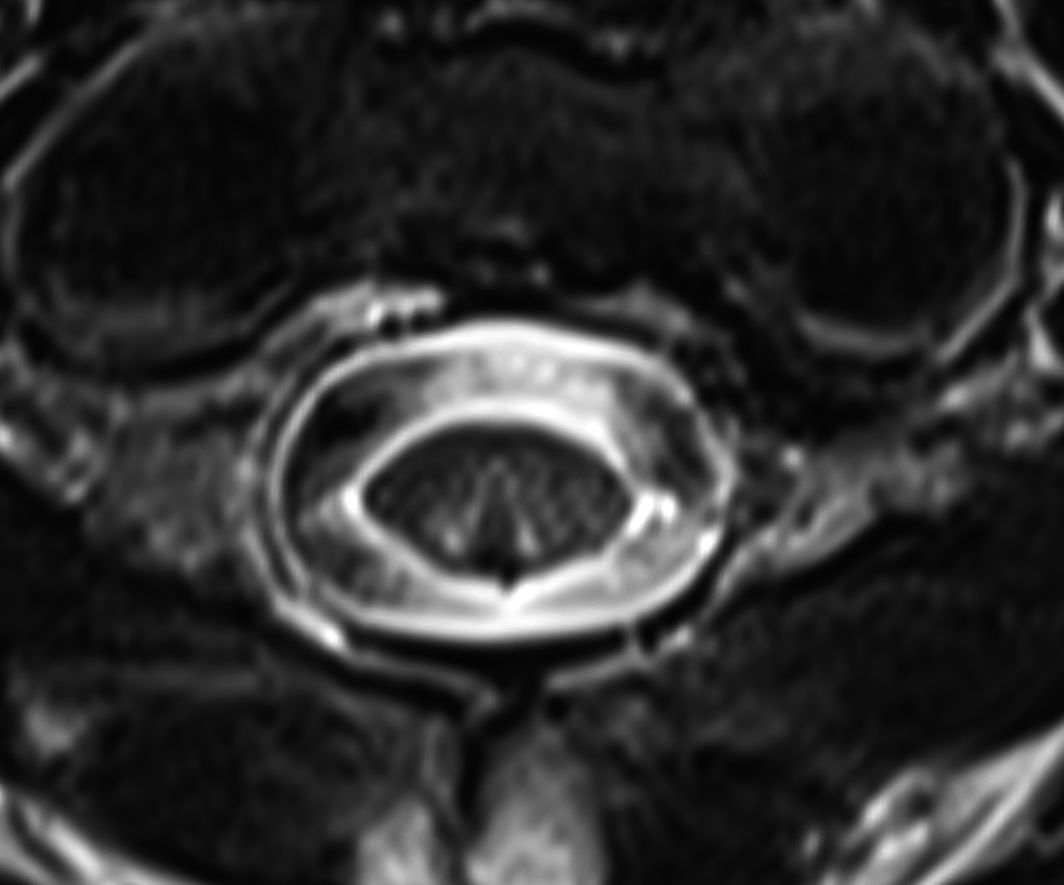
Laboratory studies showed that all seven patients had accumulated homocysteine, as is usually seen when vitamin B12 is in short supply in the body.2 Individuals who reported taking supplements had serum B12 levels that were either normal or in excess of normal, implicating a qualitative deficiency of metabolically useful B12. Evidence of demyelination was seen on spinal cord imaging in six patients, including all those who used supplements, with the “inverted V” sign4 visible on T2‐weighted magnetic resonance imaging sequences (Box 2). Despite treatment according to best practice guidelines, all patients left hospital with persistent symptoms, and most were unable to walk or to attend to their bodily needs without the assistance of family members (modified Rankin score, 4). Sadly, one of the least affected individuals re‐presented to hospital with worsened symptoms because of continued nitrous oxide misuse.
At every opportunity nitrous oxide users should be reminded of the futility of B12 supplementation, as one of many reasons why they should choose to avoid this profoundly destructive drug.
Box 1 – Patients presenting with symptoms due to nitrous oxide misuse
|
Age (years) |
Sex |
Canister use |
Duration of use |
B12 supplementation |
Ataxia severity* |
Psychiatric symptoms† |
Homocysteine level |
Serum B12 (active) |
MRI: “inverted V” sign‡ |
mRS: Day 1 |
mRS: discharge |
||||
|
|
|||||||||||||||
|
20 |
Female |
250/day |
1 year |
No |
Severe |
Yes |
High |
Low (low) |
Yes |
4 |
4 |
||||
|
30 |
Male |
60/day |
1 year |
No |
Moderate |
Yes |
High |
Low (low) |
Yes |
1 |
1 |
||||
|
30 |
Male |
100/day |
6 months |
No |
Mild |
No |
High |
Low (normal) |
No |
1 |
1 |
||||
|
21 |
Male |
200/day |
1 year |
Yes |
Severe |
Yes |
High |
Normal (normal) |
Yes |
4 |
4 |
||||
|
23 |
Female |
300/day |
2 months |
Yes |
Severe |
Yes |
High |
Normal (high) |
Yes |
4 |
4 |
||||
|
23 |
Female |
200/day |
2 months |
Yes |
Severe |
Yes |
High |
High (high) |
Yes |
4 |
4 |
||||
|
28 |
Male |
300/day |
1 year |
Yes |
Mild |
No |
High |
Normal (normal) |
Yes |
1 |
1 |
||||
|
|
|||||||||||||||
|
MRI = magnetic resonance imaging; mRS = modified Rankin score of neurological disability. * Ataxia: mild = visible gait disturbance; moderate = frequent falls; severe = inability to walk without assistance. † Psychiatric symptoms included mood disturbance, memory impairment and psychosis. ‡ MRI findings: “inverted V” sign on T2‐weighted MRI spinal cord imaging (Box 2). mRS: 0 = no symptoms; 1 = no significant disability despite symptoms; 2 = slight disability; 3 = moderate disability; 4 = moderately severe disability, unable to walk or attend to bodily needs without assistance; 5 = severe disability, bedridden; 6 = dead. |
|||||||||||||||
Competing interests
No relevant disclosures.
References
- Kaar SJ, Ferris J, Waldron J, et al. Up: the rise of nitrous oxide abuse. An international survey of contemporary nitrous oxide use. J Psychopharmacol 2016; 30: 395–401.
- Stabler SP. Clinical practice. Vitamin B12 deficiency. N Engl J Med 2013; 368: 149–160.
- Garakani A, Jaffe RJ, Savla D, et al. Neurologic, psychiatric, and other medical manifestations of nitrous oxide abuse: A systematic review of the case literature. Am J Addict 2016; 25: 358–369.
- Timms SR, Curé JK, Kurent JE. Subacute combined degeneration of the spinal cord: MR findings. AJNR Am J Neuroradiol 1993; 14: 1224–1227.
Motor Neuron Disease Mortality Trends in Australia From 1986 to 2023: A Population-Based Study
Carol M. Y. Lee, Rupendra N. Shrestha, Julian Gold, Mark Stevenson, Kelly L. Williams, Lyndal Henden, Sandrine K. K. Chan Moi Fat, Zoe Zussa, Amanda Wright, Martin Jude, Mark A. S. Laidlaw, Willem J. R. Fokkink, Dominic B. Rowe
Mild traumatic brain injury and concussion and persisting post‐concussion symptoms: new guidelines to support evidence‐based assessment and management in Australia and Aotearoa New Zealand
Karen M Barlow, Jennie L Ponsford, Alice Theodom, Gill Cowen, Gavin A Davis, Vicki Anderson, Franz E Babl, David Cole, Jennifer Cullen, Stuart R Dalziel, Melinda Fitzgerald, Howard Flavell, Caroline Yates, Rebecca Kimble, John H Olver, Rhonda Orr, Mark Ralfe, Michael Rose, Nick Rushworth, Julia Treleaven, Gary Browne, Nathan Delang, Sarah Harris, Gary Mitchell, Sean Tweedy
The prevalence of and variation in indicators of the quality and safety of long term aged care in Australia, 2019: a cross‐sectional population‐based study
Tesfahun C Eshetie, Gillian E Caughey, Catherine Lang, Olivia Ryan, Renuka Visvanathan, Craig Whitehead, Keith Evans, Janet K Sluggett, Jyoti Khadka, Carolyn Dawkins, Helena Williams, Miranda Starke, Sara Blunt, Anne Liddell, Megan Corlis, Anna Sheppeard, Penelope Lello, Marilyn Thien, Steven L Wesselingh, Maria C Inacio
Health and economic benefits of improving pre‐hospital identification of stroke in Australian women: a modelling study
Thomas Gadsden, Lei Si, Emily R Atkins, Cheryl Carcel, Xia Wang, Stephen Jan, Mark Woodward, Laura E Downey
Symptom burden, quality of life, and diagnostic journey of people with postural orthostatic tachycardia syndrome, Australia, 2021–24: a descriptive patient registry data study
Marie‐Claire Seeley, Gemma Wilson, Eric Ong, Amy Langdon, Jonathan Chieng, Danielle Bailey, Kristina Comacchio, Amanda Page, Dennis H Lau, Celine Gallagher
The intersection of rurality and dementia prevalence in Australia for Aboriginal and Torres Strait Islander and non‐Indigenous peoples
Antonia J Clarke, Marwan Ahmed, Judith M Katzenellenbogen, John Towney (Wiradjuri), Anna H Balabanski, Adrienne Withall (Dharawal Yuin), Kylie Radford, Amy Brodtmann