




Volume 210 - Issue 1
Hereditary haemorrhagic telangiectasia
Authors: Varitsara Mangkorntongsakul and Cecily J Forsyth
Med J Aust 2019; 210 (1): 16. || doi: 10.5694/mja2.12042
Published online: 14 January 2019
Published online: 14 January 2019
A 52-year-old woman presented with symptomatic iron deficiency anaemia …
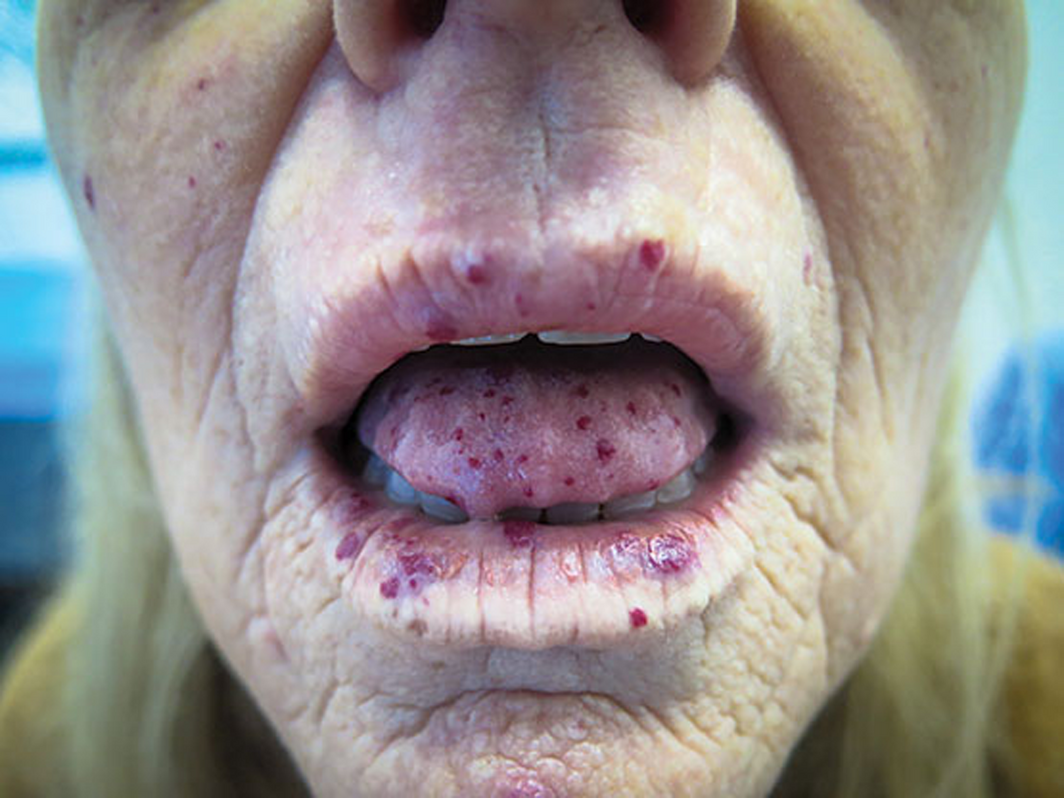
A 52‐year‐old woman presented with symptomatic iron deficiency anaemia, a lifelong history of epistaxis, and multiple mucocutaneous telangiectases consistent with a diagnosis of hereditary haemorrhagic telangiectasia (HHT). Endoscopy and colonoscopy showed multiple angiodysplastic lesions throughout her gastrointestinal tract. She was treated with iron supplementation, saline nasal sprays and tranexamic acid and underwent screening for pulmonary arteriovenous malformations. Screening for cerebral arteriovenous malformations was not performed, despite being recommended in the international HHT guidelines for asymptomatic patients, as the intervention may not be beneficial.1,2 Given that 85% of patients are found to have a mutation in a HHT gene, she has been referred for genetic testing.
Competing interests
No relevant disclosures.
References
- Faughnan ME, Palda VA, Garcia‐Tsao G, et al. International guideline for the diagnosis and management of hereditary haemorrhagic telangiectasia. J Med Genet 2011; 48: 73–87.
- Mohr JP, Parides MK, Stapf C, et al. Medical management with or without interventional therapy for unruptured brain arteriovenous malformations (ARUBA): a multicentre, non‐blinded, randomised trial. Lancet 2014; 383: 614–621.
Splenic injury in severe cases of the zoonoses Q fever and rickettsial infection: diagnostic challenges
Ashleigh Drury, Philippa Harrison, Aiveen Bannan
Health and economic benefits of improving pre‐hospital identification of stroke in Australian women: a modelling study
Thomas Gadsden, Lei Si, Emily R Atkins, Cheryl Carcel, Xia Wang, Stephen Jan, Mark Woodward, Laura E Downey
Updating the diagnosis and management of elevated serum ferritin levels in the era of routine ferritin testing of blood donors by Australian Red Cross Lifeblood
Gary D Zhang, James Chen, Daniel M Johnstone, Martin B Delatycki, Katie Allen, John K Olynyk
Early cardiovascular collapse after envenoming by snakes in Australia, 2005–2020: an observational study (ASP‐31)
Geoffrey K Isbister, Katherine Z Isoardi, Angela L Chiew, Shane Jenkins, Nicholas A Buckley
Updated recommendations for warfarin reversal in the setting of four‐factor prothrombin complex concentrate
Danielle Robinson, James McFadyen, Eileen Merriman, Chee Wee Tan, Ross Baker, Huyen Tran
Updating the diagnosis and management of iron deficiency in the era of routine ferritin testing of blood donors by Australian Red Cross Lifeblood
Gary D Zhang, Daniel Johnstone, Michael F Leahy, John K Olynyk