




Volume 209 - Issue 11
A comprehensive review of significant issues in health law
Author: Andrew Alston
Med J Aust 2018; 209 (11): 488. || doi: 10.5694/mja18.00091
Published online: 10 December 2018
Published online: 10 December 2018
Tensions and traumas in health law
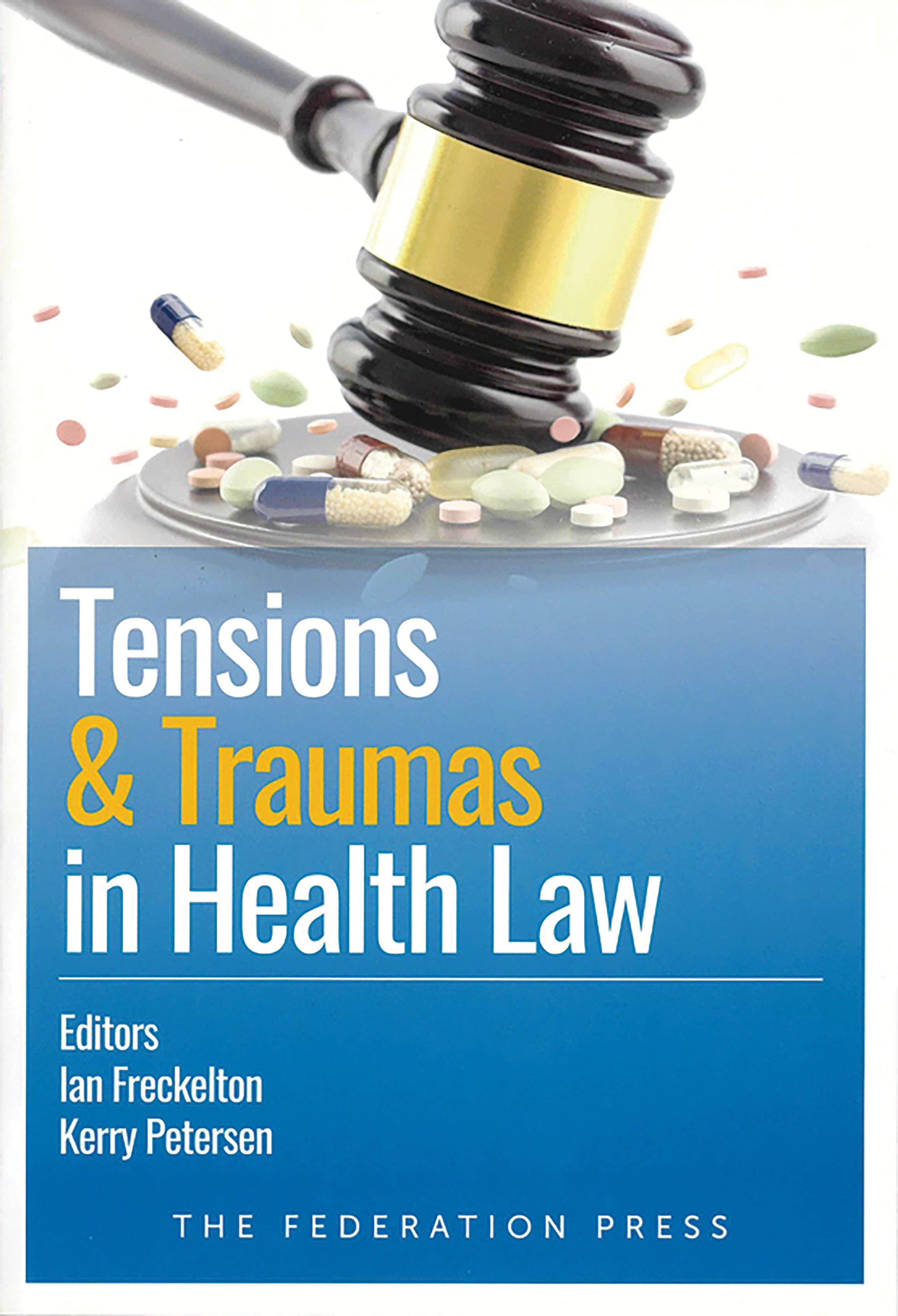
Tensions and traumas in health law. Freckelton I, Petersen K, editors. The Federation Press; 2017 ($145.00; 832 pp). ISBN 9781760021498
In every health issue there are parties with interests that do not coincide and which, in many cases, conflict. Even when they do not conflict, there are always tensions and traumas. Eminent practitioners and academics with special interests in law, medicine and ethics have contributed to the 37 chapters in Tensions and traumas in health law, edited by Ian Freckelton and Kerry Peterson. As may be anticipated, it covers the medico-legal issues of consent, privacy and confidentiality, reproductive technology, death and dying, along with civil, criminal and professional accountability. Of particular interest, it also includes significant discussion of issues of human rights, global health, medical research and law reform.
Certain topics recur throughout the book: conflicts of interest between multiple parties, the role of courts in resolving issues, the need for promptitude and compliance with good medical practice. They are of particular importance when people are especially vulnerable and in need of urgent attention. Such people have not always been well served by the law and current medical practice. The High Court decision in Marion’s case, now fortunately in abeyance, led to a rash of inappropriate court interventions and expensive and traumatic delays in providing necessary health care.1 The current practice of delay in order to ensure full participation of relevant parties has contributed to unfortunate outcomes, most recently in the Kiszko decisions.2
There are so many interested parties: patients, families, friends, carers, health professionals, ethicists, health administrators, researchers, politicians, organ donors, their next of kin, organ recipients, those who focus on prevention, those who focus on cure, those who seek profit from research or by promoting unhealthy practices, those who believe in freedom not to be vaccinated and for their children not to be vaccinated, those who want to die, those who oppose assisted dying, people whose religious convictions compel them to refuse treatment for themselves and their children, proponents of alternative health practices, and, most importantly, people who are unable to or who are prevented from making decisions for themselves, in particular, children, older people, the infirm and those with mental health problems.
Tensions and traumas in health law addresses the interests of all these parties. It is a comprehensive review of significant issues in health law. The editors are to be congratulated for putting together such a range of topics and the contributors are to be commended for their succinct scholarship.
Competing interests
No relevant disclosures.
References
- Marion (1991) FLC 92-193.
- Director Clinical Services, Child and Adolescent Health Services and Kiszko (2016) FCWA 34.
Pharmaceutical Industry Payments to Patient Groups in Australia: A Longitudinal Analysis of a Decade of Disclosures
Ashleigh Hooimeyer, Annim Mohammad, Alice Fabbri, Lisa Parker, Kellia Chiu, Barbara Mintzes
Not Gone but Often Forgotten: Action Needed to Address Tuberculosis in Aboriginal and Torres Strait Islander Communities
Nikkita Joshua, Emma L. Smith, Eunice (Cheeky) Love, Christopher P. Lowbridge, Nicole Tukana, Amy Bowden, Megan A. Campbell, Dawn Casey, James Ward
Unshrouding Social Determinants: A Case for Standardised Data in Australia's Health Information Ecosystem
Christopher Ryan, Christine T. Shiner, Rebecca J. Harris, Carrie Lethborg, Vijaya Sundararajan
Inequity Is Our Biggest Killer: Looking Upstream to Tackle the Burden of Disease in Australia
Meggan J. Devery, Katie Brooker, Kitty-Rose Foley
Inequity Is Our Biggest Killer: Looking Upstream to Tackle the Burden of Disease in Australia
Lucio Naccarella, Katrina Plamondon, Alison Brown, Alexandra Kent, Sana Shahram, Donya Eghrari, Nicole M. Rankin, Stephanie Best, Marlena Klaic, Zoe Fehlberg, Michelle Lambert, Sue Crengle
Inequity Is Our Biggest Killer: Looking Upstream to Tackle the Burden of Disease in Australia
Saman Khalatbari-Soltani, Edward Jegasothy, Seye Abimbola, Anita van Zwieten