




Medical education
Lessons from practice
Volume 209 - Issue 1
Reversible pancytopenia caused by severe copper deficiency in a patient with Wilson disease
Authors: Muhajir Mohamed, Anna Johnston, Andrew Maclaine Cross and Archna Sharma
Med J Aust 2018; 209 (1): 1112. || doi: 10.5694/mja17.00831
Published online: 2 July 2018
Published online: 2 July 2018
A 26-year-old woman was referred to the haematologist for evaluation of new onset pancytopenia
Clinical record
A 26-year-old woman was referred to the haematologist for evaluation of new onset pancytopenia. She was diagnosed with Wilson disease at 13 years of age, when she developed extrapyramidal neurological manifestations, mainly dystonia, ataxia and tremors. Despite copper chelation therapy with zinc sulphate, she had disabilities due to dystonia and became wheelchair bound, requiring high level nursing care. She underwent clinical monitoring with yearly blood tests and her previous full blood counts were consistently normal; however, serum copper values were mildly reduced, consistent with those seen in Wilson disease. Her regular medications were zinc sulphate (200 mg thrice daily), benzhexol, baclofen, diazepam and lactulose. Her nutritional intake was good. Clinical examination revealed fixed posture deformities of upper and lower limbs, bilateral partial Kayser–Fleischer rings on ocular slit-lamp examination, and there were no stigmata of liver disease.
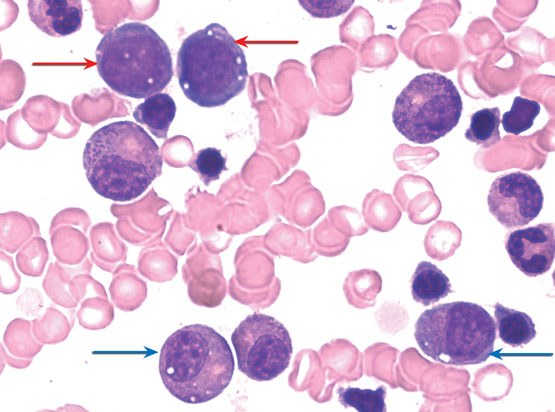
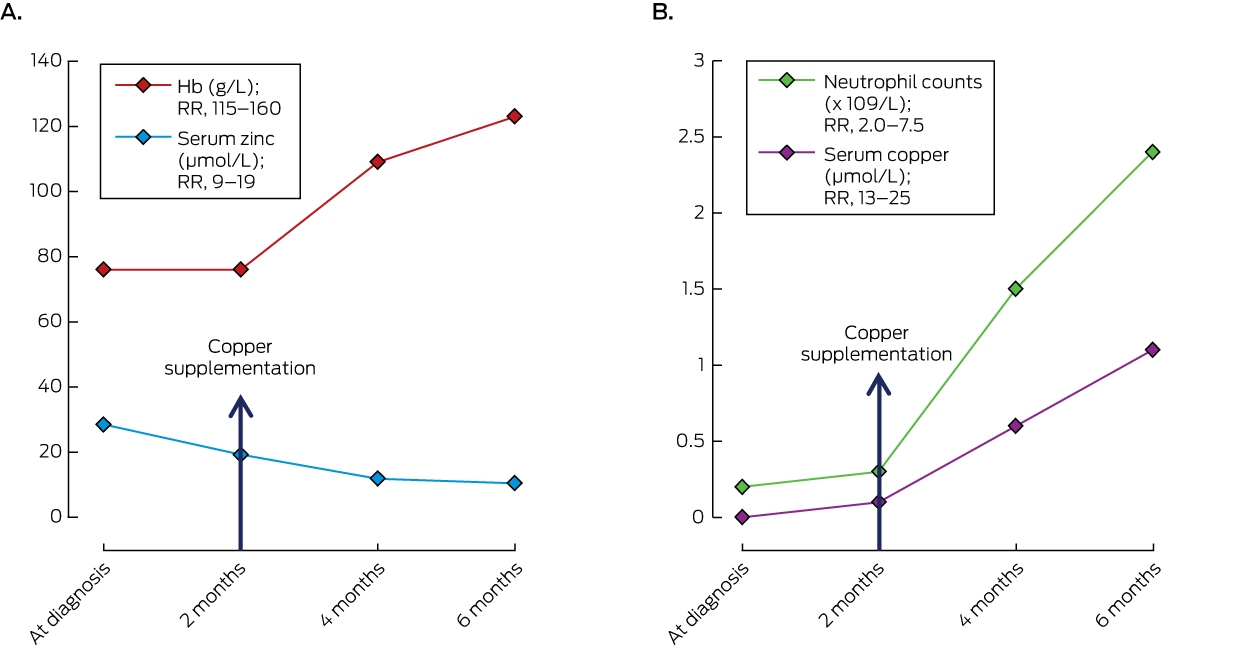
Full blood counts showed low haemoglobin (Hb) levels, 74 g/L (reference range [RR], 115–160 g/L); normal mean corpuscular volume; low white cell count, 1.2 × 10⁹/L (RR, 3.5–11 × 109/L); markedly low neutrophil count, 0.2 × 10⁹/L (RR, 2.0–7.5 × 10⁹/L); and platelet count was slightly low, 140 × 109/L (RR, 150–400 × 109/L). There were no significant morphological abnormalities on blood film examination. Serum creatinine, electrolytes, calcium, magnesium, phosphate, liver function tests and albumin levels were within normal limits. Serum B12, folate, iron studies and thyroid function tests were also normal. Serum caeruloplasmin level was very low (0.02 g/L; RR, 0.20–0.45 g/L), serum zinc level was elevated (28.4 μmol/L, RR, 9–19 μmol/L) and serum copper level was undetectable (< 0.1 μmol/L; RR, 13–25 μmol/L). Bone marrow biopsy showed normocellular marrow with moderate dyserythropoiesis and vacuoles in the cytoplasm of erythroid precursors. Defects in maturation and cytoplasmic vacuoles were also noted in myeloid precursors (Box 1). Since these bone marrow features are described in severe copper deficiency,1 zinc sulphate was ceased and blood parameters were monitored for 2 months. Even though serum zinc dropped to normal values, the serum copper level was still in undetectable range and the neutropenia did not improve significantly. Hence, a trial of copper gluconate capsules 2 mg daily was commenced and serum copper levels were monitored closely. Soon after copper supplementation, rapid improvement in the blood counts was observed after the first month, which normalised after 4 months (Hb, 122 g/L; white cell count, 4.4 × 10⁹/L; neutrophil count, 2.5 × 10⁹/L; platelet count, 248 × 109/L). At that time, serum copper levels were increasing and serum zinc levels were normal (Box 2). Repeat bone marrow biopsy revealed complete resolution of the morphological changes. Thereafter, copper supplementation was ceased and was planned to restart zinc therapy at 50% dose, with close monitoring of full blood counts, liver function tests, serum copper and zinc values.
The main causes of copper deficiency are dietary deficiency, total parental nutrition, nephrotic syndrome, bariatric surgery, gastric resection surgery and excessive ingestion of zinc.1 Copper deficiency syndromes have also been reported with long term zinc therapy in patients with Wilson disease.2 Zinc is indicated for maintenance copper chelation in Wilson disease; zinc salts are available as sulphate, acetate or gluconate, and the recommended dose is 150 mg of elemental zinc per day.3 Zinc therapy induces metallothionein that binds to copper and is trapped in the gut mucosa. Continuous sloughing of intestinal cells eventually leads to depletion of copper stores by excretion through the stools.4 Gastrointestinal side effects, such as severe dyspepsia and gastritis, may occur in patients treated with zinc therapy.3
Copper deficiency can lead to neurological or haematological manifestations, which may mimic vitamin B12 deficiency.1 Neurological features of copper deficiency include myelopathy and peripheral neuropathy, which are characterised by gait abnormalities and sensory or motor disturbances.5 Haematological manifestations of copper deficiency include anaemia with neutropenia in 52% of patients, isolated anaemia (30%), and pancytopenia (10%). In copper deficiency, reduced survival of red blood cells can occur as the result of a decrease in levels of superoxide dismutase enzyme in the red blood cell membrane. However, the mechanism of neutropenia is not clear. The bone marrow features of dyserythropoiesis, vacuolisation of erythroid and myeloid precursors, and ringed sideroblasts observed in copper deficiency can mimic myelodysplastic syndrome.1
Copper deficiency is a preventable and reversible cause of cytopenias, and the occurrence in patients with Wilson disease who are treated with zinc therapy should raise the suspicion of copper deficiency. Very few cases of copper deficiency associated with chelation therapy have been reported in patients with Wilson disease. Hence, there is lack of quality evidence for guiding optimal management, monitoring and use of alternative copper chelation agents in such situations. Moreover, the risk and incidence of liver failure due to cessation or dose reduction of zinc therapy is not known. Practical management should include cessation of zinc therapy, and a trial of copper supplementation should be considered if cytopenias do not respond to zinc cessation. Regular monitoring of full blood count, liver function tests, serum copper and zinc levels will be essential to find the right balance between over- and undertreatment.
Our patient presented with classic haematological features of copper deficiency. Prompt referral to the haematologist, early diagnosis and treatment led to complete reversal of pancytopenia and possibly prevented the development of neurological complications of copper deficiency.Lessons from practice
Copper deficiency can lead to cytopenias or neurological manifestations mimicking vitamin B12 deficiency.
Patients treated with long term zinc therapy for Wilson disease can develop copper deficiency syndrome.
In patients who are susceptible, a high index of clinical suspicion with regular monitoring of full blood counts, liver function tests, serum zinc and copper levels is essential to prevent complications of copper deficiency.
Competing interests
No relevant disclosures.
References
- Halfdanarson TR, Kumar N, Li CY, et al. Hematological manifestations of copper deficiency: a retrospective review. Eur J Haematol 2008; 80: 523-531.
- Cortese A, Zangaglia R, Lozza A, et al. Copper deficiency in Wilson’s disease: peripheral neuropathy and myelodysplastic syndrome complicating zinc treatment. Mov Disord 2011; 26: 1361-1362.
- Ala A, Walker AP, Ashkan K, et al. Wilson’s disease. Lancet 2007; 369: 397-408.
- Hoogenraad TU. Paradigm shift in treatment of Wilson’s disease: zinc therapy now treatment of choice. Brain Dev 2006; 28: 141-146.
- Gabreyes AA, Abbasi HN, Forbes KP, et al. Hypocupremia associated cytopenia and myelopathy: a national retrospective review. Eur J Haematol 2013; 90: 1-9.
Provenance: Not commissioned; externally peer reviewed.
Intranasal Adrenaline Use for the Management of Insect Venom-Induced Anaphylaxis
Thomas J. Young, Wilhelmina R. F. Johnson, Braydon L. Pennington, Troy Wanandy, Wun Y. Lau, Thanh-Thao A. Le
Gabapentinoid Poisoning Presentations to Victorian Emergency Departments: A 15-Year Trend Analysis
Bishaal Tej Gurung, Amy McNeilage, Angus Skeen, Tina Lam, Joanna F. Dipnall, Jane Hayman, Suzanne Nielsen, Ting Xia
Still Treating Yesterday's Risk? Reconsidering Antiviral Use for Mild-to-Moderate COVID-19 Cases in a Broadly Immune Population
Hadar Mudrik-Zohar, Tim Cutfield, Susan Morpeth, Thomas Hills, Eamon Duffy, Laura J. Edwards, Allen C. Cheng, Steven Y. C. Tong
Birth prevalence, clinical sequelae, and management of congenital cytomegalovirus infections in Australia, 1999–2023: a national prospective study
Ece Egilmezer, Suzy M Teutsch, Carlos Nunez, Stuart T Hamilton, Adam W Bartlett, Pamela Palasanthiran, Elizabeth J Elliott, William D Rawlinson
Concurrent use of hormonal long‐acting reversible contraception by women of reproductive age dispensed teratogenic medications, Australia, 2013–2021
Aaron E Boyce, Tony Caccetta, Jo‐Ann See, Rosemary L Nixon AM
Concurrent use of hormonal long‐acting reversible contraception by women of reproductive age dispensed teratogenic medications, Australia, 2013–2021
Michelle KY Chen, Adrian Lim, Deshan F Sebaratnam