




Volume 208 - Issue 9
The up-to-date version of an acclaimed book in the field of dementia
Author: Olivier Piguet
Med J Aust 2018; 208 (9): 387. || doi: 10.5694/mja17.00828
Published online: 21 May 2018
Published online: 21 May 2018
Dementia, 5th edition
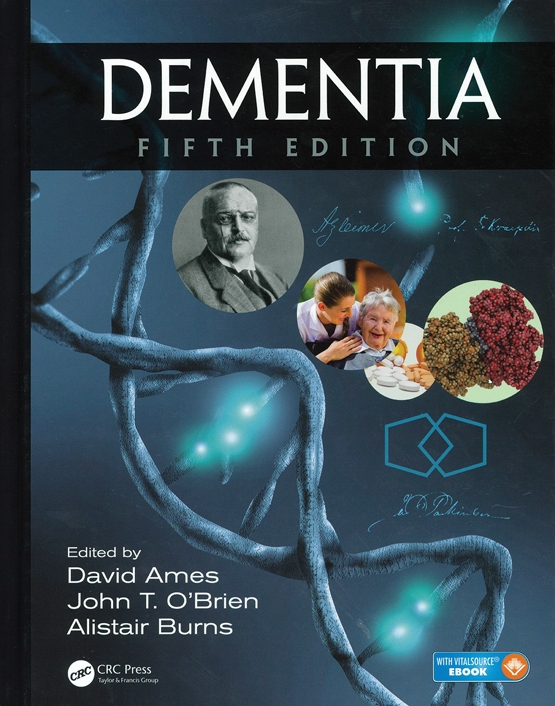
Dementia, 5th edition. Ames D, O’Brien JT, Burns A, editors. CRC Press, Taylor and Francis Group; 2017 ($334.00; 914 pp). ISBN 9781498703109
The fifth edition of Dementia has very big shoes to fill. Its previous version was the winner of the British Medical Association 2011 book award in the psychiatry category, and the winner of the Australasian Journal on Ageing book of the year award, and as such was rightly recognised as a benchmark in the field of geriatric psychiatry. The fifth edition is once again edited by David Ames (Emeritus Professor of Psychiatry at the University of Melbourne), John O’Brien (Foundation Professor of Old Age Psychiatry at the University of Cambridge) and Alistair Burns (Professor of Old Age Psychiatry at the University of Manchester), who are well known experts in the field. The team of authors assembled reads like a who’s who in dementia research from around the world.
This edition maintains the format that made the book a very popular choice for clinicians working in the field of dementia, or for those who simply wish to brush up on their knowledge of the topic. The breadth of topics covered here is a tour de force. Most chapters have been updated, reflecting the dynamics in the field and the rapid evolution of knowledge about dementia, its clinical presentations, aetiologies, diagnosis and management. The rapid pace of change and increasing understanding of these disorders is also reflected in the length of this volume, which now stands at over 900 pages — an increase of approximately 10% from its previous edition.
Arguably, the flavour of the book remains unashamedly clinical. The genetic, mechanistic and pathological components of dementia are not forgotten but take a back seat, leaving centre stage to the clinical aspects of these diseases. Most chapters are relevant to Australian clinicians, including those discussing the health economics of dementia and the global nature of this disease. With that in mind, however, a stronger presence and contributions from low income and non-Western countries would have made this volume truly international. This shortcoming notwithstanding, most readers will find that Dementia, 5th edition represents an excellent reference and is money well spent.
Competing interests
No relevant disclosures.
Motor Neuron Disease Mortality Trends in Australia From 1986 to 2023: A Population-Based Study
Carol M. Y. Lee, Rupendra N. Shrestha, Julian Gold, Mark Stevenson, Kelly L. Williams, Lyndal Henden, Sandrine K. K. Chan Moi Fat, Zoe Zussa, Amanda Wright, Martin Jude, Mark A. S. Laidlaw, Willem J. R. Fokkink, Dominic B. Rowe
Mild traumatic brain injury and concussion and persisting post‐concussion symptoms: new guidelines to support evidence‐based assessment and management in Australia and Aotearoa New Zealand
Karen M Barlow, Jennie L Ponsford, Alice Theodom, Gill Cowen, Gavin A Davis, Vicki Anderson, Franz E Babl, David Cole, Jennifer Cullen, Stuart R Dalziel, Melinda Fitzgerald, Howard Flavell, Caroline Yates, Rebecca Kimble, John H Olver, Rhonda Orr, Mark Ralfe, Michael Rose, Nick Rushworth, Julia Treleaven, Gary Browne, Nathan Delang, Sarah Harris, Gary Mitchell, Sean Tweedy
The prevalence of and variation in indicators of the quality and safety of long term aged care in Australia, 2019: a cross‐sectional population‐based study
Tesfahun C Eshetie, Gillian E Caughey, Catherine Lang, Olivia Ryan, Renuka Visvanathan, Craig Whitehead, Keith Evans, Janet K Sluggett, Jyoti Khadka, Carolyn Dawkins, Helena Williams, Miranda Starke, Sara Blunt, Anne Liddell, Megan Corlis, Anna Sheppeard, Penelope Lello, Marilyn Thien, Steven L Wesselingh, Maria C Inacio
Health and economic benefits of improving pre‐hospital identification of stroke in Australian women: a modelling study
Thomas Gadsden, Lei Si, Emily R Atkins, Cheryl Carcel, Xia Wang, Stephen Jan, Mark Woodward, Laura E Downey
Symptom burden, quality of life, and diagnostic journey of people with postural orthostatic tachycardia syndrome, Australia, 2021–24: a descriptive patient registry data study
Marie‐Claire Seeley, Gemma Wilson, Eric Ong, Amy Langdon, Jonathan Chieng, Danielle Bailey, Kristina Comacchio, Amanda Page, Dennis H Lau, Celine Gallagher
The intersection of rurality and dementia prevalence in Australia for Aboriginal and Torres Strait Islander and non‐Indigenous peoples
Antonia J Clarke, Marwan Ahmed, Judith M Katzenellenbogen, John Towney (Wiradjuri), Anna H Balabanski, Adrienne Withall (Dharawal Yuin), Kylie Radford, Amy Brodtmann