




Volume 208 - Issue 4
A review of student contribution to the Medical Journal of Australia between 2001 and 2014
Authors: Yassar Alamri and Mohamud Osman
Med J Aust 2018; 208 (4): 189-190. || doi: 10.5694/mja16.00698
Published online: 5 March 2018
Published online: 5 March 2018
The following study was conducted independently of the MJA. The MJA has not verified the accuracy of the data
To the Editor:
Given the multitude of discoveries made by medical students in previous decades,1 research carried out by such investigators should not go unnoticed. With the increasing anxiety about future training and employment prospects, many students are opting to publish their research findings early in their medical careers.2,3 Whereas the contribution of medical students from several countries has been reported (eg, New Zealand4), that of Australian medical students has not been evaluated.
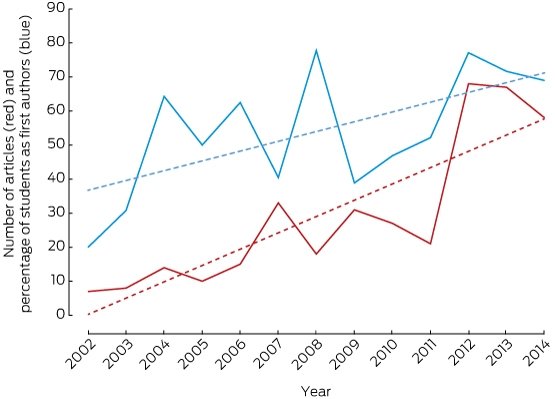
We surveyed all issues of the Medical Journal of Australia (MJA) between January 2001 (issue 1, volume 174) and December 2014 (issue 11, volume 201), reviewing a total of 319 issues — 9643 articles. Of these articles, 377 (3.9%) were authored or co-authored by doctorate, masters, medical, undergraduate and high-school students. The number of student-authored contributions significantly increased over the period from 2001 to 2014 (r = 0.87; P < 0.001) (Box). In addition, whereas the total number of authors per article remained relatively stable (mean, 3.9 ± 2.2 authors), the percentage of students as first authors gradually increased from 20% in 2002 (no students were published in 2001) to almost 70% in 2014 (r = 0.71; P = 0.005) (Box).
Medical students made up 29.2% of student authors (n = 121), and they represented almost all Australian medical schools, the most common being the University of New South Wales (n = 22), the University of Sydney (n = 16), the University of Queensland (n = 13) and Monash University (n = 11).
Several limitations inherent to this type of study ought to be acknowledged. Publications in the MJA may not necessarily be representative of true Australian medical student authorship as there are several other outlets. Moreover, due to the long lead time to publication, many student authors may not have published until after graduation. However, to our knowledge, this report is the first attempt to assess the contribution of students (especially medical students) to the Australian medical literature published in the MJA. Over the years, the Journal appears to have fostered a supportive publishing avenue for students in general and medical students specifically. Other factors underlying the observed rise in medical students authorship — such as increased research opportunities or access to grants — remain to be explored in future studies.
Competing interests
No relevant disclosures.
References
- Stringer MD, Ahmadi O. Famous discoveries by medical students. ANZ J Surg 2009; 79: 901-908.
- Amgad M, Man Kin Tsui M, Liptrott SJ, Shash E. Medical student research: an integrated mixed-methods systematic review and meta-analysis. PLoS One 2015; 10: e0127470.
- Rosenkranz SK, Wang S, Hu W. Motivating medical students to do research: a mixed methods study using Self-Determination Theory. BMC Med Educ 2015; 15: 95.
- Al-Busaidi IS, Al-Shaqsi SZ. Students’ contribution to the New Zealand Medical Journal: a 14-year review. N Z Med J 2015; 128: 47-52.
Driving Implementation-Focused Change for Gender Equity in Medical Leadership: A Consensus-Based Priority-Setting Approach
Belinda Garth, Jenny Proimos, Thuy Vy Nguyen, Sally Cross, Sarah Whitelaw, Helena J. Teede
Advancing Gender Equality in Australian Healthcare Leadership: Why National Targets Matter and What It Means for Healthcare Employers
Belinda Garth, Nicole Pope, Jenny Proimos, Helena J. Teede
Centring Aboriginal and Torres Strait Islander Voices: A Framework for Culturally Safe and Racism-Free Healthcare
Elissa Elvidge, Roianne West, Karen Nicholls, Kiara Harvey, Yeena Thompson, Geraint B. Rogers, Yin Paradies
Medical Colleges Have an Obligation to Ensure Full Participation in Clinical Quality Registries
Robert J. Aitken, Julian A. Smith, Guy J. Maddern