




Medical education
Lessons from practice
Volume 208 - Issue 11
Fulminant meningococcal sepsis due to non-groupable Neisseria meningitidis in a patient receiving eculizumab
Authors: Victoria Hall, Rekha Pai Mangalore, Simon He, Kerrie Stevens, Jason A Trubiano, Natasha E Holmes, Benjamin P Howden and Jason C Kwong
Med J Aust 2018; 208 (11): 478-479. || doi: 10.5694/mja17.01012
Published online: 18 June 2018
Published online: 18 June 2018
A 25-year-old man presented to hospital with 3 days of non-specific abdominal pain, vomiting and diarrhoea
Clinical record
A 25-year-old man presented to hospital with 3 days of non-specific abdominal pain, vomiting and diarrhoea. His past medical history included a diagnosis of paroxysmal nocturnal haemoglobinuria, for which he received fortnightly eculizumab infusions, and aplastic anaemia, treated with cyclosporine 100 mg daily. He was vaccinated 8 months before with the quadrivalent meningococcal conjugate vaccine (ACWY) and prescribed penicillin V potassium 500 mg twice daily for prophylaxis. He had not received the multicomponent meningococcal B vaccine.
A provisional diagnosis of gastroenteritis was made; however, he deteriorated several hours later, developing an altered conscious state, widespread petechial rash and fulminant septic shock. Initial investigations revealed a severe metabolic acidosis with an elevated venous blood lactate level of 9.7 mmol/L and marked disseminated intravascular coagulopathy.
Intravenous ceftriaxone 2 g every 12 hours was initiated, and he was transferred to the intensive care unit for respiratory and vasopressor support. Blood cultures were later positive for Neisseria meningitidis, with intermediate susceptibility to penicillin (minimum inhibitory concentration [MIC] = 0.5 mg/L; ETEST, bioMérieux, France), but susceptibility to ceftriaxone (MIC < 0.08 mg/L) and ciprofloxacin (MIC < 0.03 mg/L).
On further investigation, the blood culture isolates were non-groupable by agglutination with meningococcal A, B, C, W and Y antisera (Remel, Thermo Fisher Scientific, Waltham, Mass, USA), despite testing positive by polymerase chain reaction for the capsule transport gene, ctrA (TaqMan, Thermo Fisher Scientific, Waltham, Mass, USA) within the capsule locus (cps). Whole genome sequencing of the isolates showed they contained an almost identical locus to cps in local serogroup W strains, but lacked the key capsule polymerase gene, csw, within the locus (Box). In silico finetyping and phylogenetic analysis of the isolates, based on core genome single nucleotide polymorphisms, matched other recent meningococcus W isolates of the same hypervirulent clonal complex 11 strain (P1.5,2: F1-1), reported locally.1
The patient rapidly developed multi-organ failure, requiring intubation and haemofiltration. After a slow recovery, he was eventually discharged on amoxicillin 500 mg daily prophylaxis and revaccinated with the quadrivalent meningococcal conjugate vaccine (ACWY), with further consideration for meningococcal B vaccination.
Here, we report a case of fulminant meningococcal sepsis due to a csw-deficient, unencapsulated strain of N. meningitidis. N. meningitidis can cause a wide spectrum of clinical disease, including meningitis and fulminant sepsis, and more atypical disease, such as pneumonia, septic arthritis, pericarditis, conjunctivitis, epiglottitis, sinusitis, urethritis and proctitis.2 Meningococcaemia can present with non-specific symptoms, such as loss of appetite, nausea, vomiting and, occasionally, as in our patient, diarrhoea.2
Invasive meningococcal disease (IMD) is usually caused by encapsulated strains of serogroups A, B, C, W, X and Y.2 The polysaccharide capsule is a major virulence factor which enables evasion of opsonisation and complement-mediated killing, and forms the target proteins for serogrouping by agglutination, and for serogroup A, C, W and Y meningococcal vaccines.2
Eculizumab is a recombinant, humanised monoclonal antibody approved for use in paroxysmal nocturnal haemoglobinuria and atypical haemolytic uraemic syndrome, which specifically binds to and inhibits cleavage of complement protein C5, blocking formation of C5 convertase and its cleavage to C5a and C5b.3 This prevents the generation of C5bC9, the terminal membrane attack complex, an important defence mechanism against encapsulated bacteria such as N. meningitidis.3 Patients receiving eculizumab have about 1000–2000 times greater likelihood of IMD than the general population, and are recommended to have meningococcal vaccination before initiating treatment.2,3 Long term prophylaxis with penicillin is also recommended.3 Although our patient had been prescribed penicillin V potassium prophylaxis, in retrospect, he acknowledged poor compliance, and, subsequently, daily instead of twice-daily prophylaxis was used. Local epidemiological data have observed a rising prevalence of N. meningitidis with reduced susceptibility to penicillin, although the clinical significance of this remains uncertain for patients taking prophylaxis.
Our patient had not previously received the meningococcal B vaccine, due to concerns of an increased risk of haemolysis or low haemoglobin observed in patients treated with eculizumab who were vaccinated with the recombinant multicomponent meningococcal B vaccine (Bexsero, Novartis/GlaxoSmithKline).4 A safety alert in Canada noted that the risk was highest when predicted systemic levels of eculizumab were low, recommending that vaccination should occur when the underlying complement-mediated disease (paroxysmal nocturnal haemoglobinuria or atypical haemolytic uraemic syndrome) is stable and within one week of eculizumab infusion, when concentrations of the drug are still high.4
Non-groupable N. meningitidis strains have been previously isolated from clinical samples, with late complement deficiency being a major predisposing factor. These unencapsulated isolates are not covered by meningococcal vaccines targeting the polysaccharide capsule, but rarely cause invasive disease.5 However, in a recent series of 16 patients who developed IMD on eculizumab, despite prior meningococcal vaccination, 11 cases were due to non-groupable isolates.5 Our case adds to this case series and provides observational data supporting expert recommendations that these patients receive indefinite chemoprophylaxis to prevent breakthrough IMD.3
Additional information: Whole genome sequencing data of the isolates have been uploaded to the National Center for Biotechnology Information Sequence Read Archive under BioProject accession PRJNA400326.
Lessons from practice
-
Meningococcal sepsis can present with non-specific symptoms, such as fever, vomiting and diarrhoea.
-
Patients receiving eculizumab remain at risk of invasive meningococcal disease despite vaccination.
-
Non-groupable Neisseria meningitidis strains rarely cause clinical disease in immunocompetent patients, but can cause fulminant meningococcal sepsis in patients receiving eculizumab.
-
Good adherence to penicillin prophylaxis is recommended to prevent invasive meningococcal disease for patients receiving eculizumab.
Box – Diagrammatic representation of the capsule genetic (cps) locus from the meningococcus W strain M10208 (GenBank accession no. CP009422.1) (top), compared with the cps locus from the patient’s isolate*
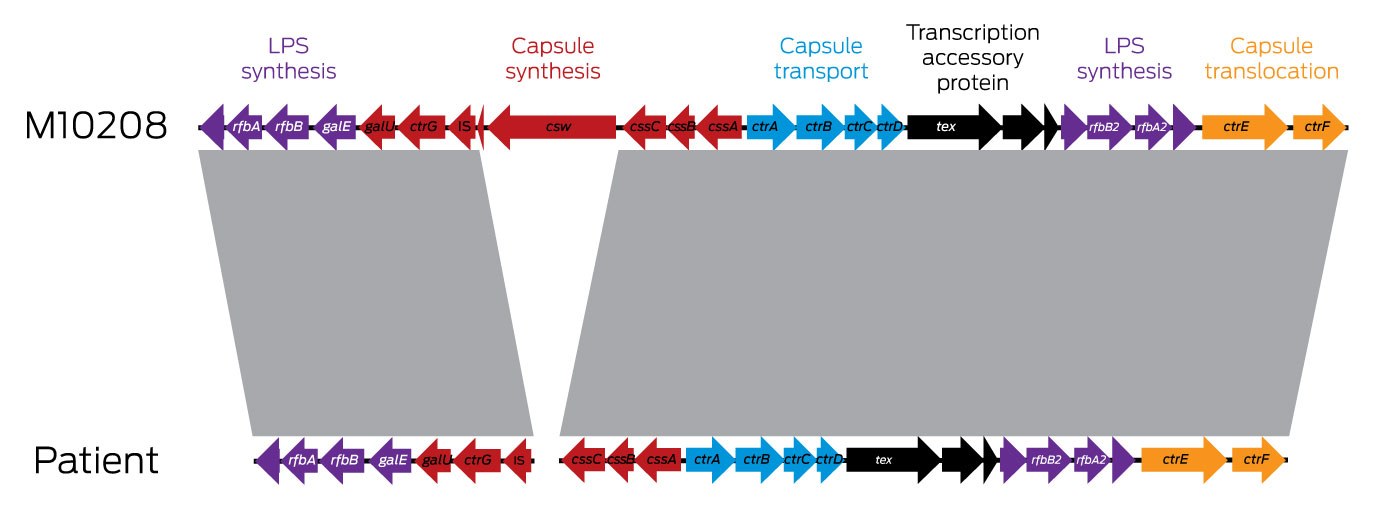
LPS = lipopolysaccharide. * Arrows represent genes oriented in the forward or reverse direction in each of the genomes. Grey blocks indicate corresponding genomic regions > 99% nucleotide identity. No csw gene was present in the patient’s meningococcal isolate genome.
Competing interests
No relevant disclosures.
Acknowledgements
This study was funded through the State Government of Victoria Department of Health and Human Services, and the Australian Government Department of Health. Jason Trubiano, Benjamin Howden and Jason Kwong are supported by the National Health and Medical Research Council. Jason Kwong and Jason Trubiano are also supported by Australian Government Research Training Program Scholarships.
References
- Bond KA, Stevens K, Bulach D, et al. Rising incidence of invasive meningococcal disease caused by Neisseria meningitidis serogroup W in Victoria. Med J Aust 2016; 204: 265-266.
- Pace D, Pollard AJ. Meningococcal disease: clinical presentation and sequelae. Vaccine 2012; 30: B3-B9.
- Benamu E, Montoya JG. Infections associated with the use of eculizumab: recommendations for prevention and prophylaxis. Curr Opin Infect Dis 2016; 29: 319-329.
- Health Canada. SOLIRIS (eculizumab) — increased risk of hemolysis or low hemoglobin with serogroup B meningococcal vaccination. Ottawa: Government of Canada; 2016. http://healthycanadians.gc.ca/recall-alert-rappel-avis/hc-sc/2016/60752a-eng.php (viewed June 2017).
- McNamara LA, Topaz N, Wang X, et al. High risk for invasive meningococcal disease among patients receiving eculizumab (Soliris) despite receipt of meningococcal vaccine. MMWR 2017; 66: 734-737.
Provenance: Not commissioned; externally peer reviewed.
Costs of Delivering the Hep B PAST Model of Care in Remote Australia: A Retrospective Pre–Post Study
Hoa Nguyen, Anh Le Tuan Nguyen, Paula Binks, Melita McKinnon, Emily Vintour-Cesar, Karen Wills, Nicola Stephens, Benjamin Cowie, Joshua S. Davis, Yuejen Zhao, Peter Nihill, Julie A. Campbell, Andrew J. Palmer, Jane Davies, Barbara de Graaff
Buruli Ulcer Acquired From Ringtail Possum Rescue
Daniel P. O'Brien, Naomi Clarke, Sara Bonnici, Mohammad A. Hussain
Q Fever Visceral Abscesses After Contact With Native Australian Marsupials
Samantha J. Laws, Enzo Binotto, James Stewart, Jennifer Ho, Trent Yarwood, Josh Hanson, Simon Smith
Hospital-Admitted Injection-Related Infections Among Incarcerated People Who Inject Drugs in Australia: A Retrospective Cohort Study
Andrew Palmer, Matthew Carter, Jeremy Yeo, Cecilia Shim, Jason Connor, Jeremy Hayllar, Gerald Holtmann, Naomi Moy, Elliott G. Playford, Naomi Runnegar, Paul J. Clark
The Live Attenuated Influenza Vaccine in Australia: An Additional Tool for Influenza Prevention
Cyra Patel, Alexis Pillsbury, Tran Nguyen, Xia Wang, Helen E. Quinn, Clayton K. Chiu, Allen C. Cheng, Katie L. Flanagan, Zhicheng Wang
Reflex Testing for Hepatitis D Infection: A Unique Opportunity to Reduce Hepatitis D-Related Chronic Liver Disease Deaths in Australia
Jessica Howell, Lauren Andersson, Miriam T. Levy, James O'Beirne, Leon Adams, Katharine Irvine, Avik Majumdar, Golo Ahlenstiel, Kathy Jackson, Krispin Hajkowicz, Joseph Doyle, Jane Davies, Sarah Cherian, Wayne Dimech, Alexander J. Thompson