




Medical education
Lessons from practice
Volume 208 - Issue 10
Pulmonary extensively drug-resistant tuberculosis in Melbourne: local control of a global health challenge
Authors: Adrian R Tramontana, David E Leslie, Aine Nolan, Maria Globan, Janet M Fyfe, Justin T Denholm and Stephen D Guy
Med J Aust 2018; 208 (10): 428-429. || doi: 10.5694/mja16.01477
Published online: 4 June 2018
Published online: 4 June 2018
The first reported case of XDR-TB in Melbourne highlights the need for Australia to continue to support global TB control efforts
Clinical record
A 21-year-old HIV-negative man presented with haemoptysis preceded by 2 weeks of cough and 1 month of constitutional symptoms. He had migrated from Nepal 11 months earlier and reported childhood contact with tuberculosis (TB). He was febrile (38.2°C); otherwise vital signs and examination were normal. A chest x-ray showed bilateral mid-zone infiltrates. From smear-negative sputum, Xpert MTB/RIF (Cepheid) assay was positive for Mycobacterium tuberculosis and a rifampicin-resistant mutation within the rpoB gene was indicated. Consequently, amikacin, moxifloxacin and prothionamide were added to first line TB therapy of isoniazid, rifampicin, ethambutol and pyrazinamide.
The Victorian Mycobacterium Reference Laboratory confirmed the identification of M. tuberculosis from sputum cultured in mycobacteria growth indicator tube broth. Box 1 summarises phenotypic susceptibility results and mutations associated with resistance identified from sequencing target genes. After 6 weeks of treatment, M. tuberculosis culture of sputum collected on the day of laboratory notification of extensively drug-resistant TB (XDR-TB) was negative. Remaining cough was minimal and the patient gained 4 kg in weight. Therapy was intensified (Box 2) and included bedaquiline, which had just completed phase 2 trials. Radiologically, bilateral cavities had evolved (Box 3). De-bulking surgery was considered but later deemed unnecessary given early culture conversion and radiological resolution over 6 months.
In the early months of treatment, psychological distress from isolation was a major issue. As shown in Box 2, side effects increased during treatment, which led to dose alterations, treatment interruptions and ultimately cessation of several agents. Treatment was completed in June 2016 after 112 weeks of TB therapy at an estimated cost of about $400 000. Monitoring for recurrence is planned for at least 5 years. At 12-month follow-up there were no signs of recurrent TB. Persistent medication side effects included right shoulder pain and headaches with associated nausea and impaired concentration.
Four adult family members were identified as household contacts; all had normal chest x-rays and were negative by either tuberculin skin test or QuantiFERON-TB Gold (Qiagen) at baseline and 3 months.
The patient identified through social media that three friends that he shared a dormitory with at boarding school in Nepal had subsequently been treated for multidrug-resistant TB (MDR-TB) or XDR-TB: one for XDR-TB in the United States and two for MDR-TB in Nepal. One of these was reportedly unwell for 2–3 months with cough while attending the boarding school. One patient treated in Nepal has since relocated internationally. Relevant jurisdictional TB programs were contacted to allow appropriate follow-up of cases and potential contacts.
TB remains a major global health challenge with about 1.67 million deaths among 10.4 million cases per year.1 Drug resistance often renders an otherwise curable disease a fatal infection; globally, the treatment success rate is 54% for MDR-TB (resistance to isoniazid and rifampicin) and 30% for XDR-TB (resistant to isoniazid, rifampicin and most effective second line agents, quinolones and injectables).1 Four cases of XDR-TB have previously been reported in Australia.2
This case highlights the therapeutic and public health benefits of prompt recognition of TB and early molecular identification of drug resistance. Early identification of rifampicin resistance with Xpert MTB/RIF assay followed by commencement of amikacin lowered the burden of infection before pulmonary cavities had completely evolved, and potentially protected against development of resistance to pyrazinamide. Transmissibility was lowered, with culture conversion being achieved by the time phenotypic sensitivities were available. As in this case, most cases of MDR/XDR-TB are primary infections rather than recurrence after previous treatment.3 With this epidemiology and the value of early diagnosis, rapid testing for rifampicin resistance should be undertaken at time of diagnosis of TB.4
World Health Organization guidelines recommend concurrent use of at least five effective agents for MDR/XDR-TB.4 Additional agents are recommended for reasons such as partial or uncertain activity of agents within the core regimen. Management requires considerable expertise, especially when treatment-limiting side effects occur. In this case with limited treatment options, the development of treatment-limiting side effects after the burden of infection had reduced probably minimised the impact on treatment efficacy.
Patient engagement and support by treating physicians and nurses was pivotal in facilitating completion of a sufficient course of treatment, especially in the face of cumulative toxicity. This was accomplished without prolonged hospitalisation. The value of engagement and social support above enforcement of treatment in MDR-TB management was demonstrated by an increase in successful outcomes from 61% to 82% in a Taiwanese study.5
This was the first reported case of XDR-TB in Melbourne. It highlights several points raised by Trauer and Cheng in the MJA in 2016, including the need for Australia to continue to support global TB control efforts.3 TB is not limited by international borders and XDR-TB is a major global health challenge.Lessons from practice
Health care professionals need to maintain awareness of the symptoms and signs of TB.
Rapid molecular diagnosis of rifampicin resistance should be undertaken at the time of diagnosis for all patients with TB and, if detected, a rapid molecular drug-resistance profile should be used to guide timely administration of effective therapy.
Patient engagement and social support, rather than relying on enforcing treatment, is essential in delivering highly toxic XDR-TB treatment.
Public health investigations for MDR/XDR-TB should consider international jurisdictions, as a cluster of MDR/XDR-TB in one country may spread globally.
Box 1 – Phenotypic susceptibility and mutations associated with resistance identified from sequencing target genes of extensively drug-resistant tuberculosis isolated from sputum
Antibiotic (critical concentration) |
Phenotypic susceptibility |
Molecular resistance mutations |
|||||||||||||
First line |
|||||||||||||||
Isoniazid (0.1 μg/mL) |
R |
katG Ser315Thr |
|||||||||||||
Rifampicin (1.0 μg/mL) |
R |
rpoB Ser531Leu |
|||||||||||||
Ethambutol (5.0 μg/mL) |
R |
embB Met306Val |
|||||||||||||
Pyrazinamide (100 μg/mL) |
S |
||||||||||||||
Second line |
|||||||||||||||
Amikacin (1.0 μg/mL) |
S |
||||||||||||||
Capreomycin (2.5 μg/mL) |
R |
rrs Cys1402Thr |
|||||||||||||
Ethionamide (5.0 μg/mL) |
R |
||||||||||||||
Kanamycin (2.5 μg/mL) |
R |
rrs Cys1402Thr |
|||||||||||||
Ofloxacin (2.0 μg/mL) |
R |
gyrA Asp94Gly |
|||||||||||||
Streptomycin (4.0 μg/mL) |
R |
||||||||||||||
R = resistant; S = sensitive. | |||||||||||||||
Box 2 – Timeline of treatment, microbiology and development of side effects
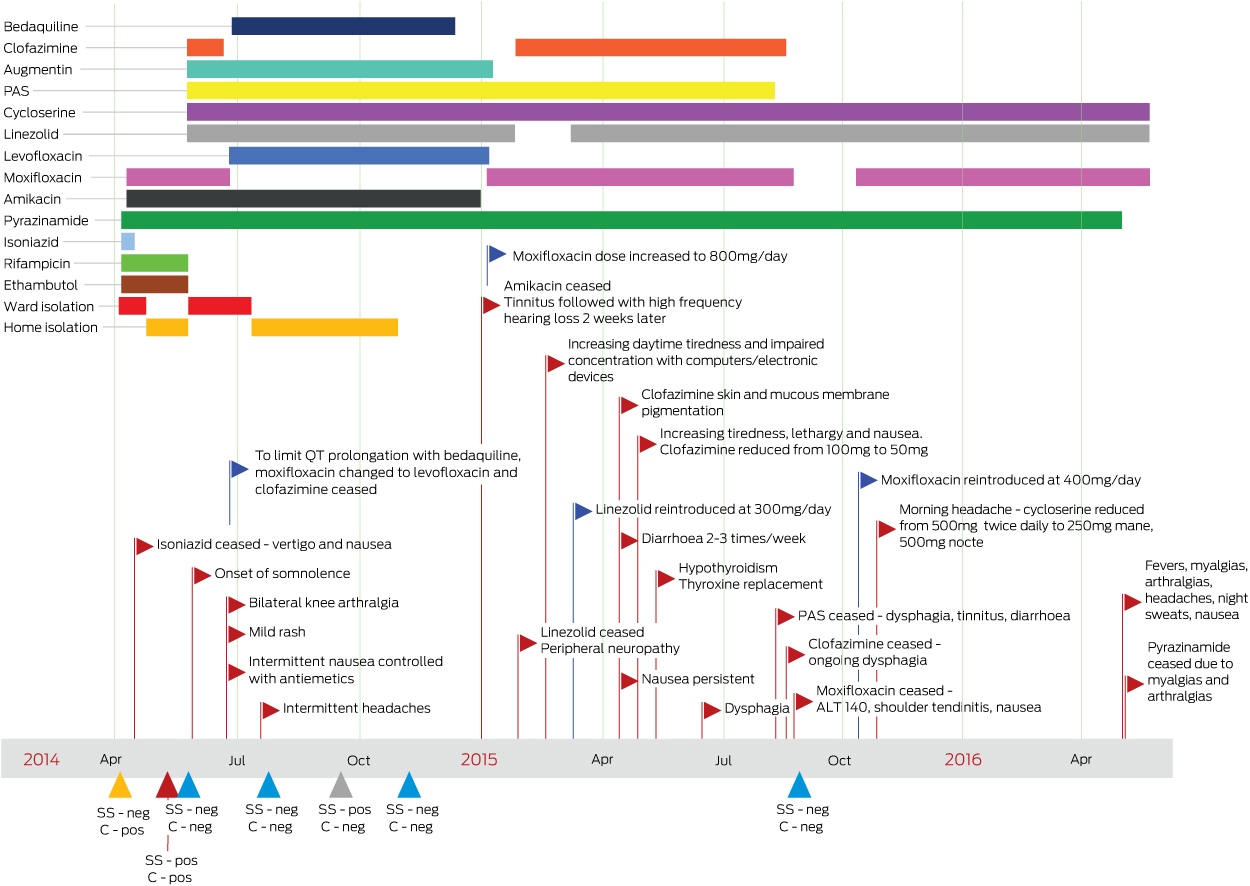
ALT = alanine aminotransferase; blue flag = change in antibiotic unrelated to side effects; C = culture result; neg = negative; PAS = para-aminosalicylic acid; pos = positive; R = resistant; red flag = side effects with or without change to antibiotic therapy; S = sensitive; SS = smear result.
Box 3 – Chest x-rays and computed tomography scans
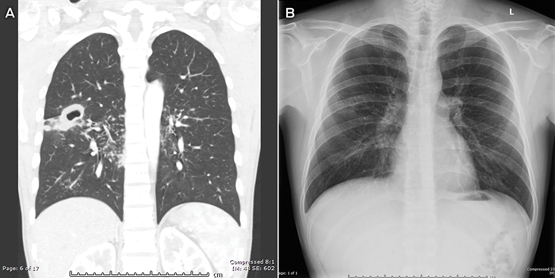
A: Coronal chest computed tomography scan showing a complex cavitating lesion in the right lower lobe invading through the oblique fissure into the right upper lobe and scattered tree in bud opacities in both lower lobes. Smaller cavitating lesion in the left lower lobe is not shown. B: Chest x-ray 6 months into extensively drug-resistant tuberculosis treatment showing complete resolution of active infiltrates and minor residual scarring at the site of prior right lower lobe cavitating lesion.
Competing interests
No relevant disclosures.
References
- World Health Organization. Global tuberculosis report 2017. http://apps.who.int/iris/bitstream/10665/259366/1/9789241565516-eng.pdf?ua=1 (viewed Nov 2017).
- Kirby T. Extensively drug-resistant tuberculosis hovers threateningly at Australia’s door. Med J Aust 2013; 198: 355.
- Trauer JM, Cheng AC. Multidrug-resistant tuberculosis in Australia and our region. Med J Aust 2016; 204: 251-253.
- World Health Organization. WHO treatment guidelines for drug-resistant tuberculosis: 2016 update. October 2016 revision. http://apps.who.int/iris/bitstream/10665/250125/1/9789241549639-eng.pdf?ua=1 (viewed Dec 2016).
- Chan PC, Huang SH, Yu MC, et al. Effectiveness of a government-organized and hospital-initiated treatment for multidrug-resistant tuberculosis patients — a retrospective cohort study. PLoS One 2013; 8: e57719.
Provenance: Not commissioned; externally peer reviewed.
Costs of Delivering the Hep B PAST Model of Care in Remote Australia: A Retrospective Pre–Post Study
Hoa Nguyen, Anh Le Tuan Nguyen, Paula Binks, Melita McKinnon, Emily Vintour-Cesar, Karen Wills, Nicola Stephens, Benjamin Cowie, Joshua S. Davis, Yuejen Zhao, Peter Nihill, Julie A. Campbell, Andrew J. Palmer, Jane Davies, Barbara de Graaff
Buruli Ulcer Acquired From Ringtail Possum Rescue
Daniel P. O'Brien, Naomi Clarke, Sara Bonnici, Mohammad A. Hussain
Q Fever Visceral Abscesses After Contact With Native Australian Marsupials
Samantha J. Laws, Enzo Binotto, James Stewart, Jennifer Ho, Trent Yarwood, Josh Hanson, Simon Smith
Hospital-Admitted Injection-Related Infections Among Incarcerated People Who Inject Drugs in Australia: A Retrospective Cohort Study
Andrew Palmer, Matthew Carter, Jeremy Yeo, Cecilia Shim, Jason Connor, Jeremy Hayllar, Gerald Holtmann, Naomi Moy, Elliott G. Playford, Naomi Runnegar, Paul J. Clark
The Live Attenuated Influenza Vaccine in Australia: An Additional Tool for Influenza Prevention
Cyra Patel, Alexis Pillsbury, Tran Nguyen, Xia Wang, Helen E. Quinn, Clayton K. Chiu, Allen C. Cheng, Katie L. Flanagan, Zhicheng Wang
Reflex Testing for Hepatitis D Infection: A Unique Opportunity to Reduce Hepatitis D-Related Chronic Liver Disease Deaths in Australia
Jessica Howell, Lauren Andersson, Miriam T. Levy, James O'Beirne, Leon Adams, Katharine Irvine, Avik Majumdar, Golo Ahlenstiel, Kathy Jackson, Krispin Hajkowicz, Joseph Doyle, Jane Davies, Sarah Cherian, Wayne Dimech, Alexander J. Thompson