




Volume 208 - Issue 1
Caution with the forthcoming rescheduling of over-the-counter codeine-containing analgesics
Authors: Stephan A Schug, Malcolm DH Dobbin and Jennifer L Pilgrim
Med J Aust 2018; 208 (1): 51-52. || doi: 10.5694/mja16.00881
Published online: 15 January 2018
Published online: 15 January 2018
To the Editor:
After extensive public consultation, the Therapeutic Goods Administration announced that all over-the-counter codeine preparations, including over-the-counter codeine-containing analgesics (OTC CCAs) will be rescheduled as prescription only in February 2018, citing the substantial risk of drug toxicity from deliberate misuse and the relative lack of efficacy compared with safer products.
Codeine is a weak analgesic — even at doses of 60 mg — and the Australian Medicines Handbook notes that “there is no conclusive evidence that products containing 8–15 mg of codeine per tablet with paracetamol, aspirin or ibuprofen have any benefits over these non-opioids alone”.1
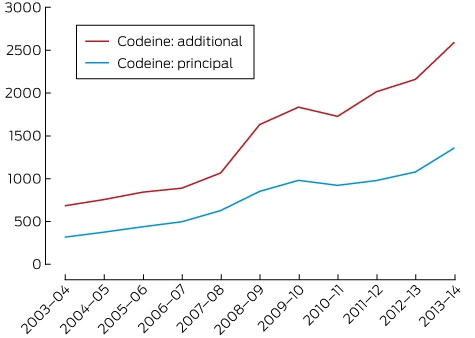
Misuse and harm are widespread, with people who are addicted to codeine taking 40 or more tablets a day. In 2016, more than 500 000 Australians aged 14 years or over used OTC CCAs non-medically. Despite more restrictive scheduling in 2010, a Poisons Information Centre described a 17.9% annual increase from 2004–2015 in calls concerning the misuse of ibuprofen–codeine analgesics.2 Moreover, drug clinics describe a 10-year four-fold increase in treatments where codeine was a drug of concern (Box).
Prolonged high-dose ibuprofen exposure secondary to codeine addiction may cause bleeding or perforated gastric ulcers; non-steroidal anti-inflammatory drug-induced enteropathy, with diaphragm disease and bowel obstruction; anaemia; protein-losing enteropathy; hypoalbuminaemia; renal tubular acidosis and death. Medical practitioners should consider OTC CCA misuse in patients presenting with non-steroidal anti-inflammatory drug-related or paracetamol-related morbidity, as many patients do not disclose their misuse, therefore creating a failure to recognise the underlying cause of the presenting complaint.4
Apart from the human cost of serious injury and loss of life, there is also the cost of treatment for dependence; the cost of hundreds of hospital admissions, involving avoidable surgery, intensive care and serious morbidity;4,5 and the statistical cost of lives lost.6 Practitioners need to prepare for the forthcoming rescheduling to avoid substituting OTC CCAs with either prescription opioid analgesics or prescribing a codeine–paracetamol product, which may cause paracetamol hepatotoxicity. In addition, practitioners should treat codeine dependence by referral, opioid replacement therapy or medicated withdrawal with follow-up.
The unfavourable risk–benefit profile for OTC CCAs means that the planned Australian rescheduling aligns with many other countries to minimise harm. Access to effective analgesics without a prescription is now provided by products with the non-addictive ibuprofen–paracetamol combination, which offer better analgesia than OTC CCAs.7
Box – Treatments provided for own drug use, by principal and additional drug of concern (codeine), from 2003–04 to 2013–143
Competing interests
No relevant disclosures.
References
- Australian Medicines Handbook. Adelaide: Australian Medicines Handbook; 2017.
- Cairns R, Brown JA, Buckley NA. The impact of codeine re-scheduling on misuse: a retrospective review of calls to Australia’s largest poisons centre. Addiction 2016; 111: 1848-1853.
- Australian Institute of Health and Welfare. Alcohol and other drug treatment services in Australia 2013–14 (AIHW Cat. No. HSE 158; Drug Treatment Series No. 25). Table SD.9. Canberra: AIHW; 2015. https://www.aihw.gov.au/reports/alcohol-other-drug-treatment-services/aodts-2013-14/data (accessed Nov 2017).
- Robertson CG, Kumar B, Bright T, Watson DI. Beware of NSAID abuse: think twice before operating! ANZ J Surg 2014; 84: 495-496.
- Mill D, Johnson J, Cock V, et al. Counting the cost of over-the-counter codeine containing analgesic misuse as measured by data related to hospital admissions to a tertiary teaching hospital over a 5-year period [unpublished presentation]. Australian Professional Society on Alcohol and Drugs, APSAD Scientific Alcohol and Drug Conference; Sydney (Australia), 30 Oct – 2 Nov 2016.
- Pilgrim JL, Dobbin M, Drummer OH. Fatal misuse of codeine–ibuprofen analgesics in Victoria, Australia. Med J Aust 2013; 199: 329-331.
- Moore RA, Wiffen PJ, Derry S, et al. Non-prescription (OTC) oral analgesics for acute pain - an overview of Cochrane reviews. Cochrane Database Syst Rev 2015 (11): CD010794.
Gabapentinoid Poisoning Presentations to Victorian Emergency Departments: A 15-Year Trend Analysis
Bishaal Tej Gurung, Amy McNeilage, Angus Skeen, Tina Lam, Joanna F. Dipnall, Jane Hayman, Suzanne Nielsen, Ting Xia
Hospital-Admitted Injection-Related Infections Among Incarcerated People Who Inject Drugs in Australia: A Retrospective Cohort Study
Andrew Palmer, Matthew Carter, Jeremy Yeo, Cecilia Shim, Jason Connor, Jeremy Hayllar, Gerald Holtmann, Naomi Moy, Elliott G. Playford, Naomi Runnegar, Paul J. Clark
The Management of Withdrawal From Alcohol and Other Drugs in Australian Custodial Settings: A Consensus Statement
Grace FitzGerald, Jocelyn Chan, Jon Cook, Mark Stoove, Michael Curtis, Suzanne Nielsen, Rebecca J. Winter, Thileepan Naren
Impact of Prescription Drug Monitoring Program Implementation on Rates and Characteristics of People Seeing Multiple Prescribers in Primary Care: A Controlled Interrupted Time-Series Analysis
Louisa Picco, Monica Jung, Grant Russell, Samanta Lalic, Mahbod A. Fini, Dan I. Lubman, Rachelle Buchbinder, Ting Xia, Suzanne Nielsen
Early Cessation of Acetylcysteine Treatment After Paracetamol Overdose (NACSTOP 2): A Non-Inferiority Randomised Controlled Trial
Anselm Wong, Richard McNulty, Sarah E. Hodgson, Naren Gunja, Andis Graudins
The risk of death after hospitalisation following intentional self‐poisoning: a retrospective observational study (PAVLOVA‐2)
Firouzeh Noghrehchi, Nicholas A Buckley, Rose Cairns