




Volume 208 - Issue 1
Cognitive impairment during pregnancy: a meta-analysis
Authors: Sasha J Davies, Jarrad AG Lum, Helen Skouteris, Linda K Byrne and Melissa J Hayden
Med J Aust 2018; 208 (1): 35-40. || doi: 10.5694/mja17.00131
Published online: 15 January 2018
Published online: 15 January 2018
General cognitive functioning, memory, and executive functioning were reduced in pregnant women, particularly during the third trimester
Abstract
Objectives: Many women report declines in cognitive function during pregnancy, but attempts to empirically evaluate such changes have yielded inconsistent results. We aimed to determine whether pregnancy is associated with objective declines in cognitive functioning, and to assess the progression of any declines during pregnancy.
Study design: We undertook a meta-analysis, applying a random effects model, of 20 studies that have reported quantitative relationships between pregnancy and changes in cognition.
Data sources: Full text articles indexed by Cumulative Index to Nursing and Allied Health Literature (CINAHL) Complete, MEDLINE Complete, and PsychINFO.
Data synthesis: The 20 studies assessed included 709 pregnant women and 521 non-pregnant women. Overall cognitive functioning was poorer in pregnant women than in non-pregnant women (standardised mean difference [SMD], 0.52 [95% CI, 0.07–0.97]; P = 0.025). Analysis of cross-sectional studies found that general cognitive functioning (SMD, 1.28 [95% CI 0.26–2.30]; P = 0.014), memory (SMD, 1.47 [95% CI, 0.27–2.68]; P = 0.017), and executive functioning (SMD, 0.46 [95% CI, 0.03–0.89]; P = 0.036) were significantly reduced during the third trimester of pregnancy (compared with control women), but not during the first two trimesters. Longitudinal studies found declines between the first and second trimesters in general cognitive functioning (SMD, 0.29 [95% CI, 0.08–0.50]; P = 0.006) and memory (SMD, 0.33 [95% CI, 0.12–0.54]; P = 0.002), but not between the second and third trimesters.
Conclusions: General cognitive functioning, memory, and executive functioning were significantly poorer in pregnant than in control women, particularly during the third trimester. The differences primarily develop during the first trimester, and are consistent with recent findings of long term reductions in brain grey matter volume during pregnancy. The impact of these effects on the quality of life and everyday functioning of pregnant women requires further investigation.
“Baby brain” refers to a subjective decline in cognition reported by up to 81% of women who have been pregnant.1,2 Memory problems, reading difficulties, confusion, disorientation, poor concentration, increased absentmindedness, and reduced motor coordination have been noted,1,3-5 as has a general slowing of cognition; forgetfulness is the most frequently cited change.1 Similar deficits in broader cognitive processes have also been reported, including in executive functions and attention.1-3
The impact of these deficits on everyday life can be significant. In case study interviews, currently and recently pregnant women have described a variety of real world consequences of “baby brain”, including impaired conversational fluency at work and home, greater reliance on note-taking for organising work and domestic commitments, frequent forgetting of appointments, difficulties with reading comprehension, and even the inability to return to work because of severe memory problems.1
Objective confirmation of these perceived cognitive deficits during pregnancy has, however, been equivocal, despite an accumulating body of empirical research. While evidence of adverse cognitive effects during pregnancy has been reported,2,6-12 other investigations have found little or no change.3,13-15 This inconsistency was also evident in the most recent meta-analysis of reports on the impact of pregnancy on memory (2007),16 which found evidence for deficits in some, but not all, components of memory.
No recent meta-analysis of findings regarding pregnancy and memory dysfunction has been published, nor has this relationship been explored in cognitive domains apart from memory. Our primary aim was therefore to examine whether pregnancy is associated with differences in memory performance (compared with non-pregnant women or with their own earlier performance), or with differences in overall cognitive function, executive function, and attention. Our second aim was to identify the specific gestational stages at which any differences emerge.
Methods
Study design
We undertook a meta-analysis of studies that have reported quantitative relationships between pregnancy and changes in cognition.
Eligibility criteria
Published studies were eligible for inclusion in our analysis if they included:
-
a sample of healthy adult pregnant women and a control group of healthy adult non-pregnant women;
-
at least one standardised objective measure of cognitive function (eg, Wechsler Adult Intelligence Scale [WAIS] subtasks); and
-
data appropriate for meta-analysis (eg, means with standard deviations [SDs]).
Studies that included adolescent women (under 18 years of age) or women with high risk pregnancies, or which exclusively employed customised, naturalistic, or self-reported cognitive measures were excluded. There were no restrictions with regard to gestational trimester, parity, socio-economic status, or ethnic background. All included studies were published in peer review journals, without restriction on publication date.
Information sources and study selection
We searched three databases — Cumulative Index to Nursing and Allied Health Literature (CINAHL) Complete, MEDLINE Complete, and PsychINFO — for a panel of terms and their combinations, including “pregnan*”, “cogniti*”, and “reward seek*” (full list in the online Appendix). The date of the final search was 11 November 2016. Two authors (SD, MH) screened the abstracts of articles for eligibility, and disagreements (< 5%) were resolved by discussion. Article reference lists were screened for additional relevant records.
Study quality and characteristics
The methodological quality of the studies included in the meta-analysis was assessed with a modified version of the Newcastle–Ottawa Scale for cohort studies.17 SD and MH independently assessed the quality of all included articles; no studies were excluded by the quality assessment.
Data extraction and effect size calculations
From each article we extracted data on author, publication year, sample size, study design, gestational trimester, age, parity, and measure scores (mean, SD). The effect size in our analysis was the standardised mean difference (SMD); that is, the difference between the pregnant and control women groups for a given outcome variable, expressed in standard deviation units. Effect sizes were computed for general cognitive functioning, and for the three primary cognitive domains: memory, attention, and executive functioning. For cross-sectional data, positive SMD values indicated that the performance of the control group was superior to that of the pregnant women group; for longitudinal studies, positive values indicated that the cognitive performance of pregnant women was superior at the later of two compared assessments.
Summary data from statistical tests were extracted to calculate the SMD and its variance. For 18 studies, these values were calculated from the reported means and SDs.2,7,10,12,14,15,18-29 We contacted the authors of eight studies for which these data were not reported, but which were otherwise eligible for inclusion. The authors of two provided the additional data, and the studies were included in our analysis.30,31 Of the remaining six studies, the authors responded in two cases that they no longer had access to the data;3,11 we received no response regarding the other four studies.6,8,32,33
A random effects model weighted individual studies to compute an average effect size for all studies. The model assumed that differences between study-level effect sizes reflected the contribution of within-study error and of sampling and systematic influences (true heterogeneity).34 Systematic influences may arise from study-level differences in participant characteristics (eg, age, gestational stage, parity), the aspects of cognitive functioning assessed, and differences in methodological quality. The I2 statistic was calculated; it quantifies the heterogeneity between individual studies as a percentage (25% = low, 50% = moderate, 75% = high levels of systematic heterogeneity).35 To assess potential bias in the reporting of effects, a fail-safe N (ie, the number of additional studies with an effect size of zero that would need to be found to render the overall effect size for the studies included in the meta-analysis non-significant) was also calculated.
For cross-sectional studies of subgroups of pregnant women (trimester 1 [T1], T2, T3), the subgroups were collapsed to a single pregnant women group for initial analyses comparing the performance of pregnant and non-pregnant women by computing a weighted average mean and SD for the cognitive task scores. Each subgroup was then separately compared with the non-pregnant control women.
In longitudinal studies of cognitive performance across pregnancy included in our meta-analysis, correlations between effect sizes were not reported. We therefore estimated effect size correlations at r = 0.5 for each study; each trimester was separately compared with each of the other two trimesters.
Results
Study selection
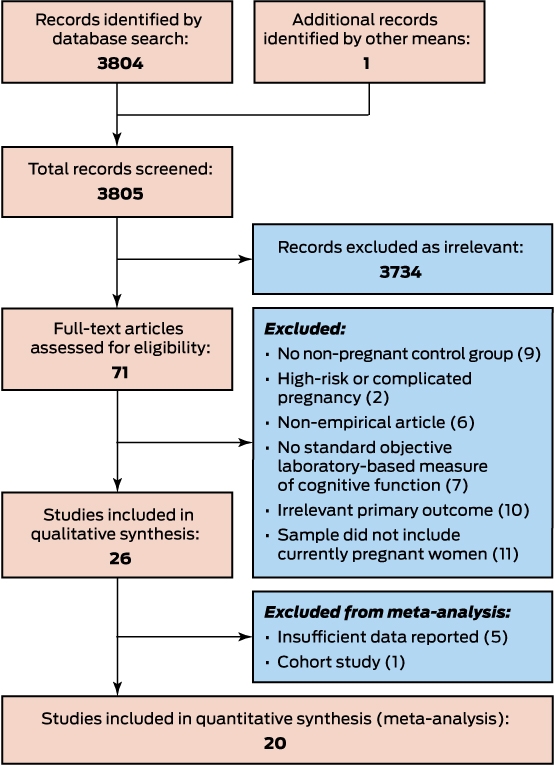
After removing duplicates, the initial search identified 3805 records, of which 3734 were excluded as irrelevant after screening their titles and abstracts. The full texts of the remaining 71 records were assessed for suitability, and 26 articles were deemed relevant; of these, sufficient data were available for twenty (see paragraph 2 of “Data extraction” for details) to include them in our meta-analysis (Box 1). The 20 studies included a total of 709 pregnant women and 521 non-pregnant women.
Study characteristics and quality assessment
The sample size, participant characteristics, study design, and the cognitive tasks assessed in each study and the methodological quality of each study are summarised in the online Appendix. In 17 of 20 studies, the pregnant women and control groups were matched by age and education or IQ level. Eight studies included a follow-up assessment, with four allowing an inter-assessment interval of longer than 12 weeks. The fail-safe N indicated that 210 additional studies with non-significant effect sizes would be required for the difference in overall cognitive performance between pregnant and control women to be statistically non-significant (ie, P > 0.05).
General cognitive functioning
We defined general cognitive functioning broadly as encompassing a range of processes, including memory, attention, executive functioning, processing speed, and verbal and visuospatial abilities (online Appendix, table 1).
Effect sizes and weighted averages for all 20 studies comparing the general cognitive performance of pregnant and non-pregnant women were calculated. Overall cognitive functioning was poorer in pregnant women than in non-pregnant women (SMD, 0.52 [95% CI, 0.07–0.97]; P = 0.025; I2 = 91%).
Additional between-groups analyses were conducted to identify the specific gestational stage at which cognitive performance changes in pregnant women. There was no significant differences in cognitive functioning between pregnant women during T1 and controls (four studies: SMD, 0.84 [95% CI, –0.47 to 2.15]; P = 0.21; I2 = 94%), nor between pregnant women during T2 and controls (three studies: SMD, 1.25 [95% CI, –0.83 to 3.34]; P = 0.24; I2 = 96%) (data not shown). Cognitive functioning in women during T3 was significantly poorer than that of control women (six studies: SMD, 1.28 [95% CI, 0.26–2.30]; P = 0.014; I2 = 93%) (Box 2).
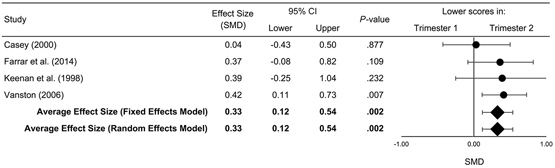
Four longitudinal studies reported effect sizes for changes in overall cognitive performance between T1 and T2; the difference was significant, with no heterogeneity (SMD, 0.29 [95% CI, 0.08–0.50]; P = 0.006; I2 = 0%) (Box 3). In contrast, differences between T2 and T3 (six studies: SMD, 0.11 [95% CI, –0.18 to 0.39]; P = 0.46; I2 = 64%) and between T1 and T3 (five studies: SMD, –0.13 [95% CI, –0.65 to 0.39]; ; P = 0.63; I2 = 88%), were non-significant (data not shown).
Memory
We defined memory as encompassing a range of subdomains, including working memory and retrieval from long term memory via recognition and recall. The 19 studies that assessed memory applied a range of measures, including several WAIS tasks (eg, digit span backwards and forwards) as well as a broad selection of other recall and recognition tasks (eg, facial recognition sets, the Rivermead behavioural memory task, visual–verbal learning tasks). Overall memory performance was significantly lower in pregnant than in non-pregnant women (SMD, 0.48 [95% CI, 0.04–0.92]; P = 0.033; I2 = 91%).
Cross-sectional studies comparing the memory performance of pregnant women at each gestational trimester with control women found significantly lower values for pregnant women during T3 (five studies: SMD, 1.47 [95% CI, 0.27–2.68]; P = 0.017; I2 = 94%) (Box 4), but not during T1 (four studies: SMD, 0.84 [95% CI, –0.47 to 2.15]; P = 0.21; I2 = 94%) or T2 (three studies: SMD, 1.17 [95% CI, –1.04 to 3.38]; P = 0.30; I2 = 97%) (data not shown). There was a high degree of heterogeneity between studies for each comparison.
Longitudinal studies comparing memory performance at different stages of pregnancy found a significant reduction in performance between T1 and T2, with negligible heterogeneity between studies (four studies; SMD, 0.33 [95% CI, 0.12–0.54]; P = 0.002; I2 = 0%) (Box 5), but not between T1 and T3 (five studies: SMD, –0.20 [95% CI, –0.73 to 0.34]; P = 0.48; I2 = 0%) or between T2 and T3 (six studies: SMD, 0.12 [95% CI, –0.17 to 0.42]; P = 0.41; I2 = 0%) (data not shown).
Executive functioning and attention
Executive functions, mediated by the frontal cortex, include attention, planning, shifting between ideas (flexibility), generating new responses (fluency), problem-solving, and abstraction, as well as the ability to inhibit inappropriate responses. The nine studies that assessed executive functions applied a range of measures, including the Cambridge Neuropsychological Test Automated Battery intra-/extra-dimensional shift task, the concept shifting test, and the paced auditory serial addition test. Attention refers to both the initial orientation of attention and sustained attention towards a given stimulus, and is included as a subset of executive functioning processes. Tasks utilised by the eight studies to assess attention included the test of everyday attention, the letter cancellation task, and the Stroop task.
Effect sizes were calculated for cross-sectional studies that compared executive functioning (nine studies) or attention (eight studies) in pregnant and control women. The averaged effect sizes for these studies were small and non-significant (executive functioning: SMD, –0.12 [95% CI, –0.52 to 0.28]; P = 0.54; attention: SMD, –0.22 [95% CI, –0.70 to 0.26]; P = 0.37).
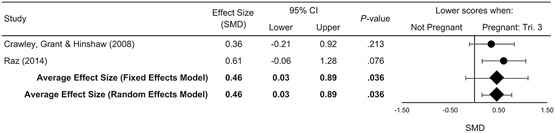
Two cross-sectional studies compared attention and executive functioning during T3 with those of controls;10,14 while the effect size for executive functioning was significant (SMD, 0.46 [95% CI, 0.03–0.89]; P = 0.036; I2 = 0%) (Box 6), that for attention was not (SMD, 0.37 [95% CI, –0.06 to 0.80]; P = 0.09). One study compared attention and executive functioning during T2 with those of controls,14 but found no significant differences (executive functioning: SMD, 0.32; P = 0.26; attention: SMD, 0.30; P = 0.30). No studies compared attention or executive functioning of women during T1 with those of control women.
Longitudinal studies comparing attention and executive functioning in pregnant women at different stages of pregnancy found no significant differences. One study reported non-significant effect sizes for differences in executive functioning and attention changes between T1 and T2 (executive functioning: SMD, 0.11; P = 0.61; attention: SMD, 0.21; P = 0.31).12 Two studies provided data that permitted us to calculate the effect size for changes in attention between T2 and T3;12,14 neither was significant (executive functioning: SMD, 0.07; P = 0.68; attention: SMD, 0.10; P = 0.53). One study provided data that permitted us to calculate the effect sizes for changes in attention between T1 and T3;12 each was small and non-significant (executive functioning SMD, 0.02; P = 0.94; attention: SMD, 0.03; P = 0.89).
Discussion
Many, but not all, women report increased forgetfulness and reduced cognitive functioning during pregnancy. We applied a meta-analytic quantitative approach to investigating the association between pregnancy and changes in cognitive functioning, and reached two major conclusions. First, the general cognitive functioning, memory, and executive functioning performance of pregnant women is significantly lower than in non-pregnant women, both overall and particularly during the third trimester. Secondly, the memory performance of pregnant women appears to decline between the first and second trimesters.
These findings are consistent with those of the 2007 meta-analysis by Henry and Rendell.16 But our meta-analysis also identified further impairments of general cognitive and executive functioning in pregnant women, and that there are also differences between trimesters. Specifically, memory performance declined during the early stages of pregnancy, but the decline either slowed or stopped from mid-pregnancy. Moreover, the magnitude of the changes in overall cognition and memory during the third trimester of pregnancy is not only statistically, but also clinically significant.
Given the small to moderate effect sizes of the differences and the limited number of longitudinal studies available, our findings need to be interpreted with caution, particularly as the declines were statistically significant, but performance remained within the normal ranges of general cognitive functioning and memory. These small reductions in performance across their pregnancy will be noticeable to the pregnant women themselves and perhaps by those close to them, manifesting mainly as minor memory lapses (eg, forgetting or failing to book medical appointments), but more significant consequences (eg, reduced job performance or impaired ability to navigate complex tasks) are less likely. However, the available literature is highly heterogeneous; further research is required to elucidate more clearly the impact of these changes on the everyday life of pregnant women.
Our meta-analysis has two important strengths. First, by adopting a quantitative meta-analytic approach it was possible to estimate the influence of artificial variance by examining systematic variables in the presence of highly heterogeneous results. A medium to high degree of heterogeneity between studies was found, with a mean I2 for studies with significant effect sizes of 61.5%. In response, we employed meta-regression to examine whether participant characteristics influenced each comparison (data not reported here). While participant age was found to be a non-significant source of artificial variance, other potential sources of systematic influence (eg, parity, education, pre-partum IQ, socio-economic status, study task selection) could not be explored because the necessary data were not available. Nevertheless, the fail-safe N indicated that 210 additional studies with zero effect sizes would be required to abrogate the significance of the overall difference, indicating that the findings of our meta-analysis are robust despite the degree of study heterogeneity.
Second, both the total sample size and the effect sizes were larger than in previous meta-analyses. We included nine studies published since the 2007 review by Henry and Rendell,16 encompassing an additional 312 pregnant and 162 non-pregnant women (76% and 45% increases respectively). This resulted in a substantial increase in the magnitude of the effect sizes for changes in memory performance. Most of the individual studies included in our meta-analysis had relatively small sample sizes compared with the cumulative total, and would not have adequate power to detect effect sizes of the magnitude we found. However, comparisons of performance in the domains of attention or executive functioning were limited to a cumulative total sample of 105 pregnant women and 82 non-pregnant controls across a maximum of two studies per comparison, so that effect sizes were small. Consequently, confident conclusions can be drawn only with respect to the effect of pregnancy on memory. Further research may establish whether subtler impairments in other cognitive domains might be detectable.
Our review provides novel insights into the impact of pregnancy on cognitive functioning, particularly memory and executive functioning. While Henry and Rendell16 concluded that processes requiring active memory processing (eg, working memory and recall) appeared to be selectively impaired in pregnant women, analyses we have undertaken (not reported here) indicate that memory performance was significantly affected even when working memory was isolated from other facets of memory. This suggests that pregnancy may be associated with declines across broader memory functions, not just working memory. This conclusion is further supported by the results of a recently published longitudinal neural imaging study which found that pregnancy was significantly associated with reduced grey matter volume in brain regions involved in social cognition.36
While our meta-analysis builds on past research by identifying the gestational trimester during which cognitive deficits may develop, it remains unclear whether these impairments are exacerbated by increasing parity, or whether memory and executive functioning return to pre-partum performance levels after giving birth. Uncertainty about the precise mechanisms underlying these deficits also persists, and about whether these diminutions of function are equivalent to those observed in neurological or psychiatric conditions associated with poorer performance in memory domains requiring active processing.
In summary, our meta-analysis identified that performance related to memory and executive functioning was significantly poorer in pregnant than in control women, particularly during the third trimester. It is recommended that future research adopt a longitudinal design to clarify the progression of these cognitive differences during pregnancy, and to establish their impact on the day-to-day cognitive functioning of pregnant women.
Box 1 – Preferred Reporting Items for Systematic Reviews and Meta-Analyses (PRISMA) outline of the selection of articles for inclusion in our meta-analysis
Box 2 – General cognitive functioning: comparison of pregnant women in their third trimester with non-pregnant control women (studies reporting between-group comparisons)
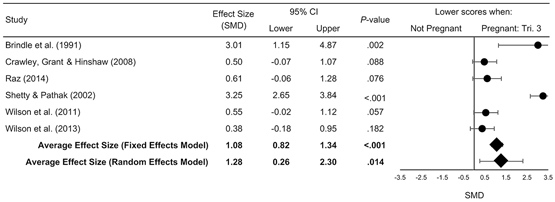
CI = confidence interval; SMD = standardised mean difference.
Box 3 – General cognitive functioning: comparison of pregnant women in their first and second trimesters (studies reporting within-group comparisons)
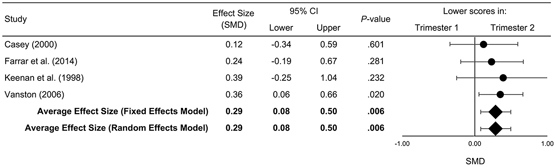
CI = confidence interval; SMD = standardised mean difference.
Box 4 – Memory functioning: comparison of pregnant women in their third trimester with non-pregnant control women (studies reporting between-group comparisons)
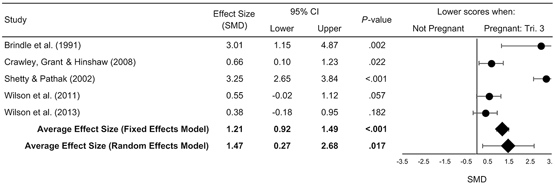
CI = confidence interval; SMD = standardised mean difference.
Competing interests
No relevant disclosures.
References
- Brett M, Baxendale S. Motherhood and memory: a review. Psychoneuroendocrinology 2001; 26: 339-362.
- Brindle PM, Brown MW, Brown J, et al. Objective and subjective memory impairment in pregnancy. Psychol Med 1991; 21: 647-653.
- Casey P, Huntsdale C, Angus G, Janes C. Memory in pregnancy. II. Implicit, incidental, explicit, semantic, short-term, working and prospective memory in primigravid, multigravid and postpartum women. J Psychosom Obstet Gynaecol 1999; 20: 158-164.
- Poser CM, Kassirer MR, Peyser JM. Benign encephalopathy of pregnancy: preliminary clinical observations. Acta Neurol Scand 1986; 73: 39-43.
- Parsons C, Redman S. Self-reported cognitive change during pregnancy. Aust J Adv Nurs 1991; 9: 20-29.
- Christensen H, Poyser C, Pollitt P, Cubis J. Pregnancy may confer a selective cognitive advantage. J Reprod Infant Psychol 1999; 17: 7-25.
- de Groot RHM, Hornstra G, Roozendaal N, Jolles J. Memory performance, but not information processing speed, may be reduced during early pregnancy. J Clin Exp Neuropsychol 2003; 25: 482-488.
- Glynn LM. Giving birth to a new brain: hormone exposures of pregnancy influence human memory. Psychoneuroendocrinology 2010; 35: 1148-1155.
- Parsons TD, Thompson E, Buckwalter DK, et al. Pregnancy history and cognition during and after pregnancy. Int J Neurosci 2004; 114: 1099-1110.
- Raz S. Behavioral and neural correlates of cognitive-affective function during late pregnancy: an event-related potentials study. Behav Brain Res 2014; 267: 17-25.
- Sharp K, Brindle PM, Brown MW, Turner GM. Memory loss during pregnancy. Br J Obstet Gynaecol 1993; 100: 209-215.
- Farrar D, Tuffnell D, Neill J, et al. Assessment of cognitive function across pregnancy using CANTAB: a longitudinal study. Brain Cogn 2014; 84: 76-84.
- Logan DM, Hill KR, Jones R, et al. How do memory and attention change with pregnancy and childbirth? A controlled longitudinal examination of neuropsychological functioning in pregnant and postpartum women. J Clin Exp Neuropsychol 2014; 36: 528-539.
- Crawley R, Grant S, Hinshaw K. Cognitive changes in pregnancy: mild decline or societal stereotype? Appl Cogn Psychol 2008; 22: 1142-1162.
- Cuttler C, Graf P, Pawluski JL, Galea LAM. Everyday life memory deficits in pregnant women. Can J Exp Psychol 2011; 65: 27-37.
- Henry JD, Rendell PG. A review of the impact of pregnancy on memory function. J Clin Exp Neuropsychol 2007; 29: 793-803.
- Wells GA, Shea B, O’Connell D, et al. The Newcastle–Ottawa Scale (NOS) for assessing the quality of nonrandomised studies in meta-analyses. The Ottawa Hospital Research Institute [website]. 2003. http://www.ohri.ca/programs/clinical_epidemiology/oxford.asp (viewed Oct 2017).
- Anderson MV, Rutherford MD. Recognition of novel faces after single exposure is enhanced during pregnancy. Evol Psychol 2011; 9: 47-60.
- Condon JT, Derham, D, Kneebone AC. Cognitive functioning during pregnancy: a controlled investigation using psychometric testing. Int J Prenatal Perinatal Psychol Med 1991; 60: 199-212.
- Harris ND, Deary IJ, Harris MB, et al. Peripartal cognitive impairment: secondary to depression? Br J Health Psychol 1996; 1: 127-136.
- Henry JF, Sherwin BB. Hormones and cognitive functioning during late pregnancy and postpartum: a longitudinal study. Behav Neurosci 2012; 126: 73-85.
- Keenan PA, Yaldoo DT, Stress ME, et al. Explicit memory in pregnant women. Am J Obstet Gynecol 1998; 179: 731-737.
- McDowall J, Moriarty R. Implicit and explicit memory in pregnant women: an analysis of data-driven and conceptually driven processes. Q J Exp Psychol A 2000; 53: 729-740.
- Onyper SV, Searleman A, Thacher PV, et al. Executive functioning and general cognitive ability in pregnant women and matched controls. J Clin Exp Neuropsychol 2010; 32: 986-995.
- Shetty DN, Pathak SS. Correlation between plasma neurotransmitters and memory loss in pregnancy. J Reprod Med 2002; 47: 494-496.
- Vanston CM, Watson NV. Selective and persistent effect of foetal sex on cognition in pregnant women. Neuroreport 2005; 16: 779-782.
- Wilson DL, Barnes M, Ellett L, et al. Compromised verbal episodic memory with intact visual and procedural memory during pregnancy. J Clin Exp Neuropsychol 2011; 33: 680-691.
- Wilson DL, Barnes M, Ellett L, et al. Reduced verbal memory retention is unrelated to sleep disturbance during pregnancy. Aust Psychologist 2013; 48: 196-208.
- Crawley RA, Dennison K, Carter C. Cognition in pregnancy and the first year post-partum. Psychol Psychother 2003; 76: 69-84.
- Casey P. A longitudinal study of cognitive performance during pregnancy and new motherhood. Arch Womens Ment Health 2000; 3: 65-76.
- Janes C, Casey P, Huntsdale C, Angus G. Memory in pregnancy. I. Subjective experiences and objective assessment of implicit, explicit and working memory in primigravid and primiparous women. J Psychosom Obstet Gynaecol 1999; 20: 80-87.
- Christensen H, Leach LS, Mackinnon A. Cognition in pregnancy and motherhood: prospective cohort study. Br J Psychiatry 2010; 196: 126-132.
- de Groot RMH, Vuurman EFPM, Hornstra G, Jolles J. Differences in cognitive performance during pregnancy and early motherhood. Psychol Med 2006; 36: 1023-1032.
- Hedges LV, Vevea JL. Fixed-and random-effects models in meta-analysis. Psychol Methods 1998; 3: 486.
- Higgins JP, Thompson SG, Deeks JJ, Altman DG. Measuring inconsistency in meta-analyses. BMJ 2003; 327: 557-560.
- Hoekzema E, Barba-Müller E, Pozzobon C, et al. Pregnancy leads to long-lasting changes in human brain structure. Nat Neurosci 2017; 20: 287-296.
Linked content
-
MJA InSight: “Baby brain”: it’s a thing
-
MJA Podcast: A/Prof Linda Byrne
Forty Years in the Making: Reporting on the Co-Creation of a National Roadmap for Birthing on Country Services for the Best Start to Life
Res McCalman, Anneka J. Bowman, Roianne West, Kristie Watego, Jyai Allen, Claire Clack, Sue Kildea, Sue Kruske, Melanie Briggs, Cleone Wellington, Rebecca Coddington, Yu Gao, Isabella Garti, Sascha Kowalenko, Sarah Ireland, Catherine Austin, John D. Boffa, Marah Prior, Kelsie Kahl, Bettina Chaseling, Sarah Khaw, Emily Armstrong, Donna Hartz, Yvette Roe
Temporal Trends in Preterm Birth Associated With Hypertensive Disorders of Pregnancy in Victoria, Australia: A Population-Based Interrupted Time-Series Study
Melvin Marzan, Heng Jiang, Daniel Lorber Rolnik, Joanne M. Said, Lisa Hui
Linguistic Manoeuvres: Obstetric Violence Camouflages Harm and Loss of Consent From Birth
Liz Sutton, Harsha Ananthram, Rebecca Matthews
Linguistic Manoeuvres: Obstetric Violence Camouflages Harm and Loss of Consent From Birth
Bashi Kumar-Hazard, Andrew M. Bisits, Sharon L. Settecasse, Jenny Gamble, Hazel Keedle, Hannah G. Dahlen
Linguistic Manoeuvres: Obstetric Violence Camouflages Harm and Loss of Consent From Birth
Wendy Pollock, Alissa Fleming, Ensieh Fooladi, Joy Kloester, Anne Tremayne, Yasmin Zisin, Bethany Carr, Kym Davey, Suzanne Willey, Jenny Gamble
Getting on the Same Page: Why Australia Needs a National Maternity Early Warning System (MEWS) Chart
Briony A. Cutts, Lucy Bowyer, Nisha Khot, Sandra Lowe, Stefan C. Kane