




Volume 207 - Issue 2
Wastewater analysis shows a large decrease in oxycodone use in Adelaide
Authors: Philip Crowley, Jason M White, Benjamin J Tscharke and Cobus Gerber
Med J Aust 2017; 207 (2): 88. || doi: 10.5694/mja17.00137
Published online: 17 July 2017
Published online: 17 July 2017
To the Editor:
In Adelaide, which comprises 78% of the population of South Australia, municipal wastewater has been subject to bimonthly analysis since 2009 to measure trends in substance use. Beginning in October 2015, there was a precipitous decrease in the detection of oxycodone residues in wastewater samples (Box). This decrease was counter to the long term trend of increasing amounts of this opioid in previous samples. Prescribing data show a continuing increase in the use of prescription opioid analgesics (POAs), including oxycodone, nationally and in SA, during the period between 1992 and 2011.1 There is a strong relationship between the amount of POAs used in a community and the amount of harm from opioid dependence and overdose.1
The cause of this regional trend change in oxycodone use has not been established. On 1 July 2015, there were some significant changes in the regulation of work injuries in SA which led to a decrease in the number of complex long term claimants, and there was also a similar change in South Australian motor vehicle injury regulation in July 2013. Complex injury claims are strongly correlated with POA use;2 however, the role of these factors is highly speculative and there may be many other factors that contributed to the results.
The methods used for the bimonthly wastewater analysis in Adelaide have been published before,3 and another group used this process to report changes in population methamphetamine use in Queensland.4 From October 2015, there was a change in the established temporal trend for oxycodone residues detected in Adelaide wastewater (Box). However, over the same period, there is no such trend change for national Pharmaceutical Benefits Scheme (PBS) and Repatriation PBS data for the number of oxycodone prescriptions dispensed (not total doses),5 or for Adelaide wastewater residues of methadone, which is predominantly dispensed for treatment of severe opioid use disorders via a specific program.
A limitation of our investigations was that no regional oxycodone prescription or wastewater data from other jurisdictions were available for comparison. Nonetheless, our findings suggest that wastewater analysis could potentially be used to rapidly monitor changes in substance use on a regional basis.
Box – Oxycodone and methadone residue in Adelaide wastewater compared with national data for the total number of oxycodone prescriptions supplied, December 2011 – February 20175
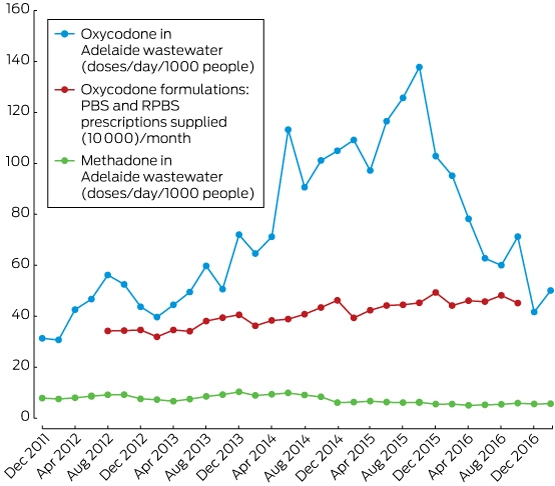
PBS = Pharmaceutical Benefits Scheme. RPBS = Repatriation Pharmaceutical Benefits Scheme.
Competing interests
No relevant disclosures.
Acknowledgements
We thank Drug and Alcohol Services South Australia for their assistance.
References
- Islam MM, McRae IS, Mazumdar S, et al. Prescription opioid analgesics for pain management in Australia: 20 years of dispensing. Intern Med J 2016; 46: 955-962.
- White JA, Tao X, Talreja M, et al. The effect of opioid use on workers’ compensation claim cost in the state of Michigan. J Occup Environ Med 2012; 54: 948-943.
- Tscharke BJ, Chen C, Gerber JP, White JM. Temporal trends in drug use in Adelaide, South Australia by wastewater analysis. Sci Total Environ 2016; 565: 384-391.
- Lai FY, O’Brien J, Thai PK, et al. Trends in methamphetamine residues in wastewater in metropolitan and regional cities in south-east Queensland, 2009-2015. Med J Aust 2016; 204: 151-152.
- Australian Government Department of Health. PBS statistics. PBS expenditure and prescriptions. https://www.pbs.gov.au/info/browse/statistics (accessed Mar 2017).
Reducing Nitrous Oxide Emissions Across the Melbourne Biomedical Precinct
Ross Robertson, Andrew Downey, Daryl Williams, Bjorn Makein, Ben Dunne, Tugce Ozturk, Ying Gu, Rebecca McIntyre
Greenhouse gas emissions associated with anaesthetic gases in Australia, 2002–2022: a retrospective descriptive analysis
Krista Verlis, Jessica F Davies, Forbes McGain, Hayden Burch, Alexandra L Barratt, Luise Kazda
Opioids and the challenges of managing chronic non‐cancer pain in rural Australia: a qualitative study
Jessica A Thomas, Jill Benson, Philip Davidson, Paul R Ward
Spinal cord stimulation patterns of care, re‐interventions, and costs for private health insurers, Australia, 2011–22: a retrospective observational study
Caitlin MP Jones, Christopher G Maher, Rachelle Buchbinder, Ian A Harris, Chung‐Wei Christine Lin, Christopher Hayes, Alexandra Gorelik
Prescription opioid supply‐restricting policies and hospital use by people prescribed opioid medications, Victoria, 2018–22: a controlled interrupted time series analysis
Suzanne Nielsen, Louisa Picco, Bosco Rowland, Nadine E Andrew, Taya A Collyer, Samanta Lalic, Rachelle Buchbinder, Christopher Pearce, J Simon Bell, Dan I Lubman, Ting Xia