




Volume 205 - Issue 11
A cautionary tale in forensic pathology
Author: Michael Burke
Med J Aust 2016; 205 (11): 509-510. || doi: 10.5694/mja16.00842
Published online: 12 December 2016
Published online: 12 December 2016
The importance of looking twice
The importance of looking twice
Professor Thomas McCrae is credited with the old adage: “More is missed by not looking than by not knowing”.
I will share a cautionary tale in which Professor McCrae’s statement may be paraphrased as “more is missed by not ‘really’ looking than by not knowing”.
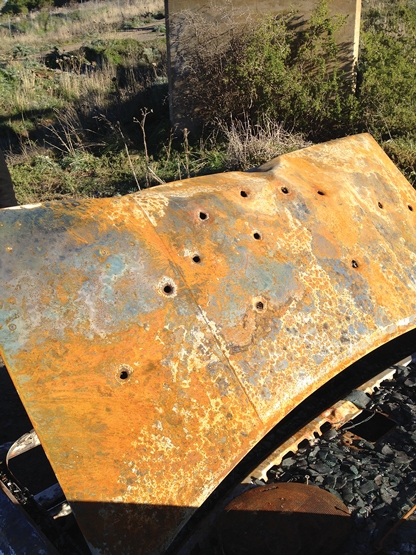
In late 2013, at around 5 o’clock in the afternoon — toward the end of a relatively quiet week as the on-call forensic pathologist in Victoria — I was called on my way home and asked to attend the scene of a suspicious death behind an industrial complex beneath the EJ Whitten Bridge, in the city of Brimbank. The homicide detective at the scene told me that a severely burnt body had been found in the boot of a burnt out car, which was situated down a steep embankment — about 100 metres behind the industrial estate — on the bank of the Maribyrnong River. There were multiple bullet holes to the boot lid of the vehicle. The discovery had been made by a young boy and girl, and confirmed by the first police officer on the scene.
As the so-called “Melbourne gangland war” had recently ended, the scene findings not surprisingly foreshadowed a possible return to gangland violence. I attended the scene and was escorted down a dirt track behind a block of concrete buildings to a floodplain, where a burnt out car was surrounded by police members and forensic crime scene examiners. The sun was setting and the ambient light was deteriorating. The situation was confounded by the fact that the vehicle’s boot was facing east and in shadows.
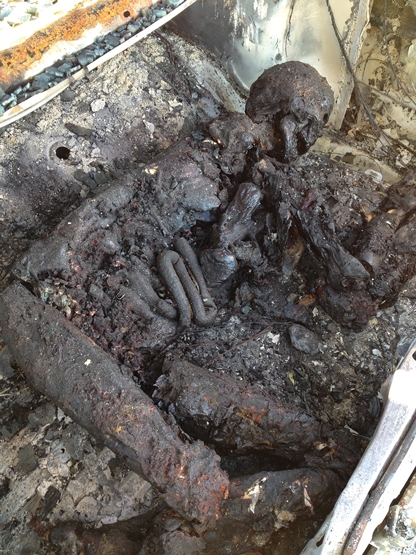
The open boot lid showed multiple circular holes spreading across its width (Box 1). The holes were particularly large, raising the possibility of the use of a large calibre rifled weapon or shotgun slugs. The distinct smell of burnt remains was immediately evident. While the boot itself lay in the shadow, the outline of a markedly burnt adult sized individual lying on its side was distinguishable (Box 2).
I declared the individual deceased and arranged for the body to be taken to the Victorian Institute of Forensic Medicine for post mortem computed tomography (CT) scanning and an autopsy later that night.
In fact, that is not exactly what happened.
I did receive a call from the Homicide Squad. I arrived at the scene and spoke to the police officer in charge of the scene. The officer immediately apologised for wasting my time and that no one had contacted me to inform me that I was not required anymore. I was somewhat surprised, especially in view of the large contingent of police officers and crime scene investigators still at the scene. It was then that I was told the full story.
Two youngsters had indeed found the burnt out car and the body in the boot. And there were numerous holes in the boot lid. A police officer had attended and confirmed their discovery and called the Homicide Squad, and subsequently the crime scene examiners.
It was here where the stories diverged.
The scene was being processed when a middle-aged person working in the industrial estate wandered up to the police officer who was maintaining the crime scene log and enquired about what was going on. It is my understanding that the officer was typically non-committal, no doubt regarding the man as a nosey member of the public. She was surprised when he suggested that he may be able to help.
He then informed the officer that a film shoot had taken place over the weekend, during which a car had been set alight.
It should be said here that crime scene examiners are trained to fully document a scene involving a suspicious death, and would not touch a body until the forensic pathologist had been consulted. While the detectives chased up this new information, the crime scene officers performed a closer inspection of the body in the boot. To their amazement they found that the body’s limbs were made from paper and the head was from an anatomy skeletal model.
So I knew all this before I examined the burnt body.
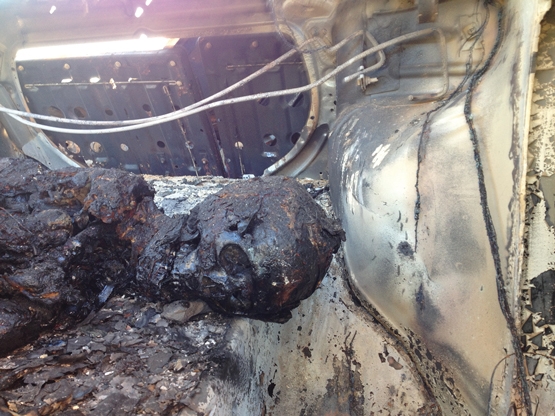
Not surprisingly, I was also taken aback by all of this. I asked if I could have a look and was escorted to the vehicle. Knowing the true story, it was all too obvious. The head had an unusual “Arnold Schwarzenegger–Terminator-like” appearance (Box 3), and the odour emanating from the boot had a distinct bacon-like quality. But more importantly, if one carefully and logically assessed the remains, there were basic forensic changes which were incompatible with a burnt human body in such circumstances.
The degree of destruction to the soft tissues of the abdomen appeared out of proportion with the changes of burning to the limbs, and there was no splitting of skin and subcutaneous fat to the limbs as one would expect given the degree of fire damage elsewhere. The ribs were not present, presumably destroyed by fire, and once again, a degree of destruction not consistent with other fire damage to the body. Probably the most obvious observation was that the joints of the lower limbs were clearly abnormal, with sharp, perpendicular edges. The bowel had a very unusual configuration and appeared to consist solely of small intestine. And lastly, a close inspection of the foot showed a small protruding metallic hook.
Later, some amateur film makers were interviewed by disgruntled police officers. They told the officers that an anatomy skeleton had been fashioned into a mannequin, with paper limbs formed from cylinders of paper and porcine offal used to simulate human intestines. The bullet holes were produced by punching a sharpened rod through the external aspect of the boot lid before the car was set alight.
I was not given the opportunity to look at the case cold. I would like to think that I would have recognised the inconsistencies and the obvious anatomical errors. However, a cursory inspection, in fading light, with tunnel vision, may well have proved otherwise.
Of course, in the end it would not really have mattered. The body would have been taken to the mortuary and the true nature of the remains would be clearly visible on the CT images. Or, even more likely, the undertakers would have been shaking their heads in disbelief — and maybe with some derision — as the mannequin was removed from the boot and the paper limbs slowly gave way.
What is the point of the story?
One hopes that a reputation is established through years of competent, unobtrusive work. It can vanish in the blink of an eye. Looking but not seeing. And seeing what one expects to see.

Competing interests
No relevant disclosures.
Provenance: Not commissioned; externally peer reviewed.
Decolonising Indigenous Health Research Requires Redefining Sex, Sexuality and Gender
Shakara Liddelow-Hunt, James H. L. Hill, Kate Daglas, Kaiwarr Clancy, Madi Day, Alistair Ott
Reducing Nitrous Oxide Emissions Across the Melbourne Biomedical Precinct
Ross Robertson, Andrew Downey, Daryl Williams, Bjorn Makein, Ben Dunne, Tugce Ozturk, Ying Gu, Rebecca McIntyre
Multimorbidity Clusters Among People Aged 65 Years and Over in Australia: A Nationwide Cross-Sectional Data Linkage Study
Weisi Chen, Christine Y. Lu, Sarah N. Hilmer, Alice A. Gibson, Edwin C. K. Tan
When ‘Liver Enzymes’ Are Not Hepatic: Late-Onset Pompe Disease
Shauna Madigan, Georgina England, Wayne Rankin
West Nile virus Kunjin subtype in rural NSW
Emily Gibson, Megan Whitley, Peter Murray, Linda Hueston, Jane Bennett, Raguharan Kathiresu, David N Durrheim
The impact of the Breast Screen NSW transition from film to digital mammography, 2002–2016: a linked population health data analysis
Rachel Farber, Nehmat Houssami, Katy J L Bell