




Volume 204 - Issue 5
A case of acute phosphate nephropathy
Authors: Aravinthan Loganathan, Ken-Soon Tan, John Moore and Kimberley Oliver
Med J Aust 2016; 204 (5): 183. || doi: 10.5694/mja15.01084
Published online: 21 March 2016
Published online: 21 March 2016
An important adverse event to consider when using oral sodium phosphate for bowel preparation in at-risk populations
A 74-year-old woman presented with a 2-day history of abdominal pain and nausea, 1 week after undergoing upper and lower endoscopies. Her comorbidities included hypertension, dyslipidaemia, sigmoid diverticulosis, transient ischaemic attack, peripheral vascular disease and mild valvular heart disease.
Medications taken before admission included telmisartan–hydrochlorothiazide, sustained-release verapamil, prazosin, rosuvastatin and aspirin.
Admission blood tests indicated acute kidney injury, with a serum creatinine concentration of 218 μmol/L (reference interval [RI], 46–99 μmol/L) and an estimated glomerular filtration rate of 19 mL/min/1.73 m2 (RI, > 60 mL/min/1.73 m2); her creatinine level 7 months earlier was 69 μmol/L. She was also hypokalaemic (potassium level, 2.9 mmol/L [RI, 3.5–5.1 mmol/L]), hypocalcaemic (corrected calcium concentration, 1.97 mmol/L [RI, 2.15–2.6 mmol/L]) and uraemic (urea concentration, 14.4 mmol/L [RI, 2.9–8.2 mmol/L]). However, she was normophosphataemic (phosphate level, 1.14 mmol/L [RI, 0.81–1.45 mmol/L]). Her urinary sediment was relatively benign, with a protein-to-creatinine ratio of 17 g/mol (RI, < 15 g/mol), an albumin-to-creatinine ratio of 3.4 g/mol (RI, < 1 g/mol) and no red cells present. Renal ultrasound showed normal sized kidneys with no evidence of obstruction.
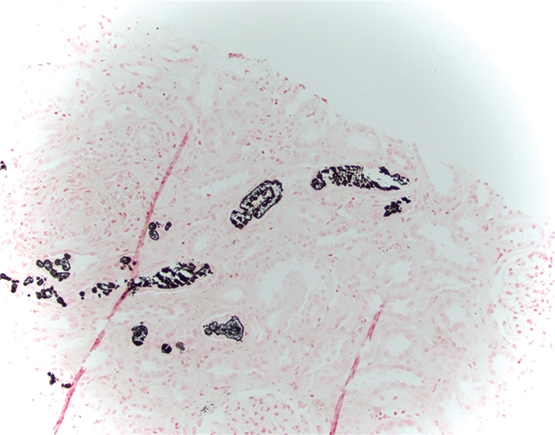
A medication review revealed she had taken 48 g of oral sodium phosphate before undergoing colonoscopy. Given the lack of improvement in renal function following intravenous hydration and withholding telmisartan–hydrochlorothiazide, a renal biopsy was performed. Light microscopy demonstrated non-polarising calcifications within the tubular cells and interstitium consistent with acute phosphate nephropathy (APN). A von Kossa stain confirmed calcium phosphate crystals (Box).
Our patient’s serum creatinine level stabilised at 130–140 μmol/L before discharge. A review in the outpatient’s clinic 1 month after discharge showed no further improvement in serum creatinine levels (131 μmol/L).
The incidence of APN is underestimated because many cases are clinically silent and can occur without evidence of hyperphosphataemia.1,2 APN occurs due to a combination of hypovolaemia and a sudden increase in serum phosphate concentration. Hypovolaemia induces proximal tubule salt and water reabsorption, resulting in a large phosphate load to the distal nephron and subsequent precipitation of calcium phosphate in the distal tubule and collecting duct.3
Associated risk factors for developing APN include increasing age, female sex, hypertension, diabetes, degree of hyperphosphatemia, pre-existing chronic kidney disease, angiotensin-converting enzyme inhibitors and angiotensin receptor blockers, diuretics, lithium and non-steroidal anti-inflammatory drugs.1,2
Patients who develop APN have a high probability of progressing to chronic kidney disease.1 Markowitz and colleagues studied a cohort of 21 patients with biopsy-proven APN. The mean serum creatinine level 17 months after oral sodium phosphate ingestion was 240 μmol/L. Four patients progressed to end-stage renal failure, requiring dialysis at the mean follow-up of 16.7 months.1 In an Icelandic study, the baseline serum creatinine level was 82 μmol/L in 15 patients before their diagnosis of APN. The mean serum creatinine level at 4-month follow-up was 180 μmol/L, with one patient becoming dialysis dependent.4
APN is an important adverse event to consider when using oral sodium phosphate for bowel preparation in at-risk populations. The consequences of APN may be significant and long term, as there is increased risk of progression to chronic kidney disease and end-stage renal failure. Thus, the clinician needs to demonstrate heightened pharmacovigilance when prescribing such agents and an increased clinical suspicion in diagnosing this condition.
Competing interests
No relevant disclosures.
References
- Markowitz GS, Stokes MB, Radharkrishnan J, D’Agati VD. Acute phosphate nephropathy following oral sodium phosphate bowel purgative: an underrecognized cause of chronic renal failure. J Am Soc Nephrol 2005; 16: 3389-3396.
- Ori Y, Rozen-Zvi B, Chagnac A, et al. Fatalities and severe metabolic disorders associated with the use of sodium phosphate enemas: a single center’s experience. Arch Intern Med 2012; 172: 263-265.
- Heher EC, Thier SO, Rennke H, Humphreys BD. Adverse renal and metabolic effects associated with oral sodium phosphate bowel preparation. Clin J Am Soc Nephrol 2008; 3: 1494-1503.
- Palmadottir VK, Gudmundsson H, Hardarson S, et al. Incidence and outcome of acute phosphate nephropathy in Iceland. PLoS One 2010; 5: e13484.
Early-Onset Colorectal Cancer With Liver-Only Metastases: A Retrospective Cohort Study Integrating Prospectively Collected Real-World Clinical and Molecular Data From an Australian National Database (2009–2024) to Guide Treatment Planning
Savio G. Barreto, Christos S. Karapetis, Shahid Ullah, Matthew Burge, Susan Caird, Angus Campbell, Azim Jalali, Ross Jennens, Muhammad A. Khattak, Belinda Lee, Stephanie H. Lim, Shehara Mendis, Louise Nott, Timothy J. Price, Jeremy D. Shapiro, Jeanne Tie, Javier Torres, Colin Williams, Rachel Wong, Vanessa Wong, Peter Gibbs
Australian Pathways for Specialist Pain Management and Early Palliative Care for People With Pancreatic Cancer: Developed Using a Community Consensus Approach
Jennifer Philip, Melanie R. Lovell, Kylee Bellingham, Gail Garvey, Gregory B. Crawford, Nicole M. Rankin, Kara Burns, Isabel Young, Vivienne Milch, Dorothy Keefe, Katrina Anderson, James Lawson, Meinir Krishnasamy
Cause‐specific mortality among Queensland people with cirrhosis, by cirrhosis aetiology and decompensation status, 2007–22: a retrospective cohort study
Vikas Bhasker, Jessica R Fong, Paul J Clark, Gunter F Hartel, Richard Skoien, James O’Beirne, Elizabeth E Powell, Patricia C Valery
Clinical practice guidelines for hepatocellular carcinoma surveillance for people at high risk in Australia: summary of recommendations
Jacob George, Nicole L Allard, Stuart K Roberts, Leon A Adams, Jane Davies, Behzad Hajarizadeh, Jennifer H MacLachlan, Suzanne E Mahady, Rosalie Altus, Catherine Brown, David C Fry, Belinda Greenwood‐Smith, Natali Smud, Patricia C Valery, Nafisa Yussf, Kate Broun, Denise Campbell, Karen Canfell, Chelsea Carle Harrison, Victoria Freeman, Paul Grogan, Catherine Holliday, Suzanne Hughes, Anna Kelly, Cathelijne Kemenade, Claire Latumahina, Amanda McAtamney, Megan Varlow, Joachim Worthington, Susan Yuill, Eleonora Feletto
Assessment of metabolic dysfunction‐associated fatty liver disease in primary care: a consensus statement summary
Leon A Adams, William W Kemp, Kate R Muller, Elizabeth E Powell, Stuart K Roberts, Luis Calzadilla Bertot, Stephanie Best, Gary Deed, Jon D Emery, Samantha L Hocking, Graham R Jones, John S Lubel, Sinead Sheils, Stephen M Twigg, Gerald F Watts, Jacob George
Treatment outcomes for people with hepatitis C referred to tertiary care in Victoria, 2021–22: a retrospective observational study
Elly Layton, Nicole Matthews, Brendan Quinn, Nasra Higgins, Gabrielle Lindeman, Mielle Abbott, Jennifer MacLachlan, Elizabeth Birbilis, Margaret E Hellard, Joseph Doyle, Benjamin C Cowie, Mark Stoové