




Reflections
Book/media/app
Volume 204 - Issue 3
A good nanny makes a difference
Author: Jackie M Street
Med J Aust 2016; 204 (3): 128. || doi: 10.5694/mja15.01243
Published online: 15 February 2016
Published online: 15 February 2016
The health gap: the challenge of an unequal world, by Michael Marmot
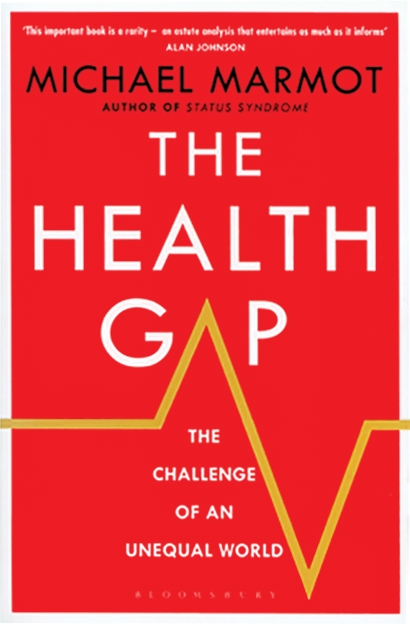
The health gap: the challenge of an unequal world. Michael Marmot. London: Bloomsbury Publishing, 2015 (400 pp, $35). ISBN 9781408857991.
Any person proposing interventions that change the lived environment, with the intention of improving health, will encounter the “nanny state” argument. This is the case be it John Snow removing the pump-handle from a cholera-infected water source in Victorian London or Nicola Roxon proposing plain packaging of cigarettes in modern Australia. Similarly, most general practitioners have experienced that sinking feeling on seeing the patient whose health issues arise from home or work environments over which the hapless GP has little sway. This book provides ammunition to defend the former and food for thought for responding to the latter. At the same time, Michael Marmot manages, in his inimitable style, to make his case both entertaining and accessible.
Marmot argues that empowerment is the key for reducing health inequalities and improving health across nations. But empowerment cannot be achieved by any magic bullet. One of the most revealing stories in the book is where Marmot, approached by a journalist — hard on the release of the World Health Organization Commission on Social Determinants of Health report, Closing the gap in a generation — is asked: “What’s the one thing you would recommend to the US President?” Marmot replies: “One thing? Read my report.” His point, made throughout the book, is that empowering a population requires broad societal change.
Empowerment is not simply equality of opportunity. Having the skills and capacity to grasp opportunity is essential. The child, who is read to less, talked to less and loved and valued less, is also much less able to exploit opportunity. Similarly, the parent educated in a poorly funded school and working a disempowering job for low pay is less able to provide a child-nurturing environment. The good news, from Marmot’s text, is that poverty and its consequences are not destiny. However, to break the link, societies do need to invest in some clear interventions: high-quality extended education, and taxes and social transfers to reduce child poverty. This book provides ample evidence that this works to improve not just the health and wellbeing of individuals but also builds wealth and prosperity in nations.
Not Gone but Often Forgotten: Action Needed to Address Tuberculosis in Aboriginal and Torres Strait Islander Communities
Nikkita Joshua, Emma L. Smith, Eunice (Cheeky) Love, Christopher P. Lowbridge, Nicole Tukana, Amy Bowden, Megan A. Campbell, Dawn Casey, James Ward
Unshrouding Social Determinants: A Case for Standardised Data in Australia's Health Information Ecosystem
Christopher Ryan, Christine T. Shiner, Rebecca J. Harris, Carrie Lethborg, Vijaya Sundararajan
Inequity Is Our Biggest Killer: Looking Upstream to Tackle the Burden of Disease in Australia
Meggan J. Devery, Katie Brooker, Kitty-Rose Foley
Inequity Is Our Biggest Killer: Looking Upstream to Tackle the Burden of Disease in Australia
Lucio Naccarella, Katrina Plamondon, Alison Brown, Alexandra Kent, Sana Shahram, Donya Eghrari, Nicole M. Rankin, Stephanie Best, Marlena Klaic, Zoe Fehlberg, Michelle Lambert, Sue Crengle
Inequity Is Our Biggest Killer: Looking Upstream to Tackle the Burden of Disease in Australia
Saman Khalatbari-Soltani, Edward Jegasothy, Seye Abimbola, Anita van Zwieten
Target Trial Emulation and the TARGET Guideline to Advance Rural and Remote Health Research
Tanvir Kapoor, Harrison J. Hansford, Brooke A. Spaeth, Adam D. Irwin, Aidan G. Cashin