




Volume 202 - Issue 4
Severe glaucoma and vision loss due to cosmetic iris implants
Authors: Dominic McCall, Alex Hamilton, John Grigg and Son Chau-Vo
Med J Aust 2015; 202 (4): 181. || doi: 10.5694/mja14.01526
Published online: 2 March 2015
Published online: 2 March 2015
A case of irreversible vision loss resulting from insertion of cosmetic colour iris implants
To the Editor: With medical tourism on the rise, public education concerning the risks of procedures performed abroad is imperative to the health and wellbeing of the Australian population. The insertion of cosmetic iris implants is a procedure currently promoted overseas. Here, we describe an example of the risks associated with this procedure.
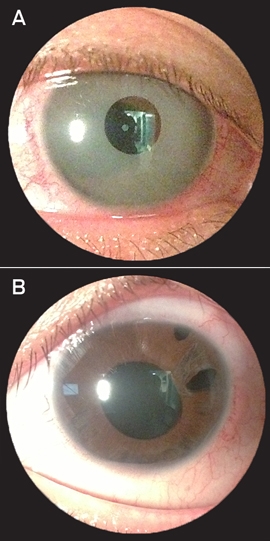
A 26-year-old man presented with acute right eye pain, conjunctival erythema and a high intraocular pressure of 40 mmHg (normal intraocular pressure is 11–21 mmHg). Secondary angle closure glaucoma was diagnosed.
Three years before presentation, the patient had bilateral NewColorIris implants inserted in Panama City. Removal of the implants was recommended but the patient initially declined. Medical glaucoma therapy was instituted. The glaucoma progressed and the eye became inflamed. The right iris implant was removed (Box).
A trabeculectomy enhanced with mitomycin C was required to control the intraocular pressure. The left implant was subsequently removed due to progressive glaucoma, and the left eye also required trabeculectomy enhanced with mitomycin C. This trabeculectomy failed, and the patient has recently undergone left glaucoma tube insertion (Baerveldt BG 101-350 Glaucoma Implant, Abbott Medical Optics). The patient's visual function declined due to progressive, irreversible glaucomatous visual field defects.
NewColorIris has been marketing and performing iris implants for cosmetic and non-cosmetic indications since 2006. To our knowledge, over 700 procedures have been performed at one site by one surgeon in Panama.
Recently, a new company called BrightOcular began offering artificial iris implants for indications such as iris heterochromia, albinism and aniridia, and for cosmetic use to change eye colour.1 The product is currently available in 10 countries worldwide.
To our knowledge, there are no published data on the safety of BrightOcular iris implants. However, given the complications associated with NewColorIris implants, as reported here and by others,2-4 we are concerned that similar safety problems may exist with this new device.
Cosmetic iris implants carry a high risk of irreversible visual loss. We highlight this risk for patients considering medical tourism and urge primary care providers to review the current literature before offering advice regarding this procedure.
Competing interests
No relevant disclosures.
References
- BrightOcular [website]. http://www.brightocular.com (accessed Aug 2014).
- Hoguet A, Ritterband D, Koplin R, et al. Serious ocular complications of cosmetic iris implants in 14 eyes. J Cataract Refract Surg 2012; 38: 387-393. 2
- Veldman PB, Behlau I, Soriano E, et al. Two cases of cosmetic iris implant explantation secondary to uveitis, glaucoma, and corneal decompensation. Arch Ophthalmol 2012; 130: 787-789. 3
- George MK, Tsai JC, Loewen NA. Bilateral irreversible severe vision loss from cosmetic iris implants. Am J Ophthalmol 2011; 151: 872-875. lefthere
A Diagnostic Headache
Thomas Glynn, Michelle T. Leech, Stacy K. Goergen, Emily Lin, Nadeem Toodayan, Ralph Junckerstorff
Neisseria meningitidis: an uncommon cause of conjunctivitis
Chloe Story, Tina Marinelli, Simeon Crawford, Amrita Ronnachit
Dismantling barriers to research and clinical care for individuals with a vision impairment
Eden G Robertson, Kate Hetherington, Meredith Prain, Julia Hall, Leighton Boyd AM, Rosemary Boyd OAM, Emily Shepard, Hollie Feller, Sally Karandrews, Fleur O'Hare, Kanae Yamamoto, Matthew P Simunovic, Robyn V Jamieson, Alan Ma, Lauren Ayton AM, Anai Gonzalez‐Cordero
The New South Wales Pharmacy Trial for herpes zoster: on the nose?
Christian P Pappas, Timothy R Holmes, Minas T Coroneo
Skin fragility disorder misdiagnosed as child abuse: a cautionary tale
Heather G Mack, Fred K Chen, John R Grigg
Health economic aspects of inherited retinal diseases: looking for cost‐effective treatments
Benjamin Kamien, Rachael Heath Jeffery, Fred K Chen