




Volume 202 - Issue 10
The gap remains: NHMRC research funding for suicide and self-harm, 2000–2014
Authors: Helen Christensen, Karolina Krysinska and Sue Murray
Med J Aust 2015; 202 (10): 525-526. || doi: 10.5694/mja15.00300
Published online: 1 June 2015
Published online: 1 June 2015
One centre of research excellence is not sufficient to make a serious dent in the problem of suicide and self-harm in Australia
To the Editor: In an article on National Health and Medical Research Council (NHMRC) funding for the National Health Priority Areas, Christensen and colleagues concluded that there was no narrowing of the gap in the proportion of funding provided to mental health research from 2001 to 2010.1 In particular, NHMRC funding per disability-adjusted life-year was the lowest for suicide and self-harm in comparison with other mental health categories and did not increase over 2001–2009.
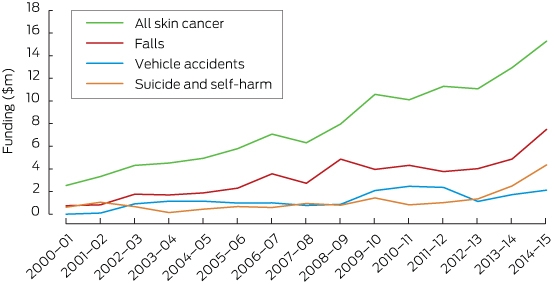
Analysis of NHMRC research funding for suicide and self-harm in comparison with other causes of high morbidity and mortality in Australia from 2000 to 2014 does not indicate that much progress has been made, and the gap still remains. Intentional self-injury in Australia ranked higher as the leading cause of death in 2013 than did skin cancers and accidental falls (14th, 16th and 18th leading cause, respectively).2 In 2013, suicide claimed more lives (2520) than either skin cancers (2209), accidental falls (1920) or transport accidents (1428); and the standardised suicide rate considerably exceeded mortality rates for these causes of death (10.7 compared with 8.3, 6.7 and 6.0 per 100 000 population, respectively).2 Yet NHMRC research funding for suicide and self-harm from 2000 to 2014 was lower than that for all skin cancers, falls and vehicle accidents (Box).3-5
Over this period, the NHMRC invested $17 407 912 in suicide research in the mental health category, funding 41 projects, including 21 project grants, four research fellowships and three early career fellowships.3 We have observed an evolution and a shift in the types of funding available and granted. NHMRC project grants to create new knowledge, which dominated in the early 2000s, have received less and less funding over time, suggesting that the complexity of suicide research may be out of step with NHMRC competitive criteria. On the other hand, funding opportunities for grants to build Australia's future capability (such as research, early career and career development fellowships) have increased, including fellowships to the NHMRC Centre of Research Excellence in Suicide Prevention (CRESP). Although only in operation for 3 years, funding for this new centre ($2 564 924 for 2012–2017) accounts for almost 10% of the total NHMRC actual expenditure. Three of five NHMRC project grants over 2013–2014 were awarded to CRESP researchers.
However, this investment is simply not enough. One centre of research excellence is not sufficient to make a serious dent in the problem of suicide and self-harm in Australia. All the while, we are losing seven people a day to suicide, a fact that requires an immediate response. The outrage associated with deaths from HIV/AIDS led to social action and subsequent science that has reduced the impact of this disease, allowing people to live meaningful lives. We need to do the same for suicide, which takes the lives of our productive and young people every day.
Competing interests
No relevant disclosures.
References
- Christensen H, Batterham PJ, Hickie IB, et al. Funding for mental health research: the gap remains. Med J Aust 2011; 195: 681-684. 1
- Australian Bureau of Statistics. Causes of death, Australia, 2013. Canberra: ABS, 2015. (ABS Cat. No. 3303.0.) http://www.abs.gov.au/ausstats/abs@.nsf/mf/3303.0 (accessed May 2015).
- National Health and Medical Research Council. Mental health (NHPA). https://www.nhmrc.gov.au/grants-funding/research-funding-statistics-and-data/funding-statistics-grants-and-funding-data/menta (accessed Mar 2015).
- National Health and Medical Research Council. Injury related issues (NHPA). https://www.nhmrc.gov.au/grants-funding/research-funding-statistics-and-data/funding-statistics-grants-and-funding-data/injur (accessed Mar 2015).
- National Health and Medical Research Council. Cancer (NHPA). https://www.nhmrc.gov.au/grants-funding/research-funding-statistics-and-data/funding-statistics-grants-and-funding-data/cance (accessed Mar 2015).
Co-Designed Best Practice Principles for the Care of Fathers and Non-Birthing Parents Exposed to Perinatal Trauma: A Participatory Action Research Study
Alka Kothari, Dale Trevor, Glen Quinn, Jane Geltch, Joel Dulhunty, Helen Skouteris, Leonie K. Callaway
Reorienting Allied Health Into Community-Based Care for People Experiencing Trauma and Social Disadvantage
Simon Rosenbaum, Grace McKeon, Gulsah Kurt, Oscar Lederman, Kemi Wright, Sabuj Kanti Mistry, Jackie E. Curtis, Philip B. Ward, Zachary Steel, Hamish Fibbins, Rachel Morell, Melissa C. Eaton, Andrew Watkins, Ben Harris-Roxas, Brendan Goodger, Eleanor Beck, Megan Teychenne, Joseph Firth, Davy Vancampfort, David Burns, Russell Roberts, Tristan Favaloro, Danielle Weber, Rosanna Barbero, Vasili Maroulis, Melissa Holmes, Stefan Mackenzie, Chiara Mastrogiovanni, Afsana Anwar, Uzma Choudhry, Catherine Sherrington, Jane Currie, Thomas Gadsden, Scott Teasdale
Stigmatising Attitudes Towards People With Depression, Bipolar Disorder, Borderline Personality, ADHD and Early and Long-Term/Untreated Schizophrenia: Representative Survey of Australian Adults
Amy J. Morgan, Anna M. Ross, Gayle McNaught, Rachel Green, Nicola J. Reavley
Psychosocial Hazards for Healthcare Workers: Supporting the Second Victim Also Helps the Primary Victims
Sarah Michael
Supporting Population Mental Health in the Wake of Mass Tragedies
Susan J. Rees, Derrick M. Silove