




Volume 201 - Issue 3
Removing the interview for medical school selection is associated with gender bias among enrolled students
Authors: Natasha Behrendorff and David Liu
Med J Aust 2014; 201 (3): 143-144. || doi: 10.5694/mja14.00428
Published online: 4 August 2014
Published online: 4 August 2014
Increasing school-leaver enrolments and offering fewer graduate-entry places may explain gender bias
To the Editor: Wilkinson and colleagues recently presented data showing a reduction in female graduate-entry enrolments in the University of Queensland's medical program,1 and suggested that this was due to the removal of interviews from the selection process and gender bias in GAMSAT scores.
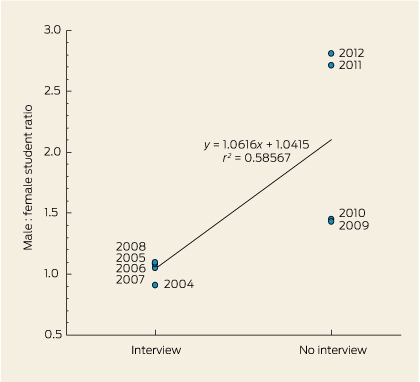
This explanation is a poor fit for the observed data (r2 = 0.586; see Box 1). The GAMSAT gender bias explains why male students were favoured (and not female), but Wilkinson et al did not explain why removing the interview would directly impact enrolments. Since the magnitude of the GAMSAT bias has remained stable over time, the yearly increase in the magnitude of bias towards male enrolments from 2009 until 2012 remains unexplained.
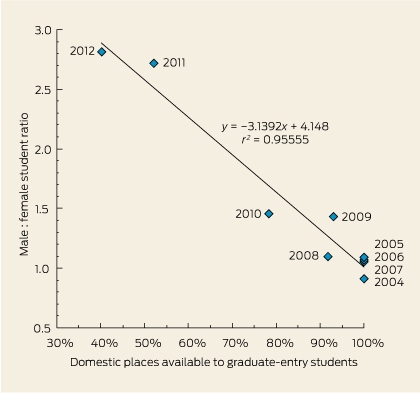
We present an alternate hypothesis: that the gender bias occurred due to the increase in school leaver pathway enrolments, and the corresponding decrease in direct graduate-entry places offered (r2 = 0.956, Box 2).
Before 2009, about 130% of the expected intake was shortlisted for interview using GAMSAT score as the ranking criterion. From 2009 onwards, 100% of the intake was selected using GAMSAT ranking only — thereby raising the cut-off score. Given the male GAMSAT bias, this resulted in the small increase in male enrolments between 2008 and 2009.
Data from Wilkinson et al show that since 2010, the school leaver pathway intake has increased substantially but the total domestic enrolment has remained constant. This reduced the number of places offered to graduate-entry applicants, which resulted in higher GAMSAT cut-offs2 that favoured male applicants due to the underlying GAMSAT gender bias.
We believe that the dramatic bias towards male graduate-entry enrolments in 2011 and 2012 is a direct consequence of the reduction in the number of places offered. To restore gender equity in a GAMSAT-based ranking system, we recommend that the School of Medicine restore the graduate-entry intake in future cohorts to prior levels.
Competing interests
No relevant disclosures.
References
- Wilkinson D, Casey MG, Eley DS. Removing the interview for medical school selection is associated with gender bias among enrolled students. Med J Aust 2014; 200: 96-99. lefthere
- University of Queensland. Doctor of Medicine (MD) - Direct Entry for Graduates. http://www.uq.edu.au/study/?page=189904 (accessed Jul 2014).