




Volume 200 - Issue 7
Murray to the Mountains intern training program: involvement of small health services
Authors: John B Best, Shane L Boyer, Craig J De Lacy, Jacque S Phillips, Terrence M Welch and Geoff J McColl
Med J Aust 2014; 200 (7): 378-380. || doi: 10.5694/mja13.10802
Published online: 21 April 2014
Published online: 21 April 2014
A well organised, rurally based intern program delivers high-quality training and diverse experience
A well organised rurally based intern program delivers high-quality training and diverse experience
The Murray to the Mountains (M2M) intern training program was first proposed in 2009. Its purpose was to address current and projected shortages in the medical workforce in rural Victoria and beyond.
Perceived medical workforce shortages and maldistribution have stimulated increases in the recruitment of international medical graduates and in the number of graduating Australian students. As a result, the number of domestic and international medical school graduates rose from 1860 in 2007 to 3284 in 2012 — a 76.6% increase.1 The subsequent demand for positions, from internship to vocational training, presented an opportunity to examine the possibility of training students and interns in rural and regional settings as an alternative to major urban hospitals.2
The M2M intern training program provides a rural alternative, at the same time improving health care in the area, through:
enhancement of the level of skills and training of interns locally;
regional retention of new graduates during their early postgraduate years; and
a resultant cohort of rurally oriented general practitioners and medical specialists.
M2M had access to the University of Melbourne Rural Clinical School (Shepparton and Wangaratta campuses), and the chief executive officers (CEOs) of the health services involved in the program were strong advocates.
Location
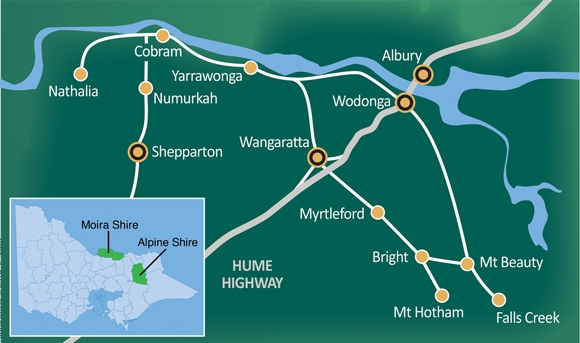
The core of the M2M program comprised Cobram District Health, Nathalia District Hospital, Numurkah District Health Service (NDHS) and Yarrawonga Health (YH) in Moira Shire, and Mount Beauty District Hospital, one of the three Alpine Heath campuses. The Moira and Alpine Shires are in the Upper Hume region in north-east Victoria (Box 1).
Health services
Acute bed numbers at the beginning of 2012 are shown in Box 2. Emergency care is provided by nursing staff and the GP on call. All health services include residential aged care facilities for high-care residents. YH and NDHS also have facilities for low-care residents, and YH has a dementia-specific facility. The Moira Shire health services share a half-time director of medical services (DMS), and Alpine Health has a part-time DMS.
General practices
There are eight general practices in the “M2M towns”: two each in Cobram, Numurkah and Yarrawonga and one each in Nathalia and Mount Beauty. At the beginning of 2012, the year of the inaugural intern intake, there were 42 GPs working full- or part-time in these practices (38.6 full-time equivalent [FTE]).
Mount Beauty Medical Centre operates the Falls Creek Medical Centre during the ski season from 10:00 am to 5:30 pm 7 days a week. At least two doctors from the Centre (one senior GP and one senior GP registrar) are in the clinic at all times. The GPs are supported by 40 visiting medical, surgical and other specialists. Most come from Wangaratta, Shepparton and Albury-Wodonga. Consultant geriatricians come from Western Health as part of a clinical and teaching program. Visiting specialists are credentialled and privileged for a given scope of practice at the local health service. They consult at either the general practices or the hospital.
The Murray to the Mountains model
Interns are required by the Postgraduate Medical Council of Victoria (PMCV) to complete at least 48 weeks of supervised clinical experience comprising three core terms (medicine, surgery and emergency medicine) and non-core rotations in the hospital or in general practice. The M2M program tests the proposition that interns based in small country towns will receive appropriate postgraduate training and may develop a local attachment. The key to the M2M program is that the interns are based in small rural towns and “rotate in” to larger regional health services for their core rotations, thus staying in the region and further strengthening their link to the area. Cooperation from Northeast Health Wangaratta and Albury Wodonga Health has been integral to these core rotations.
This “rotating in” counters the traditional model of intern distribution whereby interns traditionally “rotate out” from parent hospitals (major metropolitan and some major regional hospitals) to rotation sites. As a result, in the traditional model, the interns may feel no allegiance to the rural location.
Interns
In 2011, 213 final-year medical students expressed interest in undertaking their internship at an M2M site, 90 of whom made a written application. Questionnaires were sent to those 90 — 50 replied, 30 were interviewed, 21 were graded and five (three women and two men) were selected. One came from each of the Universities of Melbourne, Notre Dame Australia (Fremantle) and Tasmania, and two came from Monash University.
Short-listing for interview, grading and final selection were based on: 1) academic performance, 2) referees’ reports and 3) rural background, previous attendance at a rural clinical school or previous rural general practice placement. As part of the PMCV computer matching service, before allocation, prospective interns were placed into priority groups depending on whether, for example, they were Australian permanent residents, or whether they went to a Victorian university or an interstate university.
Program funding
The Victorian Department of Health (DoH) has provided the funding for the M2M interns and program infrastructure, including for the director of clinical training (DCT). It is anticipated that economies of scale can be achieved by increasing intern numbers with little increase in infrastructural requirements.
Each health service provides funding for clinical governance, essentially for the DMS. The Australian Government Department of Health, through General Practice Education and Training Limited, funds the general practice rotation through the Prevocational General Practice Placements Program. This funding goes to the participating practices via the Bogong Regional Training Network.
M2M obtained funding for two other programs that have increased, among other things, intern expertise in specific areas. The first is the visiting clinical and teaching geriatric program. Consultant geriatricians from Western Health visit the four Moira Shire health services at 6-week intervals to review patients and provide up to three educational sessions. This program has enhanced service provision and improved the skill sets of health professionals. The second was a series of six videoconferences on paediatric health from Royal Children’s Hospital specialists. Eleven local sites have been involved, demonstrating how videoconferencing can be used to augment the M2M program. The program was also funded in 2013.
Program management
The core management team of the M2M program comprises CEOs of the five health services. The CEO at NDHS has financial responsibility for the program. The Manager — Regional Junior Medical Programs is responsible for introducing the new interns to their first job, ensuring optimal social conditions and encouraging an undergraduate and postgraduate interactive working environment.
The Moira Shire health services DMS chairs the Joint Credentialing and Privileging Committee for the Moira Shire health services and that for Alpine Health. These committees are responsible for making recommendations on credentialling and privileging annually. All medical practitioners wishing to work within the M2M health services are interim credentialled and privileged by the chair of the committees, further unifying clinical governance within M2M.
The Moira Shire health services DMS is also the DCT. Combining these two roles has been important in ensuring the M2M model functions effectively. The DCT has a role in the orientation program, assuring supervision, ongoing assessment during the year and pastoral care. This supervision role has involved ensuring the participation of the interns in the various training program activities and obtaining feedback.
Training program
The five interns were based with different general practices for their 20-week general practice terms. This 20-week block, rather than the more usual 10 weeks, provides greater continuity of learning and a better opportunity for the interns to have a thorough grounding in general practice, and maximises the benefit of the learning experience in a single location, particularly in areas such as the snowfields rotation. It also minimises the amount of relocation and allows for annual leave to be taken without diminishing the value of the general practice experience. Parallel consulting is the basis for teaching in general practice,3 together with managing hospital inpatients and residents in aged care facilities.
The formal components of the training program are:
eight skills workshops (emergency birthing, otolaryngology, ophthalmology, dental, cardiology, fractures, diagnostic imaging review, communication skills);
eight grand rounds;
six clinical review meetings; and
speakers at monthly medical education committee meetings.
The M2M program aims for diversity and collegiality, and the longer the interns are in the general practice location, the more likely these objectives are to be fulfilled.
Developing links and expanding the program
The “mingling” of the extended rural cohort students, who are completing the University of Melbourne medical program and have a year in rural general practice as part of that course, with the interns provides the opportunity to create “curriculum intersections” (areas in training where the curriculum requirements can come together) for medical students and interns.
The DoH has approved an increase from five to 10 M2M interns in 2014. There are adequate positions and funding for sufficient core rotation positions in postgraduate year (PGY) 1, to meet the needs of the developing rural medical generalist program and to assure access to PGY2 and PGY3 jobs.
The introduction of the rural medical generalist concept by the DoH has proved vital for the expansion of the M2M concept. Although its initial focus has been providing more procedural GPs, there is the prospect of a proposed non-procedural stream, for example, mental health professionals.
Outcomes
The objectives of recruitment and retention have been achieved. Feedback from the five interns about their M2M experience has been very positive. All five obtained PGY2 positions in the area for 2013, at Albury Wodonga Health or Northeast Health Wangaratta, and are interested in working in rural or regional practice. Thus, the M2M program has provided additional intern training places, and the DoH approval for an increase from five to 10 interns for 2014 acknowledges the program’s success.
Discussion
The aim of M2M is to provide a diverse program for interns who understand their capabilities but can react appropriately when confronted with the unexpected. The general practice rotation includes both conventional general practice consulting and the diversity provided by a small health service with an operating theatre and visiting specialists. Interns may assist the surgeon or the anaesthetist. The program targets collegiality and strongly encourages interns to remain in the region or return after training elsewhere.
A University of Melbourne–M2M link has been established. Links to the regional health services have also been established in the first year, but if intern career development is to be enhanced without necessarily moving beyond the region, further places must be found for the PGY2 and PGY3 years. M2M has enhanced the local intellectual capital by recruiting outside expertise through workshops, grand rounds, clinical review and a wider range of speakers who will increasingly constitute a “videoconferenced presence”, providing interactive presentations by videoconference to multiple sites across the region.

2 Acute care beds by number and type at the beginning of 2012, and number of births in 2011
|
Number and type of beds |
|
|||||||||||||
Health service |
Medical |
Medical and surgical |
Medical, surgical and obstetrics* |
Births in 2011 |
|||||||||||
Cobram District Health |
|
12 |
|
|
|||||||||||
Nathalia District Hospital |
6 |
|
|
|
|||||||||||
Numurkah District Health Service |
|
21 |
|
|
|||||||||||
Yarrawonga Health |
|
|
24 |
85 |
|||||||||||
Mount Beauty District Hospital |
|
|
10 |
5 |
|||||||||||
* Obstetrics services for normal, low-risk patients only. |
|||||||||||||||
Competing interests
No relevant disclosures.
Acknowledgements
We thank Janine Sargeant and Jayne Ramshaw for their assistance with preparing the manuscript.
References
- Medical Deans Australia and New Zealand. Annual tables: 2013 student statistics. http://www.medicaldeans.org.au/statistics/annualtables (accessed Dec 2013).
- Strasser R, Neusy AJ. Context counts: training health workers in and for rural and remote areas. Bull World Health Organ 2010; 88: 777-782. i1115732
- Walters L, Prideaux D, Worley P, et al. What do general practitioners do differently when consulting with a medical student? Med Educ 2009; 43: 268-273. i1115736