




Volume 200 - Issue 1
Gonorrhoea infection, reinfection and co-infection in men in inner Sydney: a population-based analysis
Authors: Kelly-Anne Ressler, Mark J Ferson and Elizabeth J Smedley
Med J Aust 2014; 200 (1): 26. || doi: 10.5694/mja13.10945
Published online: 20 January 2014
Published online: 20 January 2014
Data linking multiple disease notifications from the same individuals show patterns of infection in Sydney men
To the Editor: From 2000 to 2009, national and New South Wales gonorrhoea notification rates were reasonably stable, but since 2010 have shown a marked rise.1 In a recent inner Sydney clinic-based study, most infections were in men who have sex with men (MSM), and chlamydia co-infection was common.2
In 2010, NSW Health introduced a new notifiable diseases database, which enables linking of multiple disease notifications from the same individual. We used the database to examine the pattern of notifications of gonorrhoea infection, reinfection and co-infection in residents of South Eastern Sydney Local Health District from 1 January 2010 to 31 December 2012. Ethics approval was not required as the Director of the Public Health Unit (M J F) is custodian of local notifiable diseases data and has authority to publish such data.
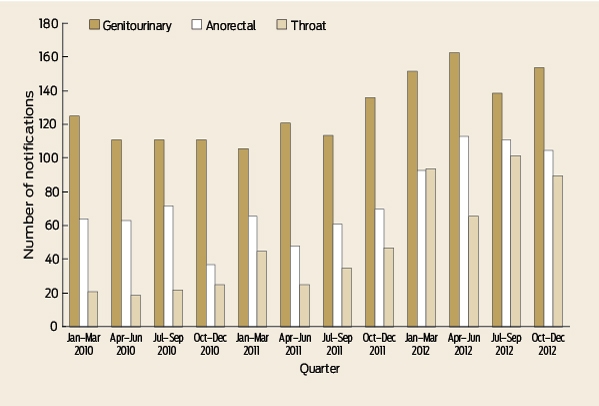
During the study period, 3132 cases of gonorrhoea were reported. We concentrated our analyses on men, who represented 2765 cases (88.3%). Of note was a fourfold increase in throat infections, from 87 in 2010 to 352 in 2012, and a 78.8% rise in anorectal infections, from 236 in 2010 to 422 in 2012 (Box 1). Almost one in 10 notifications (9.2%) were for two or more sites of infection.
The 2765 notifications were for 2430 men, of whom 272 (11.2%) had more than one episode of gonorrhoea infection in the 3-year period, or an 8.1% reinfection rate within 1 year. Thirteen men had notifications of infection at the same site within 10 weeks of the original notification; some of these may have represented treatment failure, an important concern in the context of increasing antibiotic resistance among isolates of Neisseria gonorrhoeae.3 The numbers of men with concurrent notifications of either primary or secondary syphilis or chlamydia are shown in Box 2. In addition, 841 men (34.6%) had notifications of two or more episodes of any sexually transmissible infection at any time during the 3-year period.
This population-based analysis allowed us to quantify the frequency of multiple notifiable sexually transmissible infections in men living in south-eastern Sydney, an area with Australia’s largest concentration of MSM,4 and in whom there has been a high rate of infectious syphilis.5 The rates of reinfection6 and co-infection with chlamydia2 were similar to those reported in sexual health clinic clients. As gonorrhoea is notifiable only by laboratories, demographic and risk factor information is not routinely provided. Work is currently proceeding in NSW on using enhanced surveillance to gain information on Indigenous status and risk factors for gonorrhoea infection.
Competing interests
No relevant disclosures.
References
- Australian Government Department of Health and Ageing. National Notifiable Diseases Surveillance System. http://www9.health.gov. au/cda/source/rpt_3.cfm (accessed Jul 2013).
- Templeton DJ, Manokaran N, O’Connor CC. Prevalence and predictors of chlamydia co-infection among patients infected with gonorrhoea at a sexual health clinic in Sydney. Sex Health 2012; 9: 392-394. 0_i1142908
- Whiley DM, Goire N, Lahra MM, et al. The ticking timebomb: escalating antibiotic resistance in Neisseria gonorrhoeae is a public health disaster in waiting. J Antimicrob Chemother 2012; 67: 2059-2061. 0_i1142910
- Madeddu D, Grulich A, Richters J, et al. Estimating population distribution and HIV prevalence among homosexual and bisexual men. Sex Health 2006; 3: 37-43. 0_i1142912
- Botham SJ, Ressler KA, Maywood P, et al. Men who have sex with men, infectious syphilis and HIV coinfection in inner Sydney: results of enhanced surveillance. Sex Health 2013; 10: 291-298. doi: 10.1071/SH12142. 0_i1142914
- Hughes G, Nichols T, Peters L, et al. Repeat infection with gonorrhoea in Sheffield, UK: predictable and preventable? Sex Transm Infect 2013; 89: 38-44. 0_i1142918
Costs of Delivering the Hep B PAST Model of Care in Remote Australia: A Retrospective Pre–Post Study
Hoa Nguyen, Anh Le Tuan Nguyen, Paula Binks, Melita McKinnon, Emily Vintour-Cesar, Karen Wills, Nicola Stephens, Benjamin Cowie, Joshua S. Davis, Yuejen Zhao, Peter Nihill, Julie A. Campbell, Andrew J. Palmer, Jane Davies, Barbara de Graaff
Buruli Ulcer Acquired From Ringtail Possum Rescue
Daniel P. O'Brien, Naomi Clarke, Sara Bonnici, Mohammad A. Hussain
Q Fever Visceral Abscesses After Contact With Native Australian Marsupials
Samantha J. Laws, Enzo Binotto, James Stewart, Jennifer Ho, Trent Yarwood, Josh Hanson, Simon Smith
Hospital-Admitted Injection-Related Infections Among Incarcerated People Who Inject Drugs in Australia: A Retrospective Cohort Study
Andrew Palmer, Matthew Carter, Jeremy Yeo, Cecilia Shim, Jason Connor, Jeremy Hayllar, Gerald Holtmann, Naomi Moy, Elliott G. Playford, Naomi Runnegar, Paul J. Clark
The Live Attenuated Influenza Vaccine in Australia: An Additional Tool for Influenza Prevention
Cyra Patel, Alexis Pillsbury, Tran Nguyen, Xia Wang, Helen E. Quinn, Clayton K. Chiu, Allen C. Cheng, Katie L. Flanagan, Zhicheng Wang
Reflex Testing for Hepatitis D Infection: A Unique Opportunity to Reduce Hepatitis D-Related Chronic Liver Disease Deaths in Australia
Jessica Howell, Lauren Andersson, Miriam T. Levy, James O'Beirne, Leon Adams, Katharine Irvine, Avik Majumdar, Golo Ahlenstiel, Kathy Jackson, Krispin Hajkowicz, Joseph Doyle, Jane Davies, Sarah Cherian, Wayne Dimech, Alexander J. Thompson