




Volume 199 - Issue 7
Neat model for ethical problem solving
Author: Peter W Saul
Med J Aust 2013; 199 (7): 511. || doi: 10.5694/mja13.10868
Published online: 7 October 2013
Published online: 7 October 2013
Into a fourth edition - and my, how it’s grown! Having started life in 1998 at a portable (but hardly pocket-sized) 500 pages, it is now a hefty 1200. Most of the growth comes from the doubling in size of the chapters, with a few entirely new sections for this edition, most notably some cautionary tales about emerging biotechnologies. Sexuality and reproduction has received much greater attention, ...
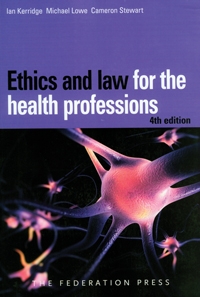
Ethics and law for the health professions, 4th ed.
Ian Kerridge, Michael Lowe, Cameron Stewart. Sydney: Federation Press, 2013 (1232 pp, $90). ISBN 9781862879096
Into a fourth edition — and my, how it’s grown! Having started life in 1998 at a portable (but hardly pocket-sized) 500 pages, it is now a hefty 1200. Most of the growth comes from the doubling in size of the chapters, with a few entirely new sections for this edition, most notably some cautionary tales about emerging biotechnologies. Sexuality and reproduction has received much greater attention, as has our rather problematic relationship with the drug industry.
This new edition also has the most sophisticated model for ethical problem solving in clinical medicine that I have seen — a neat attempt to distil the best from existing models in use in the United States clinical ethics industry.
As in the earlier editions, the first question posed is “what is ethics?”, but it behoves a reviewer to also ask “what use is ethics, and why do we want a 1200-page textbook on it?”. We have little empirical evidence that clinicians see “ethics” as separable from other elements of clinical practice, or that they use models for ethical problem solving (however sophisticated). So there seems little likelihood that such a textbook could occupy the same ecological niche as a Harrison’s.
But this text has great strengths that have become more apparent with its increasing maturity. The integration of ethics and law is nicely balanced — at arm’s length in the beginning, but more integrated as the book progresses through the core topics.
The authors, Ian Kerridge and Cameron Stewart of the University of Sydney’s Centre for Values, Ethics and the Law in Medicine, and Northern Territory community geriatrician Michael Lowe, are more than qualified for the job. Stewart’s legal radar is spot on, with laser-sharp analysis, and Kerridge and Lowe give full rein to their imagination, drawing in material from a dizzying array of sources.
Most of all, this book is that greatest rarity — a standard text that is a page turner, a cracking read that quotes from the Bhagavad Gita, and contains a Henry Lawson poem, in full. You don’t get that in Harrison’s.
Mending the Road: A Way Forward From Silence and Silencing
Ayman Hamdan, Anisa J. N. Jafar
Seven Vessel Spontaneous Coronary Artery Dissection and Concurrent Transient Global Amnesia After an Emotional Trigger
Michael J. Stewart, Tom R. Sutherland
Seven Vessel Spontaneous Coronary Artery Dissection and Concurrent Transient Global Amnesia After an Emotional Trigger
Virginia Barbour
Research Priority Setting Is Not Research: A Call for Ethical Clarity in Australia
Bec Jenkinson, Gordon McGurk, Jonathan Quicke, Janelle Bowden, Nadine E. Foster
Organ Donation After Oral Ingestion of a Voluntary Assisted Dying Substance
Joanne Kantianis, Helen I. Opdam, Rohit L. D'Costa
Equity, Diversity and Inclusion From the Start: Reforming Australia's Research Infrastructure for Inclusive Participation
Danielle M. Muscat, Kirsten J. McCaffery, Heather L. Shepherd, Marguerite Tracy