




Volume 199 - Issue 4
Consistently high incidence of diabetic ketoacidosis in children with newly diagnosed type 1 diabetes
Authors: Carol M Willis, Jennifer A Batch and Mark Harris
Med J Aust 2013; 199 (4): 241-242. || doi: 10.5694/mja12.11808
Published online: 2 September 2013
Published online: 2 September 2013
To the Editor: Data from the tertiary paediatric hospitals in Brisbane (Royal Children’s and Mater Children’s Hospitals) support Claessen and colleagues’ letter.1
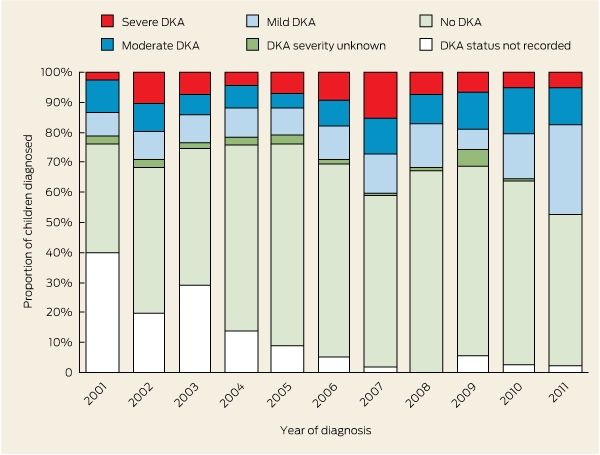
A total of 1091 children aged < 18 years were initially admitted from 1 January 2001 to 31 December 2011 with a new diagnosis of type 1 diabetes (T1D) (Box). Diabetic ketoacidosis (DKA) was defined as venous pH < 7.3 or serum bicarbonate level < 15 mmol/L in association with hyperglycaemia and ketoacidosis. Severity was defined ...
To the Editor: Data from the tertiary paediatric hospitals in Brisbane (Royal Children’s and Mater Children’s Hospitals) support Claessen and colleagues’ letter.1
A total of 1091 children aged < 18 years were initially admitted from 1 January 2001 to 31 December 2011 with a new diagnosis of type 1 diabetes (T1D) (Box). Diabetic ketoacidosis (DKA) was defined as venous pH < 7.3 or serum bicarbonate level < 15 mmol/L in association with hyperglycaemia and ketoacidosis. Severity was defined as mild (pH 7.2 to < 7.3, or serum bicarbonate level 10 mmol/L to < 15 mmol/L), moderate (pH 7.1 to < 7.2, or serum bicarbonate 5 mmol/L to < 10 mmol/L) and severe (pH < 7.1, or serum bicarbonate < 5 mmol/L). Overall, 348 of 1091 children (31.9%; 95% CI, 29.1%–34.7%) presented with DKA over the 11 years studied. Initial analysis of trend suggested that the proportion of DKA was increasing over the period (χ2 test for trend, P = 0.005). However, when the 119 children whose DKA status was not recorded were excluded, this trend was no longer significant (P = 0.296), suggesting that the trend observed was a result of case ascertainment bias. To further assess this bias we analysed the period from 1 January 2006 to 31 December 2011 (which had minimal patients with DKA status not recorded), and there was no change in the trend of DKA presentations (P = 0.272).
A recent Australian study aimed at increasing awareness of T1D resulted in a decreased number of children presenting with DKA in the intervention region (15/40 to 4/29; P < 0.03), while in the control region there was no significant reduction in the rate of DKA over the same period (46/123 to 49/127).2
We confirm the high rates of DKA in children first admitted with a diagnosis of T1D to tertiary paediatric hospitals in Brisbane, and this has not decreased over the past decade. Given that DKA is associated with significant morbidity and mortality, combined with recent evidence that improved awareness of T1D can decrease DKA rates at presentation, it seems appropriate to initiate public awareness campaigns on a larger scale.3

Competing interests
No relevant disclosures.
References
- Claessen FM, Donaghue K, Craig M. Consistently high incidence of diabetic ketoacidosis in children with newly diagnosed type 1 diabetes [letter]. Med J Aust 2012; 197: 216. https://www.mja.com. au/journal/2012/197/4/consistently-high-incidence-diabetic-ketoacidosis-children- newly-diagnosed-type-1
- King BR, Howard NJ, Verge CF, et al. A diabetes awareness campaign prevents diabetic ketoacidosis in children at their initial presentation with type 1 diabetes. Pediatr Diabetes 2012; 13: 647-651. 0_CBBDCEFE
- Edge JA, Ford-Adams ME, Dunger DB. Causes of death in children with insulin dependent diabetes 1990-96. Arch Dis Child 1999; 81: 318-323. 0_CBBHGCDB
When ‘Liver Enzymes’ Are Not Hepatic: Late-Onset Pompe Disease
Shauna Madigan, Georgina England, Wayne Rankin
Primary Hyperparathyroidism in Adults: Recent Developments in Diagnosis and Management
Elizabeth Wootton, Sunita M. C. De Sousa, Richard L. Prince, Donald S. A. McLeod, David A. Pattison, Mathis Grossmann
Severe Hypoglycaemia Secondary to Chronic Opioid-Induced Hypothalamic–Pituitary–Adrenal Axis Suppression: An Under-Recognised Phenomenon
Michael Do, Annabelle Hayes, Malgorzata Brzozowska
Rethinking diabetes care for Indigenous Australians: the need for Indigenous‐codesigned and led diabetes models of care
Natalie Nanayakkara, Sharon Atkinson‐Briggs, Alicia J Jenkins, Neale D Cohen
The first Australian evidence‐based guidelines on male infertility
Darren J Katz, Liza O’Donnell, Robert I McLachlan, Tim J Moss, Clare V Boothroyd, Veena Jayadev, Sarah R Catford