




Volume 199 - Issue 10
Re-treating bleeding hereditary haemorrhagic telangiectasia with bevacizumab
Authors: Gwo Yaw Ho, Edward Zhong and Boris Chern
Med J Aust 2013; 199 (10): 658. || doi: 10.5694/mja13.10260
Published online: 18 November 2013
Published online: 18 November 2013
The monoclonal antibody bevacizumab is used to treat symptomatic bleeding in patients with hereditary haemorrhagic telangiectasia; the bleeding often recurs in time, and it seems it may be effective and safe to re-treat with bevacizumab.
To the Editor: Symptomatic bleeding in patients with hereditary haemorrhagic telangiectasia (HHT) has been reported to respond to bevacizumab treatment. In this Journal in March 2011, Cruikshank and Chern described the successful treatment of gastric HHT with bevacizumab.1 Here, we present the result of a rechallenge with bevacizumab in the same patient.
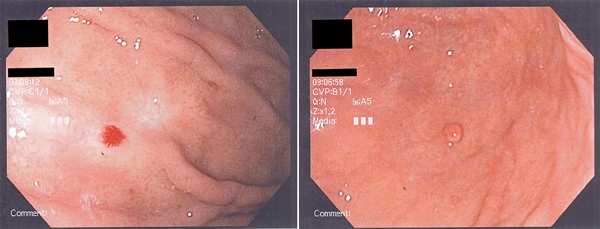
Following 18 months of being haemorrhage-free after therapy with bevacizumab, the 72-year-old man returned to the clinic with increased frequencies of epistaxis and upper gastrointestinal bleeding. Multiple facial and hand telangiectasias were observed. Endoscopy revealed two HHT lesions and evidence of residual gastric antral vascular ectasia (Box).
The patient was rechallenged with six cycles of intravenous bevacizumab therapy, delivered fortnightly at a dose of 5 mg/kg, and completed in May 2012. He tolerated the treatment well and reported no adverse side effects; specifically, there was no hypertension or proteinuria. He reported Grade 1 lethargy, which was likely due to anaemia as he had a haemoglobin level of 89 g/L. His anaemia resolved during the course of the treatment.
A follow-up endoscopy after the bevacizumab therapy showed complete resolution of the HHT lesions and few residual hypoplastic polyps. The patient has reported no further gastrointestinal bleeding or epistaxis to date. We continue to monitor him, and will consider further bevacizumab treatment if needed.
Despite there being little evidence for the repeated use of intravenous bevacizumab therapy in patients with HHT, our case suggests that bevacizumab rechallenge is effective and safe. The time until relapse in patients with HHT after a dose regimen of bevacizumab therapy comparable to the one we used has been reported to range from 3 months to a year.2-4 In our patient, the initial bevacizumab therapy was successful in suppressing the HHT for up to 18 months.
Competing interests
No relevant disclosures.
References
- Cruikshank RP, Chern BW. Bevacizumab and hereditary haemorrhagic telangiectasia. Med J Aust 2011; 194: 324-325. 0_i1142864
- Brinkerhoff BT, Poetker DM, Choong NW. Long-term therapy with bevacizumab in hereditary hemorrhagic telangiectasia. N Engl J Med 2011; 364: 688-689. 0_i1142866
- Brinkerhoff BT, Choong NW, Treisman JS, Poetker DM. Intravenous and topical intranasal bevacizumab (Avastin) in hereditary hemorrhagic telangiectasia. Am J Otolaryngol 2012; 33: 349-351. 0_pgfId-2884136
- Bose P, Holter JL, Selby GB. Bevacizumab in hereditary hemorrhagic telangiectasia. N Engl J Med 2009; 360: 2143-2144. 0_i1142870
Splenic injury in severe cases of the zoonoses Q fever and rickettsial infection: diagnostic challenges
Ashleigh Drury, Philippa Harrison, Aiveen Bannan
Health and economic benefits of improving pre‐hospital identification of stroke in Australian women: a modelling study
Thomas Gadsden, Lei Si, Emily R Atkins, Cheryl Carcel, Xia Wang, Stephen Jan, Mark Woodward, Laura E Downey
Updating the diagnosis and management of elevated serum ferritin levels in the era of routine ferritin testing of blood donors by Australian Red Cross Lifeblood
Gary D Zhang, James Chen, Daniel M Johnstone, Martin B Delatycki, Katie Allen, John K Olynyk
Early cardiovascular collapse after envenoming by snakes in Australia, 2005–2020: an observational study (ASP‐31)
Geoffrey K Isbister, Katherine Z Isoardi, Angela L Chiew, Shane Jenkins, Nicholas A Buckley
Updated recommendations for warfarin reversal in the setting of four‐factor prothrombin complex concentrate
Danielle Robinson, James McFadyen, Eileen Merriman, Chee Wee Tan, Ross Baker, Huyen Tran
Updating the diagnosis and management of iron deficiency in the era of routine ferritin testing of blood donors by Australian Red Cross Lifeblood
Gary D Zhang, Daniel Johnstone, Michael F Leahy, John K Olynyk