




Volume 199 - Issue 10
Epidemiology of tuberculosis and levels of vitamin D in Australia: person, place and time
Authors: Jennifer H MacLachlan and Benjamin C Cowie
Med J Aust 2013; 199 (10): 655-656. || doi: 10.5694/mja13.10478
Published online: 18 November 2013
Published online: 18 November 2013
The coincident seasonality of active TB cases and vitamin D deficiency suggests that low vitamin D levels may increase the likelihood of reactivation of tuberculosis. Vitamin D testing and supplementation is therefore recommended for high-risk groups.
To the Editor: We recently reported the impact of latitude on seasonality of tuberculosis in Australia, with greater cyclic variation in southern parts of the continent.1 We hypothesise that this seasonality is partly determined by differences in ultraviolet radiation exposure and subsequent vitamin D synthesis.1-3
Vitamin D deficiency (serum 25-hydroxyvitamin D levels below 50 nmol/L)3 has become a significant public health concern in Australia. Australians with darker skin, including some migrants and Aboriginal and Torres Strait Islander people, are at particular risk of both vitamin D deficiency3,4 and tuberculosis.1,5
Similar to our findings regarding tuberculosis incidence,1 a recent Australian study found that vitamin D deficiency was most prevalent in spring and that risk was highest for residents in major cities, people from socioeconomically disadvantaged areas, and those aged 20–39 and ≥ 80 years.2 These factors also apply to tuberculosis, including the age distribution (Box).
The correlations between seasonal variations in, and risk factors for, vitamin D deficiency and tuberculosis in Australia reinforce the ecological association between these conditions. Such associations cannot determine causality; but their consistency argues that guidelines should consider the potential impact of vitamin D deficiency on people at greatest risk of tuberculosis.1 The increased risk of tuberculosis conferred by vitamin D receptor polymorphisms supports a causal role for vitamin D deficiency in active tuberculosis.6
Despite increasing observational data regarding vitamin D deficiency and risk of tuberculosis, evidence supporting vitamin D supplementa-tion to reduce this risk is lacking.6 However, given the broader potential health impacts of vitamin D deficiency in high-risk populations, we support recent calls to increase vitamin D testing in these groups and to promote supplementation for those at greatest risk of both tuberculosis and vitamin D deficiency, including migrants with darker skin.3
Serum 25-hydroxyvitamin D levels of at least 50 nmol/L at the end of winter have been recommended for optimal bone and muscle function,3 with supplementation continued into spring to avert depletion.2 This seasonal focus on ensuring adequate vitamin D levels in people at risk of both vitamin D deficiency and tuberculosis could also reduce the seasonal peak of disease each spring, particularly in the southern states of Australia.1
Age distribution of tuberculosis (TB) notifications* and vitamin D levels† in Australia
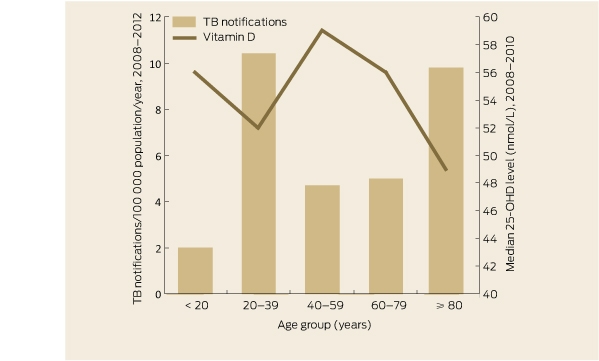
25-OHD = 25-hydroxyvitamin D. * Source: National Notifiable Diseases Surveillance System. † Source: Boyages and Bilinski.2
Competing interests
No relevant disclosures.
References
- MacLachlan JH, Lavender CJ, Cowie BC. Effect of latitude on seasonality of tuberculosis, Australia, 2002–2011. Emerg Infect Dis 2012; 18: 1879-1881. 0_CHDECJJA
- Boyages S, Bilinski K. Seasonal reduction in vitamin D level persists into spring in NSW Australia: implications for monitoring and replacement therapy. Clin Endocrinol (Oxf) 2012; 77: 515-523. 0_i1142915
- Nowson CA, McGrath JJ, Ebeling PR, et al. Vitamin D and health in adults in Australia and New Zealand: a position statement. Med J Aust 2012; 196: 686-687. 0_i1142918
- Vanlint SJ, Morris HA, Newbury JW, Crockett AJ. Vitamin D insufficiency in Aboriginal Australians. Med J Aust 2011; 194: 131-134. 0_i1142921
- McBryde ES, Denholm JT. Risk of active tuberculosis in immigrants: effects of age, region of origin and time since arrival in a low-exposure setting. Med J Aust 2012; 197: 458-461. 0_i1142924
- Ralph AP, Lucas RM, Norval M. Vitamin D and solar ultraviolet radiation in the risk and treatment of tuberculosis. Lancet Infect Dis 2013; 13: 77-88. 0_i1142927
Costs of Delivering the Hep B PAST Model of Care in Remote Australia: A Retrospective Pre–Post Study
Hoa Nguyen, Anh Le Tuan Nguyen, Paula Binks, Melita McKinnon, Emily Vintour-Cesar, Karen Wills, Nicola Stephens, Benjamin Cowie, Joshua S. Davis, Yuejen Zhao, Peter Nihill, Julie A. Campbell, Andrew J. Palmer, Jane Davies, Barbara de Graaff
Epidemiology and Quality of Care for Aboriginal and Torres Strait Islander Peoples Treated by Emergency Medical Services for Stroke in Victoria, Australia: Retrospective Analysis of Linked Data
Candice Menezes, Ziad Nehme, Luke J. Burchill, Tegwyn McManamny, Angela Dos Santos, Michelle Crilly, Luke P. Dawson, Benjamin Clissold, David Anderson, Emily Nehme
Hepatitis C Among First Nations Australians: A Rethink Is Required to Meet the 2030 Elimination Target
James Ward, Emily Pegler, Kellie Stacy, Stephen Harfield
Sovereignty and Survival: Understanding Lung Cancer Outcomes for Aboriginal and Torres Strait Islander People in Australia, a Case–Control Study
Alice R. T. Bergin, Luc te Marvelde, Roger L. Milne, Benjamin J. Solomon, Kris Ivanova, Peter Savas, Stephen J. Luen, Jay Hamann, Andrea Casey, Nicole Watt, Sue M. Evans, Gail Garvey, Sherene Loi
Rethinking Rheumatic Fever Diagnosis: Progress, Pitfalls and the Path Towards a Definitive Test
Anna P. Ralph, Rachel Webb, Tom Parks, Nicole J. Moreland, Asha C. Bowen, Benjamin Jones, Emma Ndagire, Andrea Z. Beaton
Not Gone but Often Forgotten: Action Needed to Address Tuberculosis in Aboriginal and Torres Strait Islander Communities
Nikkita Joshua, Emma L. Smith, Eunice (Cheeky) Love, Christopher P. Lowbridge, Nicole Tukana, Amy Bowden, Megan A. Campbell, Dawn Casey, James Ward