





Volume 198 - Issue 9
The challenge of suicide prevention
Author: Ruth Y Lim
Med J Aust 2013; 198 (9): 503-504. || doi: 10.5694/mja12.10766
Published online: 20 May 2013
Published online: 20 May 2013
Alarge military truck slowly rolls up to the small emergency unit in Mullaitivu, a remote town on the north-eastern coast of Sri Lanka. In the back of the truck are two bodies. A young man and woman still entwined. Tied to each other with muddied strips of saree cotton, once vibrant and colourful. A double suicide pact outlined in a simple letter in the hands ...
Alarge military truck slowly rolls up to the small emergency unit in Mullaitivu, a remote town on the north-eastern coast of Sri Lanka. In the back of the truck are two bodies. A young man and woman still entwined. Tied to each other with muddied strips of saree cotton, once vibrant and colourful. A double suicide pact outlined in a simple letter in the hands of the farmer who stumbled across their bodies in a jungle clearing. An illegal marriage across castes, an unborn child, chronic pain from shelling injuries sustained over decades of civil war. Deaths of loved ones, dire job prospects and the vision of life ahead lived in abject poverty have proved too much for the young couple.
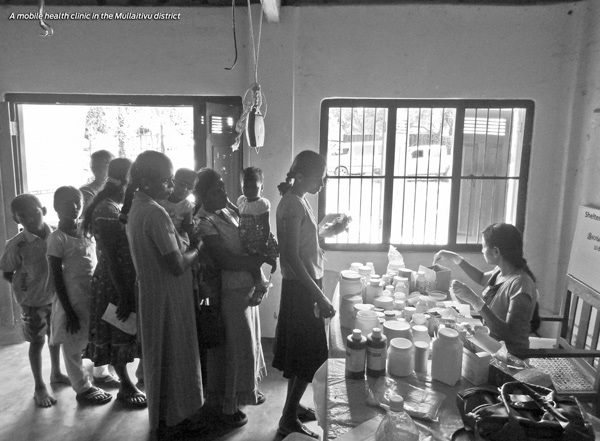
In early 2009, Mullaitivu was the last stronghold of the Liberation Tigers of Tamil Eelam and the site of the last land battle between the Sri Lanka Army and the Tamil Tigers. Today, as the last of the government internment camps close down, it is home to thousands of newly resettled internally displaced people struggling to rebuild their lives under UNHCR-administered tarpaulin and four timber poles per family. A small government grant covers basic costs for the first few months, after which meagre compensation is only available for those with significant war-related disabilities — multiple amputations, paraplegia, head injuries. Basic infrastructure is still minimal, employment opportunities are scarce, and those who are physically able turn to farming or backbreaking paddy field work to make ends meet. Dirt roads become impassable during the monsoon season, and most travel hours via foot, bicycle or tuktuk to seek primary medical care.
In a short period of 6 months spent working at the Mullaitivu District Hospital emergency unit, I witness countless suicide attempts. Young and old. Male and female. Educated and illiterate. Attempted, sometimes completed. Methods employed vary, but poisons are popular. And effective. Here are their stories.
A young man, just 24 years of age, drinks a litre of kerosene before being rushed to the emergency unit. He fell in love last year and eloped. But she is the wrong caste and the wrong religion. Upon return to his village, he finds his father has already proclaimed the death of his son to the whole village, and held a funeral service for him. After a lengthy stay in hospital and significant chemical pneumonitis, he makes a full physical recovery.
An elderly man, probably 70 years of age, drinks an unknown quantity of the fatal organophosphate pesticide paraquat. He is also an alcoholic who has battled with the cheap locally brewed toddy (fermented coconut sap) ever since his release from a camp 2 years ago. He lost his two eldest sons during the latter part of the war, and his wife lost a leg during shelling raids. The conversation about the near-universal fatality of paraquat ingestion with him and his wife is one I would gladly never repeat. He dies a slow death from irreversible respiratory fibrosis on the medical ward over the following week.
A mother of two is rushed into the emergency unit in an agitated, drowsy state. No one saw what happened, but there is an empty bottle of MCPA, a readily available herbicide, out the back of her shelter. With no antidote or treatment available, we monitor her over hours of agitation, drowsiness and rhabdomyolysis. Upon her recovery, she tells our counsellors that she watched her husband die at the hands of soldiers, and does not know the whereabouts of her elder two sons, captured by militants 3 years earlier. She also has some persistent vaginal bleeding and a linear posterior vaginal wall tear. She does not remember, or will not say, how this happened.
According to the World Health Organization, suicide is the thirteenth leading cause of death in the world and the third leading cause of death between the ages of 15 and 34 years.1 About 1 million people are estimated to die from suicide this year and a further 10–20 million people will attempt suicide worldwide.
The latest available data show that Sri Lanka ranks second in suicide rates among Asian nations, at 24 deaths per 100 000 population.1 Non-Indigenous Australia’s suicide rate is under 10 deaths per 100 000 population (NB, Indigenous Australia’s suicide rate is close to three times higher).2 In spite of these figures, it is widely believed that there is still substantial underreporting of suicide in Sri Lanka, especially in the war-torn north-eastern region, known to have the highest suicide rate in the country.1 Moreover, deaths from poisons are often misclassified as accidental or due to an undetermined cause, resulting in further underestimation of the real rate of suicide.3
The profile of suicide and suicidal behaviour differs significantly between developed and developing countries. Available data indicate that the association between mental disorders and suicide is less robust in developing countries.1 Socioeconomic stress and maladjustment, social and family conflict, physical and sexual abuse, lack of access to health care services and displacement appear to be as significant in predisposing to suicidal behaviour as underlying mental health or substance misuse.4 In terms of age distribution, proportionally more suicides in developing countries occur below the age of 30 years, at enormous psychological, social and economic cost.1
Despite the obvious burden of suicide and suicidal behaviour, mental health and suicide prevention are low priorities for many developing nations struggling to address infectious diseases, malnutrition, infant and maternal mortality and the growing epidemic of chronic diseases. Across South-East Asia, there is an average of 0.44 mental health professionals (including psychiatrists, psychiatric nurses, psychologists and psychiatric social workers) per 100 000 population.5 Non-government organisations dedicated to mental health attempt to fill the enormous gap in mental health services in the developing world, but much of the work being done lacks rigorous evaluation and quality control.1 Within the international arena, the United Nations Convention on the Rights of Persons with Disabilities was only widely ratified in 2006.6
Strategies for suicide prevention in developing countries, as outlined by the World Health Organization1 and other international health alliances including the Disease Control Priorities Project,4 need to be comprehensive and multifaceted to deal with this significant but of hidden global health issue. Reliable and accurate reporting and data collection is of paramount importance but often complicated by ineffective, inefficient bureaucracy and distorted by social stigma and cultural attitudes towards suicide. Political and financial stumbling blocks hinder development of strong national suicide prevention plans that should ideally emphasise support for vulnerable populations and education on suicide prevention for primary health care workers. Access to basic medical health care is often limited, and funding for mental health services is low on the priority list for many struggling nations.
Mullaitivu was an endearing place. Simultaneously, it was a beautiful and dreadful reminder of the resilience and fallibility of humankind. But stories from this town are not unique. It is becoming evident that suicide and suicidal behaviour is a significant public health problem in the developing world. The major challenge for effective suicide prevention strategies is the need to be comprehensive, coordinated and committed with very limited resources and significant system constraints.
References
- Hendin H, Phillips M, Vijayakumar L, et al, editors. Suicide and suicide prevention in Asia. Geneva: World Health Organization, 2008. www.who.int/mental_health/resources/suicide_prevention_asia.pdf (accessed Jul 2012).
- Australian Bureau of Statistics. Causes of death, Australia, 2009. Canberra: ABS, 2011. (ABS Cat. No. 3303.0.) http://www.abs.gov.au/ausstats/abs@.nsf/mf/3303.0 (accessed Jul 2012).
- Asian Legal Resource Centre. Preventing suicide in Sri Lanka [statement submitted to the United Nations Commission on Human Rights]. 3 Feb 2003. http://www.unhchr.ch/Huridocda/Huridoca.nsf/TestFrame/2265274258fe12adc1256d020036a35e?Opendocument (accessed Jul 2012).
- Vjayakumar L, Nagaraj K, John S. Suicide and suicide prevention in developing countries. Washington, DC: Disease Control Priorities Project, 2004. (Working Paper No. 27.) http://www.dcp2.org/file/41/wp27.pdf (accessed Jul 2012).
- World Health Organization. Atlas: mental health resources in the world. Geneva: WHO, 2001. www.who.int/mental_health/media/en/244.pdf (accessed Jul 2012).
- United Nations. Convention on the Rights of Persons with Disabilities. http://www.un.org/disabilities/default.asp?id=150 (accessed Jul 2012).
Dousing the burning inequity of global warming for people experiencing homelessness
Timothy English, Alejandro Vásquez Hernández, Glenn Miller, Nuala Fogarty, Charles Cosgrove, Paul Rosenthal, Matthew Larkin, Jon Swain, Danielle Austin, Jo River
The contribution of evidence‐based practice and the practice‐based evidence approaches to contemporary Australian psychology: implications for culturally safe practice
Paul Gray (Wiradjuri), Dawn Darlaston‐Jones, Pat Dudgeon AM (Bardi), Kate Derry, Joanna Alexi, William Smith (Wiradjuri and Wemba Wemba), Tanja Hirvonen (Jaru and Bunuba), David Badcock, Shraddha Kashyap, Belle Selkirk (Noongar)
Explaining risk in chronic conditions: the Yolŋu science of signs
Emma Haynes, Alison Mitchell, Minitja Marawili (Yolŋu), Dawn C Bessarab (Bardi)
Is it time to retire the label “CALD” in public health research and practice?
Sabine Allida, Della Maneze
What do Aboriginal people in the Northern Territory value during the operation journey? A qualitative study
Edith B Waugh, Marita Hefler, Sophie Pascoe, Mark Mayo, Matthew JL Hare, David A Story, Neil Wilkshire, Peter Henwood, David Croker, Jampijinpa Ross
Fulfilling First Nations health, cultural safety and equity accreditation standards in primary medical education: reflections from a First Nations desktop review team
Paul Saunders, Nicole Mercer, Maria Mackay, Ian Lee, Madelyne Hudson‐Buhagiar, Miriam Cavanagh, Emma Milliss, Melody Muscat, Kathleen Martin, Adam Shipp, Melissa Johnson, Belinda Gibb