




Volume 198 - Issue 8
Injuries to the head and face sustained while surfboard riding
Authors: Simon J Dimmick, Patrick V Sheehan, Mark Gillett and Suzanne E Anderson
Med J Aust 2013; 198 (8): 419-419. || doi: 10.5694/mja13.10006
Published online: 20 May 2013
Published online: 20 May 2013
To the Editor: Surfboard riding is an iconic pastime in Australia. Injuries to the head and face constitute a considerable proportion of surfing injuries;1-5 26% of acute surfing injuries are to the head and face, and these make up 42% of emergency department presentations by surfers.3
We conducted a retrospective review at our tertiary referral hospital of patients who underwent medical imaging for injuries sustained to ...
To the Editor: Surfboard riding is an iconic pastime in Australia. Injuries to the head and face constitute a considerable proportion of surfing injuries;1-5 26% of acute surfing injuries are to the head and face, and these make up 42% of emergency department presentations by surfers.3
We conducted a retrospective review at our tertiary referral hospital of patients who underwent medical imaging for injuries sustained to the head and face while surfboard riding from January 2008 to January 2012. We searched the hospital radiology databases for patient records containing the terms “surfboard”, “surfer” or “surfing”. Patients were included if they were injured while surfboard riding and were excluded if they were injured during other water-based activities (eg, bodyboarding, kitesurfing, bodysurfing, paddleboarding). Twenty-nine patients were identified: 23 males and six females (mean age, 34 years; range, 10–73 years). Of the 26 who had acute injuries, 17 had imaging of the head only, seven had imaging of the head and cervical spine and two underwent a trauma protocol (computed tomography scans of the head, spine, chest and abdomen). Fifteen patients had been struck in the head by their own board, nine had other mechanisms of injury (primarily involving contact with the sea floor and associated neck pain), one collapsed while surfing and one was retrieved from the surf unconscious (mechanism of injury was unknown). The most common significant injuries were facial fractures (five of 26 patients, all of whom had been struck by their own board). One patient ruptured their left globe after being struck by their own board. No intracranial trauma (eg, intracranial haemorrhage, contusion) was identified.
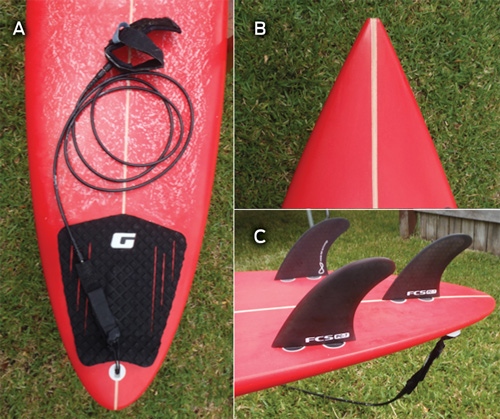
Surfboard design and surfing accessories have evolved significantly over the past 20 years. Lighter, shorter boards are now commonly used and provide greater manoeuvrability in the water. Leg ropes are universally used to ensure that surfer and board do not become separated (Box). However, lighter boards and leg ropes might increase the risk of being struck and injured by one’s own board during a “wipe-out”. The pointed nose and fins on the undersurface of the board are also potentially injurious (Box).
Understanding injury mechanisms can drive surfboard and surfing accessory design to reduce the risk of injury and death. Protective devices — such as helmets, protective eyewear and nose guards that cover the tip of the surfboard — have been marketed, but there is no evidence of their effectiveness in injury reduction.

Competing interests
No relevant disclosures.
Acknowledgements
We thank Cameron Sutton (radiographer, Royal North Shore Hospital) for providing the surfboard photographs. This study was funded by a grant from the Royal Australian and New Zealand College of Radiologists.
References
- Hay CS, Barton S, Sulkin T. Recreational surfing injuries in Cornwall, United Kingdom. Wilderness Environ Med 2009; 20: 335-338. 0_CHDEBHGH
- Nathanson A, Bird S, Dao L, Tam-Sing K. Competitive surfing injuries: a prospective study of surfing-related injuries among contest surfers. Am J Sports Med 2007; 35: 113-117. 0_pgfId-2752372
- Taylor DM, Bennett D, Carter M, et al. Acute injury and chronic disability resulting from surfboard riding. J Sci Med Sport 2004; 7: 429-437. 0_pgfId-2752380
- Nathanson A, Haynes P, Galanis D. Surfing Injuries. Am J Emerg Med 2002; 20: 155-160. 0_pgfId-2752387
- Lowdon BJ, Pateman NA, Pitman AJ. Surfboard-riding injuries. Med J Aust 1983; 2: 613-616. 0_i1142877
‘Once Bitten’: A Case of Tetanus Following Snakebite in Australia
Adrian A. S. Doherty, Naomi N. E. Clarke, Sarah Fletcher, Sarah Huffam, Camille V. Awburn, Eugene Athan
Epidemiology and Quality of Care for Aboriginal and Torres Strait Islander Peoples Treated by Emergency Medical Services for Stroke in Victoria, Australia: Retrospective Analysis of Linked Data
Candice Menezes, Ziad Nehme, Luke J. Burchill, Tegwyn McManamny, Angela Dos Santos, Michelle Crilly, Luke P. Dawson, Benjamin Clissold, David Anderson, Emily Nehme
Intranasal Adrenaline Use for the Management of Insect Venom-Induced Anaphylaxis
Thomas J. Young, Wilhelmina R. F. Johnson, Braydon L. Pennington, Troy Wanandy, Wun Y. Lau, Thanh-Thao A. Le
Gabapentinoid Poisoning Presentations to Victorian Emergency Departments: A 15-Year Trend Analysis
Bishaal Tej Gurung, Amy McNeilage, Angus Skeen, Tina Lam, Joanna F. Dipnall, Jane Hayman, Suzanne Nielsen, Ting Xia
They Brought the Hospital to Me
Hugh N. Burrill
Predictors of Ambulance Transport to Hospital for Older People Living in Tasmanian Aged Care Facilities: A Retrospective Cohort Study
Sharon Andrews, Pieter F. Fouche, Belinda Flanagan, Michael McDermott, Melanie Greenwood