




Volume 198 - Issue 5
The brain painting: “the snake eating away the life of your memory”
Author: Anna L Dwyer
Med J Aust 2013; 198 (5): 287. || doi: 10.5694/mja12.11135
Published online: 18 March 2013
Published online: 18 March 2013
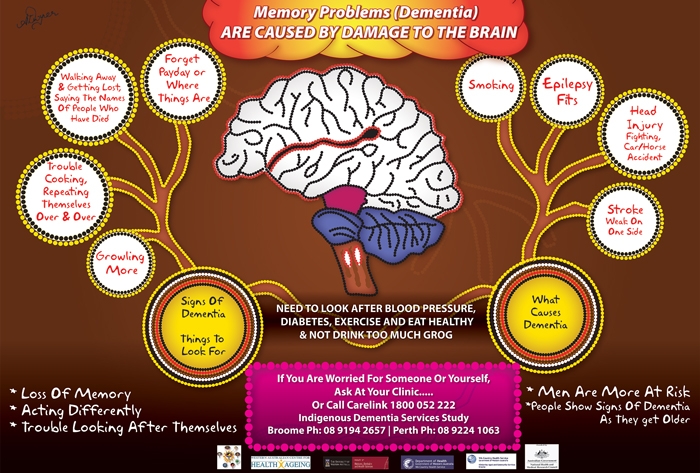
In a highly commended artwork entry for the 2012 Dr Ross Ingram Memorial Prize, a traditional dot painting style and storytelling is used as the basis for a health promotion poster addressing the risks and signs of dementia in Aboriginal people.
This painting is aimed at an Aboriginal audience and depicts the brain and “the snake eating away the life of your memory” to represent dementia. I intentionally used traditional dot painting style and storytelling to speak directly to Aboriginal people and to bring the causes and signs of dementia to their attention.
I am a Karajarri woman from Bidyadanga community in Western Australia. I was the project officer for the Indigenous Dementia Services Study, funded by the National Health and Medical Research Council and conducted by the Western Australian Centre for Health and Ageing at the University of Western Australia. This painting was used as the foundation for a health promotion poster based on the results of the study. The poster explains the risk factors for dementia in Aboriginal people as determined by the research group, including smoking, head injury, previous stroke, epilepsy and old age (listed in the spaces to the right of the brain in the poster). This research also found that dementia is more widespread in Aboriginal men than women. Along with the risk factors, the poster highlights some of the signs of dementia to assist family in identifying the condition (listed in the spaces on the left of the brain in the poster).
Copies of the not-for-profit poster have been distributed Australia-wide and are displayed in health clinics, Aboriginal organisations and other related organisations. For copies of the poster, please contact wacha@uwa.edu.au.
References
- Smith K, Flicker L, Dwyer A, et al. Factors associated with dementia in Aboriginal Australians. Aust N Z J Psychiatry 2010; 44: 888-893. 0_BFGECBDC
Decolonising Indigenous Health Research Requires Redefining Sex, Sexuality and Gender
Shakara Liddelow-Hunt, James H. L. Hill, Kate Daglas, Kaiwarr Clancy, Madi Day, Alistair Ott
Beyond Structural Neglect: Using Evidence to Strengthen Primary Health Care Systems, Policies and Programs for Aboriginal and Torres Strait Islander Men
Kootsy Canuto, Celina Gaweda, James Smith, Karla J. Canuto
Costs of Delivering the Hep B PAST Model of Care in Remote Australia: A Retrospective Pre–Post Study
Hoa Nguyen, Anh Le Tuan Nguyen, Paula Binks, Melita McKinnon, Emily Vintour-Cesar, Karen Wills, Nicola Stephens, Benjamin Cowie, Joshua S. Davis, Yuejen Zhao, Peter Nihill, Julie A. Campbell, Andrew J. Palmer, Jane Davies, Barbara de Graaff
Epidemiology and Quality of Care for Aboriginal and Torres Strait Islander Peoples Treated by Emergency Medical Services for Stroke in Victoria, Australia: Retrospective Analysis of Linked Data
Candice Menezes, Ziad Nehme, Luke J. Burchill, Tegwyn McManamny, Angela Dos Santos, Michelle Crilly, Luke P. Dawson, Benjamin Clissold, David Anderson, Emily Nehme
Hepatitis C Among First Nations Australians: A Rethink Is Required to Meet the 2030 Elimination Target
James Ward, Emily Pegler, Kellie Stacy, Stephen Harfield
Sovereignty and Survival: Understanding Lung Cancer Outcomes for Aboriginal and Torres Strait Islander People in Australia, a Case–Control Study
Alice R. T. Bergin, Luc te Marvelde, Roger L. Milne, Benjamin J. Solomon, Kris Ivanova, Peter Savas, Stephen J. Luen, Jay Hamann, Andrea Casey, Nicole Watt, Sue M. Evans, Gail Garvey, Sherene Loi