




Volume 198 - Issue 11
The drover’s wife
Authors: Matthew J Links and Theodora Bikou
Med J Aust 2013; 198 (11): 632. || doi: 10.5694/mja13.10290
Published online: 17 June 2013
Published online: 17 June 2013
Family stories provide the key to understanding the patient’s wishes and open doors to plain speaking, in this reflection on caring for a woman who is unable to communicate.
Finding the strength to say it like it is
One day she sat down “to have a good cry,” as she said — and the old cat rubbed against her dress and “cried too.” Then she had to laugh.1
The registrar called about her first consultation as a trainee oncologist. The “case” was a 69-year-old previously well woman (let’s call her Tracey) from a semirural setting, who had gone to bed, one week ago, as normal, and had then woken up to find she was having difficulty holding her coffee mug. Within 24 hours she was intubated, ventilated and transferred to a metropolitan centre. A week later she had been diagnosed with a severe demyelinating polyneuropathy and metastatic squamous cell cancer of the lung.
We reviewed all the data, spoke to other members of the team and agreed on a plan of supportive care and withdrawal of ventilatory support. The next difficult task was communicating this to the patient. Our only method of communication was that she could answer yes or no by blinking her eyelids: one blink for “no”, two blinks for “yes”. We went through why her condition precluded effective treatment of her cancer, and that we were recommending “keeping her comfortable”. We asked if this made sense to her — two blinks.
The family conference was shaping up to be a nightmare. The family had no time to come to terms with the situation, the diagnostic pathway was complex, and different family members were coping at different speeds. All the medical teams involved were represented: intensive care, respiratory, neurology and oncology. The sheer number of people involved, the formality and foreign environment all made for a surreal experience. Each team took their turn explaining the situation. The talk was of nerve conduction tests and ventilation, electrical impulses and biopsies, but the news on all fronts was technical and dire. Eventually one daughter had had enough — “I can’t cope with this anymore”, she cried. Feeling helpless, one of the team took her hand, and said “It’s OK, it’s OK”. “It’s not OK” was the inarguable response.
Then we tried a different approach — “What sort of person is Tracey, what is she like? Is she the sort of person who knows what she wants, is she a strong person?” The sobbing slowly eased. “Strong”, her husband guffawed. “If she was here I know what she would say to you all — bugger off.” We all broke out laughing, and the atmosphere changed. Tracey’s husband went on to recount some stories about her, demonstrating her resilience, independence and free spirit. We were able to then lead the discussion to talk about her wishes and their alignment with what her medical teams and family wanted for her — not to suffer. The meeting closed with some sort of “resolution”. The family spent some quiet time with her, painted her nails, cut off some locks of her hair to keep. They recounted their stories of her life. A day later, ventilatory support was withdrawn and she died peacefully.
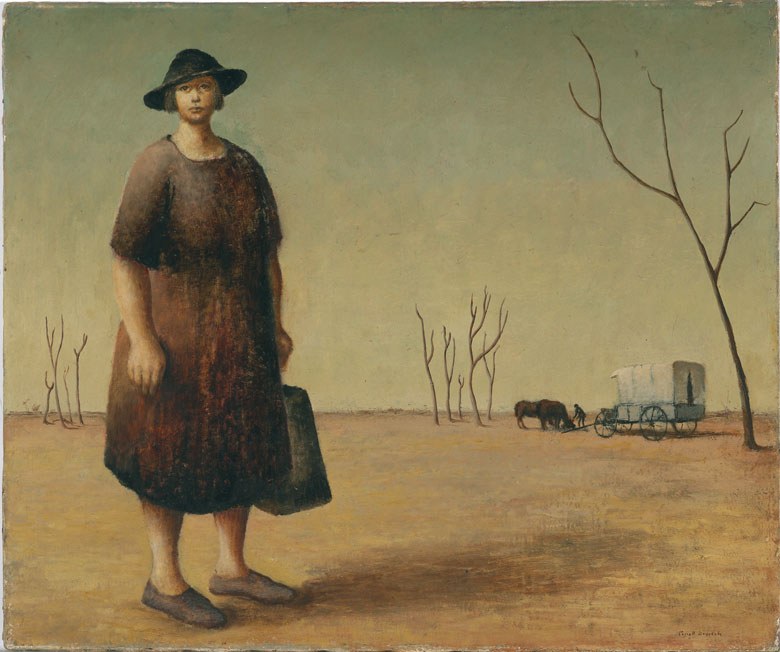
The stories of Tracey reminded us how difficult it is to find the real person behind the intubated woman who could only communicate by blinking. Thinking about the Australian sense of resilience and love of plain speaking, the image of Russell Drysdale’s The drover’s wife came to mind. Not as a stereotype of laconic Australian humour, but as a celebration of the incredible strength and resilience of ordinary people. We often struggle with what to say under circumstances like these — and what could we say that was reassuring? How much do we try to couch things in euphemism, versus speaking plainly? How do you establish a family’s preferences? Here we were given a very good indication that, in this family, speaking plainly was preferred.
Shifting the focus to Tracey as a person also allowed the family to tell us about her and made them the experts. It helped us all deal with the fear and grief involved. Engaging in a conversation based on this information allowed us to develop a plan that was centred on her needs and wishes. This “drover’s wife” taught us about the strength of the Australian character in colourful terms. We could only listen, smile and, in respect of her wishes, “bugger off” to let her die with her family.
Competing interests
No relevant disclosures.
Acknowledgements
We would like to thank Frank Brennan for his comments on the manuscript.
References
- Lawson H. The drover’s wife. The Bulletin 1892; 23 July. EBCCFHIB
Provenance: Not commissioned; externally peer reviewed.
Motor Neuron Disease Mortality Trends in Australia From 1986 to 2023: A Population-Based Study
Carol M. Y. Lee, Rupendra N. Shrestha, Julian Gold, Mark Stevenson, Kelly L. Williams, Lyndal Henden, Sandrine K. K. Chan Moi Fat, Zoe Zussa, Amanda Wright, Martin Jude, Mark A. S. Laidlaw, Willem J. R. Fokkink, Dominic B. Rowe
Mild traumatic brain injury and concussion and persisting post‐concussion symptoms: new guidelines to support evidence‐based assessment and management in Australia and Aotearoa New Zealand
Karen M Barlow, Jennie L Ponsford, Alice Theodom, Gill Cowen, Gavin A Davis, Vicki Anderson, Franz E Babl, David Cole, Jennifer Cullen, Stuart R Dalziel, Melinda Fitzgerald, Howard Flavell, Caroline Yates, Rebecca Kimble, John H Olver, Rhonda Orr, Mark Ralfe, Michael Rose, Nick Rushworth, Julia Treleaven, Gary Browne, Nathan Delang, Sarah Harris, Gary Mitchell, Sean Tweedy
The prevalence of and variation in indicators of the quality and safety of long term aged care in Australia, 2019: a cross‐sectional population‐based study
Tesfahun C Eshetie, Gillian E Caughey, Catherine Lang, Olivia Ryan, Renuka Visvanathan, Craig Whitehead, Keith Evans, Janet K Sluggett, Jyoti Khadka, Carolyn Dawkins, Helena Williams, Miranda Starke, Sara Blunt, Anne Liddell, Megan Corlis, Anna Sheppeard, Penelope Lello, Marilyn Thien, Steven L Wesselingh, Maria C Inacio
Health and economic benefits of improving pre‐hospital identification of stroke in Australian women: a modelling study
Thomas Gadsden, Lei Si, Emily R Atkins, Cheryl Carcel, Xia Wang, Stephen Jan, Mark Woodward, Laura E Downey
Symptom burden, quality of life, and diagnostic journey of people with postural orthostatic tachycardia syndrome, Australia, 2021–24: a descriptive patient registry data study
Marie‐Claire Seeley, Gemma Wilson, Eric Ong, Amy Langdon, Jonathan Chieng, Danielle Bailey, Kristina Comacchio, Amanda Page, Dennis H Lau, Celine Gallagher
The intersection of rurality and dementia prevalence in Australia for Aboriginal and Torres Strait Islander and non‐Indigenous peoples
Antonia J Clarke, Marwan Ahmed, Judith M Katzenellenbogen, John Towney (Wiradjuri), Anna H Balabanski, Adrienne Withall (Dharawal Yuin), Kylie Radford, Amy Brodtmann