




Volume 197 - Issue 5
Sleep tight
Author: John M Worthington
Med J Aust 2012; 197 (5): 1-1. || doi: 10.5694/mja12.10784
Published online: 3 September 2012
Published online: 3 September 2012
DISTURBANCES OF SLEEP and daytime function are important diagnostic symptoms. Although most of us are well versed in the features and important impacts of sleep apnoea, a search for insomnia should be an indispensable part of most history-taking.Almost a third of our symptomatic patients present with symptoms of stress or mood disorder, where investigations of physical symptoms such as fatigue, dizziness, daily headache, chest pain ...
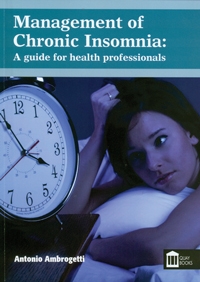
Management of chronic insomnia: a guide for health professionals.
Antonio Ambrogetti. London: Quay Books Division, MA Healthcare (v + 97 pp, $20.15). ISBN 9781856423151.
DISTURBANCES OF SLEEP and daytime function are important diagnostic symptoms. Although most of us are well versed in the features and important impacts of sleep apnoea, a search for insomnia should be an indispensable part of most history-taking.
Almost a third of our symptomatic patients present with symptoms of stress or mood disorder, where investigations of physical symptoms such as fatigue, dizziness, daily headache, chest pain and tingling are negative, and the patient seems objectively well. A few questions about sleep initiation or maintenance can provide a sensitive and specific indication of stress, grief, anxiety and depression, and redirect the therapeutic approach, circumventing years of patient symptoms and futile investigation.
Ambrogetti’s short, easily read book clearly explains how to identify sleep initiation and maintenance problems, and related abnormalities of daytime function. The author is an Australian sleep specialist and a conjoint lecturer at the School of Medicine and Public Health, University of Newcastle, New South Wales. His book is a useful read for those in primary care and subspecialty practice.
The book features a practical guide to differentiating tiredness, sleepiness, fatigue, poor motivation and concentration, and their individual significance. There is a well ordered discussion of management strategies, a helpful glossary and a collection of representative case studies with an Australian flavour.
I do not share the author’s enthusiasm for melatonin and I would counsel against the use of sleeping tablets. However, the discussion of these treatments is comprehensive and does provide appropriate caveats to their use. Although I would place a greater emphasis on the benefits of regular moderate exercise for improving sleep quality and daytime wellbeing, and often use short-course tricyclics for patients with somatic symptoms and sleep disturbance, this takes nothing way from a useful little book on an important topic.
‘Once Bitten’: A Case of Tetanus Following Snakebite in Australia
Adrian A. S. Doherty, Naomi N. E. Clarke, Sarah Fletcher, Sarah Huffam, Camille V. Awburn, Eugene Athan
Epidemiology and Quality of Care for Aboriginal and Torres Strait Islander Peoples Treated by Emergency Medical Services for Stroke in Victoria, Australia: Retrospective Analysis of Linked Data
Candice Menezes, Ziad Nehme, Luke J. Burchill, Tegwyn McManamny, Angela Dos Santos, Michelle Crilly, Luke P. Dawson, Benjamin Clissold, David Anderson, Emily Nehme
Intranasal Adrenaline Use for the Management of Insect Venom-Induced Anaphylaxis
Thomas J. Young, Wilhelmina R. F. Johnson, Braydon L. Pennington, Troy Wanandy, Wun Y. Lau, Thanh-Thao A. Le
Gabapentinoid Poisoning Presentations to Victorian Emergency Departments: A 15-Year Trend Analysis
Bishaal Tej Gurung, Amy McNeilage, Angus Skeen, Tina Lam, Joanna F. Dipnall, Jane Hayman, Suzanne Nielsen, Ting Xia
They Brought the Hospital to Me
Hugh N. Burrill
Predictors of Ambulance Transport to Hospital for Older People Living in Tasmanian Aged Care Facilities: A Retrospective Cohort Study
Sharon Andrews, Pieter F. Fouche, Belinda Flanagan, Michael McDermott, Melanie Greenwood