




Volume 197 - Issue 11
Climate canaries
Author: Yvonne E Cossart
Med J Aust 2012; 197 (11): 658. || doi: 10.5694/mja12.11223
Published online: 10 December 2012
Published online: 10 December 2012
PETER DOHERTY’s ability to span the gap between the most abstract basic science and the everyday world is once again evident in this, his third popular science paperback. Put it on your Christmas gift list. It will intrigue the nerdiest high school student, stimulate the most militant environmentalist and give pleasure to anyone who has worked in the biological sciences or medicine during the past ...
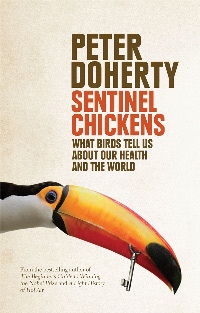
Sentinel chickens: what birds tell us about our health and the world.
Peter Doherty. Melbourne University Press, 2012 (240 pp, $29.99). ISBN 9780522861105.
PETER DOHERTY’s ability to span the gap between the most abstract basic science and the everyday world is once again evident in this, his third popular science paperback. Put it on your Christmas gift list. It will intrigue the nerdiest high school student, stimulate the most militant environmentalist and give pleasure to anyone who has worked in the biological sciences or medicine during the past half century. Read it yourself too, for the informal asides about the ideas and people the author has encountered in his Nobel Prize-winning career in Australia and the United States.
At the heart of the book is the concept that wild birds act as an early warning system of impending ecological catastrophe. Its second theme is the use of birds in investigations of human biology and diseases. Topical examples involving humans as well as birds, such as avian influenza and the West Nile virus, are included, along with outbreaks occurring exclusively among birds and involving environmental contamination or degradation. They are explained simply, but without sacrificing the main scientific import.
The author is equally interested in how and why particular discoveries were made, and his descriptions of the technology and excitement involved demystify the research process. While the choice of examples is informed by an incurable curiosity, it also reflects the author’s early background and training as a vet with professional responsibilities for minimising the impact of untoward environmental effects on livestock.
The notes appended to the text amplify some points of technological interest, and the well chosen bibliography includes research books and papers as well as official websites — a great resource for teaching as well as for personal follow-up. It is a pity that the references of the poems and novels mentioned are not included, since they provide a powerful counterpoint to Doherty’s reminiscences of his early career and subsequent life in science.
Costs of Delivering the Hep B PAST Model of Care in Remote Australia: A Retrospective Pre–Post Study
Hoa Nguyen, Anh Le Tuan Nguyen, Paula Binks, Melita McKinnon, Emily Vintour-Cesar, Karen Wills, Nicola Stephens, Benjamin Cowie, Joshua S. Davis, Yuejen Zhao, Peter Nihill, Julie A. Campbell, Andrew J. Palmer, Jane Davies, Barbara de Graaff
Buruli Ulcer Acquired From Ringtail Possum Rescue
Daniel P. O'Brien, Naomi Clarke, Sara Bonnici, Mohammad A. Hussain
Q Fever Visceral Abscesses After Contact With Native Australian Marsupials
Samantha J. Laws, Enzo Binotto, James Stewart, Jennifer Ho, Trent Yarwood, Josh Hanson, Simon Smith
Hospital-Admitted Injection-Related Infections Among Incarcerated People Who Inject Drugs in Australia: A Retrospective Cohort Study
Andrew Palmer, Matthew Carter, Jeremy Yeo, Cecilia Shim, Jason Connor, Jeremy Hayllar, Gerald Holtmann, Naomi Moy, Elliott G. Playford, Naomi Runnegar, Paul J. Clark
The Live Attenuated Influenza Vaccine in Australia: An Additional Tool for Influenza Prevention
Cyra Patel, Alexis Pillsbury, Tran Nguyen, Xia Wang, Helen E. Quinn, Clayton K. Chiu, Allen C. Cheng, Katie L. Flanagan, Zhicheng Wang
Reflex Testing for Hepatitis D Infection: A Unique Opportunity to Reduce Hepatitis D-Related Chronic Liver Disease Deaths in Australia
Jessica Howell, Lauren Andersson, Miriam T. Levy, James O'Beirne, Leon Adams, Katharine Irvine, Avik Majumdar, Golo Ahlenstiel, Kathy Jackson, Krispin Hajkowicz, Joseph Doyle, Jane Davies, Sarah Cherian, Wayne Dimech, Alexander J. Thompson