




Volume 196 - Issue 3
A Pandora’s box: sustainable pharmaceutical supply
Authors: Robert Pearce, Simon Quilty, Jacqueline Kewley and Lisa M Harris
Med J Aust 2012; 196 (3): 170-171. || doi: 10.5694/mja11.11521
Published online: 20 February 2012
Published online: 20 February 2012
To the Editor: After our recently published article1 and subsequent criticism2 that shortages in benzylpenicillin were a “storm in a teacup”, we would like to detail the increasing number of drug shortages at John Hunter Hospital. Not only does this pose increasing costs to pharmacy but there are escalating threats to patient care.
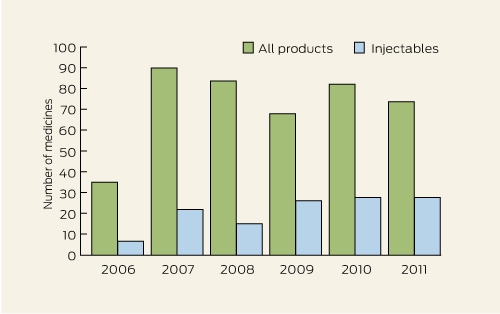
As part of our routine formulary management, records are kept on drug shortages, collected to communicate urgent pharmaceutical issues and not designed as a research tool (Box). All shortages recently experienced in this hospital have been in generic medicines, particularly injectables, although any drug is potentially vulnerable. There are shortages that recur; thiopentone has twice been in short supply in recent months, noradrenaline has had recurrent periods of short supply, and intravenous labetalol is currently critically low and has previously been discontinued by a supplier in Australia, requiring a new manufacturer to be found. At the time of writing, midazolam 5 mg/5 mL injection is in short supply despite there being three generic brands in Australia, suggesting that all products come from the same source.
The shortages we are experiencing are similar to but less extensive than those described in the United States.3 However, our list is far from complete as we cannot detect suppliers’ shortages that are resolved before our hospital shelves are affected.
Hospitals cope in the usual ways — stockpiling (which protects some networks and harms others), switching to alternatives where possible, and finding new suppliers. Not only does this directly compro-mise patient care, it has been shown that subsequent changes in formulary increase medication errors4,5 — not to mention the economic impact, which is not known in Australia but has been estimated to cost $216 million each year in the US.3
Governments in the US and United Kingdom are taking decisive action to rectify this problem. However, the issue remains unrecognised in Australia and the Therapeutic Goods Administration has indicated to the authors that monitoring shortages is not its legislative responsibility. In the interests of national health care security, this issue needs to be resolved immediately by the federal government. Urgent action must be taken to identify medicines that are “essential” and to safeguard their supply through all possible avenues to ensure short-term health care sustainability.

Competing interests
No relevant disclosures.
References
- Quilty S, Harris LM, Kewley J, et al. A Pandora’s box: sustainable pharmaceutical supply. Med J Aust 2011; 195: 510-511. 0_CHDGBHJA
- ABC Radio. New penicillin sourced but worries over supply continue [transcript]. PM. 29 Sep 2011. http://www.abc.net.au/pm/content/2011/s3329037.htm (accessed Jan 2012).
- Chabner B. Drug shortages — a critical challenge for the generic-drug market. N Engl J Med 2011; 365: 2147-2149. 0_i1142881
- Gatesman M, Smith T. The shortage of essential chemotherapy drugs in the United States. N Engl J Med 2011; 365: 1653-1655. 0_i1142883
- NSW Department of Health Clinical Safety, Quality and Governance Branch. Safety Notice 022/09. Safe use of midazolam. http://www.health.nsw.gov.au/resources/quality/sabs/pdf/sn_22_09.pdf (accessed Jan 2012).
Designing Housing to Reduce Overcrowding-Related Harms: Rheumatic Heart Disease as the Canary in the Coal Mine
Simon Quilty, Veronica Matthews, Angus Baumann, James Marangou, Bo Remenyi, Gavin Wheaton, Serena Morton Nabanunga, Norman Frank Jupurrurla, Simon Robinson, Steve Mintern, Cary Duffield, Joshua R. Francis, Paul C. Memmott
Australian Climate Leadership in 2026: COP-Out or Step-Up for Health?
Catherine G. A. Pendrey, Angie Bone, Aletha Ward, Francis Nona, Michelle Isles, Paul M. Kelly, Nicholas J. Talley
The impact of the Breast Screen NSW transition from film to digital mammography, 2002–2016: a linked population health data analysis
Rachel Farber, Nehmat Houssami, Katy J L Bell
Shifting focus to adolescent wellbeing and inclusive participation in the digital age
Allyson R Todd, Elena Wang, Stephanie R Partridge
The CURE Asthma roadmap
Gary P Anderson, Anthony Flynn, Phil G Bardin, John D Blakey, Shyamali C Dharmage, Paul Foster, Peter G Gibson, Adam Jaffe, Alan James, Christine R Jenkins, Sundram Sivamalai, Peter D Sly, Guy B Marks, Vanessa M McDonald, Judy Wetttenhall
Protecting public interest journalism as a public health good
Bronwyn Fredericks, Neha Lalchandani, Melissa A Sweet, Alex Cramb, Carmel Williams