




Volume 196 - Issue 1
“Blunderburg” revisited
Author: Merrilyn Walton
Med J Aust 2012; 196 (1): 79. || doi: 10.5694/mja11.11522
Published online: 16 January 2012
Published online: 16 January 2012
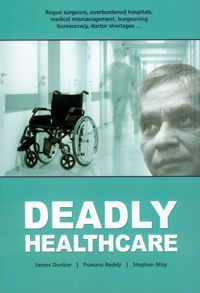
Deadly healthcare.
James Dunbar, Prasuna Reddy, Stephen May. Brisbane: Australian Academic Press, 2011 (194 pp, $34.95). ISBN 9781921513756.
This account of the lead-up to the 2010 trial of Jayant Patel — dubbed “Dr Death” by the media — is excellent, which is not surprising considering Professors Dunbar and Reddy’s background in health services implementation research at Deakin University, Victoria. Unfortunately, the same can’t be said for the authors’ coverage of the real impact of the Patel case on health regulation in Australia.
The Australian Health Practitioner Regulation Agency (AHPRA) is mentioned only to record its establishment in July 2010. Missing is any reference to the Health Practitioner Regulation National Law Act (enacted in Queensland in 2009 and in the other states in 2010), which came into existence before the AHPRA and started to make it extremely difficult for a similar situation to occur today.
The reader is left with the impression that little has changed and similar tragedies could occur today. But while there are no guarantees that a rogue doctor can no longer be appointed, regulation has changed radically since then.
Today, complaints from doctors and the community are not so much about the cursory checking of international medical graduates’ qualifications but about the AHPRA requiring too much information. Patient safety is an explicit principle underpinning the National Health Practitioner Regulation Law, which created the Medical Board of Australia and the AHPRA. The authors fail to mention the new mandatory reporting laws that require health professionals to report those who place the health and safety of patients at risk.
However, the facts about the Patel case provided in this book should be interesting for those new to regulation and clinical governance.
Capturing the Benefits of Clinical Quality Registries
Taryn Bessen, Stephen McDonald
Medical Colleges Have an Obligation to Ensure Full Participation in Clinical Quality Registries
Thomas J. Hugh
Getting on the Same Page: Why Australia Needs a National Maternity Early Warning System (MEWS) Chart
Briony A. Cutts, Lucy Bowyer, Nisha Khot, Sandra Lowe, Stefan C. Kane
Data for Equity: Can Linked Administrative Data Inform Pathways to More Equitable Child Health?
Sarah Gray, Shuaijun Guo, Meredith O'Connor, Elodie O'Connor, Katrina Williams, Hannah Badland, Susan Woolfenden, Josie Dickerson, Gerry Redmond, Marnie Downes, Sharon R. Goldfeld
Specialty College Selection: Why Change is Critical to Support a Future Rural Workforce
Matthew R. McGrail, Jenny May AM, Katherine Logan
Differentiated and simplified oral HIV pre‐exposure prophylaxis (PrEP) models hold the key to virtually eliminating HIV transmission in Australia by 2030
Tyson Arapali, Sarah Warzywoda, Anthony K J Smith, Curtis Chan, Timothy R Broady, Erin Sullivan, Catherine MacPhail, Mohamed A Hammoud, Alexander Dowell‐Day, Benjamin R Bavinton