




Volume 196 - Issue 1
“Blunderburg” revisited
Author: Caroline M de Costa
Med J Aust 2012; 196 (1): 79. || doi: 10.5694/mja11.10966
Published online: 16 January 2012
Published online: 16 January 2012
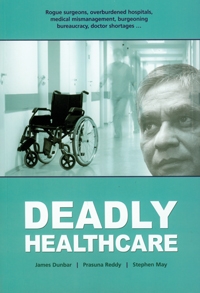
Deadly healthcare.
James Dunbar, Prasuna Reddy, Stephen May. Brisbane: Australian Academic Press, 2011 (194 pp, $34.95). ISBN 9781921513756.
This is a compelling read. Dr Jayant Patel arrived at Queensland’s Bundaberg Hospital on April Fools’ Day 2003 and, in the words of former Federal Health Minister Michael Wooldridge, “walked into an environment tailor-made for disaster to occur”. In June 2010, he was sentenced to seven years’ imprisonment for manslaughter and grievous bodily harm involving four patients operated on in Bundaberg. An appeal was dismissed.
The authors of this well documented account are eminently qualified to tell the tale — Professor Dunbar teaches clinical governance and risk management at Flinders University in Adelaide, Professor Reddy is a health and organisational psychologist at Flinders and Stephen May is a former psychologist and journalist.
As they explain, Patel was far from being the only one at fault. The authors carefully examine the bureaucratic structures and attitudes in existence in Queensland Health, and the personal and professional failings of particular administrative staff at the Queensland Medical Board and the hospital that led to Patel — whose registration as a specialist surgeon was restricted in two US states — being appointed as director of surgery at Bundaberg. They find that the hospital was “fiscally driven”, and Patel’s ability to perform large numbers of operations benefited the budget and completely overrode concerns about patient outcomes.
The gulf between management and clinicians is neatly encapsulated in the story of an administrator telling a senior Bundaberg clinician concerned about Patel’s activities: “You have to understand that this is a business.” To which the doctor replied: “That’s where the problem is, you see. I think it’s a hospital.”
The efforts of this clinician and many other staff, patients and relatives to achieve justice are well described, as are the findings of the numerous formal inquiries and the details of Patel’s trial. Patel’s earlier life and medical training have been meticulously researched and the authors have attempted to give a balanced view, pointing out that many of the 1000 patients he operated on at Bundaberg benefited from his surgery. Had the proper checks and balances been in place, the negative outcomes might never have occurred.
Has the Queensland public health system learnt from the Patel case? Sadly, the authors conclude that it has not — their final sentence warns that a case like Patel’s “could be happening right now in your own modern overburdened healthcare system”.
Capturing the Benefits of Clinical Quality Registries
Taryn Bessen, Stephen McDonald
Medical Colleges Have an Obligation to Ensure Full Participation in Clinical Quality Registries
Thomas J. Hugh
Getting on the Same Page: Why Australia Needs a National Maternity Early Warning System (MEWS) Chart
Briony A. Cutts, Lucy Bowyer, Nisha Khot, Sandra Lowe, Stefan C. Kane
Data for Equity: Can Linked Administrative Data Inform Pathways to More Equitable Child Health?
Sarah Gray, Shuaijun Guo, Meredith O'Connor, Elodie O'Connor, Katrina Williams, Hannah Badland, Susan Woolfenden, Josie Dickerson, Gerry Redmond, Marnie Downes, Sharon R. Goldfeld
Specialty College Selection: Why Change is Critical to Support a Future Rural Workforce
Matthew R. McGrail, Jenny May AM, Katherine Logan
Differentiated and simplified oral HIV pre‐exposure prophylaxis (PrEP) models hold the key to virtually eliminating HIV transmission in Australia by 2030
Tyson Arapali, Sarah Warzywoda, Anthony K J Smith, Curtis Chan, Timothy R Broady, Erin Sullivan, Catherine MacPhail, Mohamed A Hammoud, Alexander Dowell‐Day, Benjamin R Bavinton