




Volume 196 - Issue 1
Adhesive tape in the health care setting: another high-risk fomite?
Authors: Patrick N A Harris, Chris Ashhurst-Smith, Sandy J Berenger, Alison Shoobert and John K Ferguson
Med J Aust 2012; 196 (1): 34. || doi: 10.5694/mja11.11211
Published online: 16 January 2012
Published online: 16 January 2012
To the Editor: We read with interest the article by Pinto and colleagues regarding colonisation of reusable tourniquets by multiresistant organisms (MROs).1 We highlight that surgical adhesive tape also has the potential to act as a significant fomite in health care settings.
We collected partially used surgical tape rolls from several clinical areas of three hospitals in the Hunter New England Area Health Service. Using hands disinfected with alcohol gel, tape rolls from different locations in each area were placed into 21 clean collection bags (up to three tapes per bag).
Tapes from each batch were placed in 21 sterile containers with 15 mL of brain–heart infusion broth and incubated overnight at 35°C in carbon dioxide. The broths were subcultured onto Columbia horse-blood agar (Oxoid Australia, Adelaide, SA), MacConkey agar (Oxoid) and differential selective media to detect vancomycin-resistant enterococci (VRE) (chromID VRE; bioMérieux, Marcy L’Étoile, France), methicillin-resistant Staphylococcus aureus (MRSA) (Brilliance MRSA; Oxoid) and multiresistant gram-negative bacteria (chromID ESBL; bioMérieux). A multiplex tandem polymerase chain reaction assay (MRSA4; AusDiagnostics, Sydney, NSW) to detect MRSA and methicillin-susceptible S. aureus (MSSA) was also performed on all broth cultures. Routine species level identification was performed (VITEK MS; bioMérieux). Susceptibility was determined in accordance with Clinical and Laboratory Standards Institute criteria.2
In 11 of the 21 tape batches, MRSA and/or VRE were identified. Of these, four were positive for MRSA and 10 for VRE, with three positive for both. MSSA was identified in two, both in association with VRE. All batches showed evidence of contamination with other bacteria such as Bacillus cereus, coagulase-negative staphylococci, non-multiresistant Enterobacteriaceae, Pseudomonas spp, Acinetobacter spp and other enterococci.
Our results indicate that surgical adhesive tapes are frequently contaminated with MROs. Interpretation of these results is limited by the small number of tapes and clinical areas sampled, and the difficulty of proving a relationship to clinical infection. However, items such as intravenous cannulae, surgical drains and wound dressings are frequently fixed using surgical adhesive tape. This may lead to colonisation and subsequent infection. Furthermore, tape rolls are often left lying on contaminated surfaces, are handled by multiple individuals and cannot be disinfected.
Surgical adhesive tape is a potential reservoir of pathogenic bacteria3 and fungi4 and was implicated in a prolonged S. aureus outbreak in a neonatal unit.5 The role of surgical tape as a potential fomite was reported in 19746 but has not been widely acknowledged since.
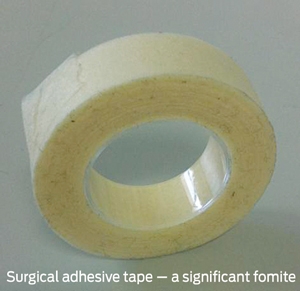
Removing the outer layer of the tape roll is unlikely to reduce contamination, given visible contamination of the side of many rolls (Figure).3 Short rolls of surgical adhesive tape should be supplied in sealed packets and used for individual patients, only after hand disinfection, and discarded after use.
Competing interests
No relevant disclosures.
References
- Pinto AN, Phan T, Sala G, et al. Reusable venesection tourniquets: a potential source of hospital transmission of multiresistant organisms. Med J Aust 2011; 195: 276-279. 0_i1142886
- Clinical and Laboratory Standards Institute. Performance standards for antimicrobial susceptibility testing; twentieth informational supplement. CLSI document M100-S20. Wayne, Pa: CLSI, 2010. 0_i1142888
- Redelmeier DA, Livesley NJ. Adhesive tape and intravascular-catheter-associated infections. J Gen Intern Med 1999; 14: 373-375. 0_i1142890
- Everett ED, Pearson S, Rogers W. Rhizopus surgical wound infection with elasticized adhesive tape dressings. Arch Surg 1979; 114: 738-739. 0_i1142892
- Wilcox MH, Fitzgerald P, Freeman J, et al. A five year outbreak of methicillin-susceptible Staphylococcus aureus phage type 53,85 in a regional neonatal unit. Epidemiol Infect 2000; 124: 37-45. 0_i1142894
- Berkowitz DM, Lee WS, Pazin GJ, et al. Adhesive tape: potential source of nosocomial bacteria. Appl Microbiol 1974; 28: 651-654. 0_i1142897
Costs of Delivering the Hep B PAST Model of Care in Remote Australia: A Retrospective Pre–Post Study
Hoa Nguyen, Anh Le Tuan Nguyen, Paula Binks, Melita McKinnon, Emily Vintour-Cesar, Karen Wills, Nicola Stephens, Benjamin Cowie, Joshua S. Davis, Yuejen Zhao, Peter Nihill, Julie A. Campbell, Andrew J. Palmer, Jane Davies, Barbara de Graaff
Buruli Ulcer Acquired From Ringtail Possum Rescue
Daniel P. O'Brien, Naomi Clarke, Sara Bonnici, Mohammad A. Hussain
Q Fever Visceral Abscesses After Contact With Native Australian Marsupials
Samantha J. Laws, Enzo Binotto, James Stewart, Jennifer Ho, Trent Yarwood, Josh Hanson, Simon Smith
Hospital-Admitted Injection-Related Infections Among Incarcerated People Who Inject Drugs in Australia: A Retrospective Cohort Study
Andrew Palmer, Matthew Carter, Jeremy Yeo, Cecilia Shim, Jason Connor, Jeremy Hayllar, Gerald Holtmann, Naomi Moy, Elliott G. Playford, Naomi Runnegar, Paul J. Clark
The Live Attenuated Influenza Vaccine in Australia: An Additional Tool for Influenza Prevention
Cyra Patel, Alexis Pillsbury, Tran Nguyen, Xia Wang, Helen E. Quinn, Clayton K. Chiu, Allen C. Cheng, Katie L. Flanagan, Zhicheng Wang
Reflex Testing for Hepatitis D Infection: A Unique Opportunity to Reduce Hepatitis D-Related Chronic Liver Disease Deaths in Australia
Jessica Howell, Lauren Andersson, Miriam T. Levy, James O'Beirne, Leon Adams, Katharine Irvine, Avik Majumdar, Golo Ahlenstiel, Kathy Jackson, Krispin Hajkowicz, Joseph Doyle, Jane Davies, Sarah Cherian, Wayne Dimech, Alexander J. Thompson