




Volume 195 - Issue 9
Medicine as the reluctant handmaiden of war
Author: Astika Kappagoda
Med J Aust 2011; 195 (9): 546-547.
Published online: 7 November 2011
Published online: 7 November 2011
War and Medicine.
Canadian War Museum, Ottawa, Ontario, Canada
27 May to 15 November 2011.
Medicine is, and has always been, the ambiguous, uncertain and reluctant handmaiden of war. Nowhere is this more evident than in “War and Medicine”, an impressive collaborative effort between the Wellcome Collection, London, and the Deutsches Hygiene-Museum, Dresden. The exhibition was developed to better understand the role of medicine and its practitioners in the context of war. It reminds us that the involvement of medicine in armed conflict is not straightforward. Medical staff and their patients are put in difficult situations, which potentially compromise the main objectives of patient care, but which have resulted in important medical advances for everyone.
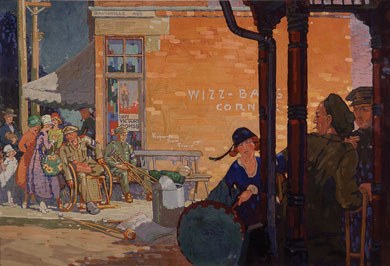
Wounded World War I veterans sit outside the Orthopaedic Military Hospital and artificial limb factory in Toronto. Some veterans informally called the intersection of Davisville Avenue and Yonge Street, “Whizz-Bang Corner”, after a similarly named spot on the Western Front. The streets of Toronto were not nearly as dangerous, but veterans had new challenges to face as they reintegrated into postwar society.
A war record. Painted by Stanley Francis Turner. Beaverbrook Collection of War Art. CWM 1970261-0766.
The exhibition, covering 300 artefacts and taking 3 hours to view, is currently showing until 15 November 2011 at the Canadian War Museum in Ottawa (http://www.warmuseum.ca/medicine), a city chosen in the 19th century to be capital of Canada as much for military, strategic and tactical purposes as anything else. The exhibition is also strategic — the Wellcome Trust and the Hygiene-Museum both have a mission to get the public to think of science (and medicine) as a cultural phenomenon. The intersection of war and medicine provides an ideal opportunity to explore this issue, which transcends the history between two former adversaries in the 20th century.
Frequently graphic, the material for the exhibition is wide-ranging and simply explained, and highly effective for that reason. There are diaries, manuals, highly crafted portable surgical toolkits used by the “sawbones” (somewhat eye-watering, given their intended use), Florence Nightingale’s charts documenting epidemiological patterns in military hospitals, educational (and sometimes propaganda) film footage from times long gone, pathology specimens and anatomical casts, artwork and photographs of traumatised soldiers, and army issue boots and clothing torn through by shrapnel and mortar.
The totality of the exhibits gives a solid sense of how medicine in war evolved from the “four humours” theory of health and disease through to the application of modern medicine. Timely care, the systematic use of evidence-based knowledge, and a more inclusive view, akin to that of humanitarian relief, of the physical and mental effects of war for both combatants and civilians are issues now integral to military medicine. This evolution has occurred in tandem with the development of warfare from fighting at close quarters by massed forces in squalid environments, through to present-day, remotely conducted military assaults, and asymmetric warfare against adversaries dispersed in civilian populations or in exposed or difficult terrain, such as the current conflict in Afghanistan. Medicine in the war zone has also had to adapt to novel, sometimes unconventional, military technological developments in transport, weaponry, personal protection, communications and intelligence, as well as incorporating advances in medicine. In many senses, military medicine, because of the unique conditions under which it operates, is at the forefront of clinical practice.
The exhibition successfully conveys the essential tensions that pull at military medicine. Doctors in the war zone concentrate on applying science-based skills to the patient in front of them. After all, they are there to provide help, and, in war, there are so many who need it. Why would doctors not be there? However, at the same time, the role of medical personnel, though committed to the principle of “do no harm”, is to work within an environment where (mostly) men deliberately and systematically try to kill each other. To what extent are doctors, by extension, involved in acts of war, where military objectives may run into professional and moral duty? Is a doctor a witness, a participant or an advocate in the context of war and its casualties? May ethical and professional compromises be the price to pay for the undeniable advances in medical care these doctors make? These questions prompt us to try to make sense of how doctors and the medical system work with and within war, and how the practice of medicine is consequently changed. An exhibition such as this is vital to enable us to think through these issues.
“War and Medicine” sensibly organises the issues into three strands: the system (how medical care is organised at the battlefront), the body, and the mind. At all of these levels, it reminds us that important innovations in medicine and health care, which we now take for granted, took place during wartime. In the 19th century, Florence Nightingale acted to curb mortality in the Crimean War. Wars in the 20th century have given rise to many surgical procedures (in particular, those in orthopaedics, plastic surgery and neurosurgery) and the techniques of physical, psychological and social rehabilitation following disfiguring injuries and procedures. The terrible psychological consequences of war recognised by the military doctors led to more general recognition and management of post-traumatic psychiatric syndromes in both serving personnel and civilians, where trauma does not necessarily occur in armed conflict.
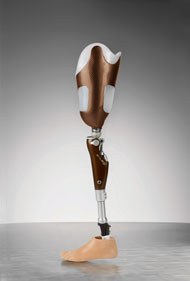
The C-Leg, a computerised leg invented in 1987 by Canadian engineer Kelly James, is a modern example of a prosthetic leg that mimics the normal human gait. Developed by Otto Bock HealthCare, the C-Leg uses sensors, a microprocessor in the knee joint and hydraulics to adjust to different terrain. It was first issued to injured Canadian military personnel in 2006.
Photograph courtesy of Otto Bock HealthCare Canada Ltd. Caption courtesy of the Canadian War Museum.
However, medicine’s involvement in war has been a double-edged sword. Medicine in war has helped countless soldiers and civilians, and has contributed to advances in medical understanding (Box 1), but at the same time, there have been many untoward consequences. As a result of the military’s tight control of information, relatives at home have never known for sure about the welfare of an injured family member at the front. The focus on military operations has meant that compassion for casualties and their families has often been neglected by the military, and medical staff have not been able to intervene. Then there is the unintended or unavoidable harm of medical procedures, with its attendant ethical issues, and — notoriously — the experiments that doctors in wartime performed on unwilling or unknowing subjects. Did the original members of the Guinea Pig Club (Box 2) — the self-named personnel in World War II who received novel pedicle flap grafts to treat extensive facial burns — think their surgeons were treating them, experimenting on them, or both? What counted as consent, and what do we make of their black humour about the surgeons’ work? It is true that the sheer extent of casualties in war, the need to develop medical strategies in response, and the pressures that medical staff work under to give their patients a chance, provide an important laboratory for significant medical innovations and lessons that apply well beyond the battlefield. But equally, some medical procedures are a warning of unintended consequences, and of the areas where medicine should not go.
In some respects, “War and Medicine” may seem incomplete for the Australian audience. It is significantly contextualised for Canada, with about half the artefacts coming from Canadian archives. For an Australian audience, this necessary adaptation of the themes to the Canadian audience unavoidably leaves some holes. There is not as much coverage of issues such as Agent Orange, and how medical care was organised in tropical environments. In contrast to Canada, Australia’s military has had to respond to incidents on home soil or nearby — the bombing of Darwin in 1942, the numerous natural disasters in Australia, bombings in South-East Asia. Australian medicine has learned substantially from these events, and one wonders, were this exhibition to make it to Australia, how the curators would attempt to provide the local perspective. Any travelling exhibition has a personality of its own and evolves in some way. How would an Australian contribution change this exhibition?
Another difficulty is that the exhibition does not flesh out the contemporary practice of medicine in war as well as it does that of the past. Yes, we do see footage of a British soldier with a penetrating chest injury being helicoptered out of Afghanistan with a medical evacuation team, and the detail of the Canadian Army’s medical equipment kit, but one feels that something is missing to gain a good overall understanding. Maybe time is needed to develop the required perspective. Or perhaps military organisations have not made all medically relevant information available to the exhibition organisers. Modern medicine thrives on information sharing, and such filtering of information runs counter to good medical practice. In this situation, how can civilian and military medicine fully help each other? Do the wishes of medical staff to freely share medical information come a poor second to military security? Does medicine have to be the handmaiden of war in this way?
Despite these minor shortcomings, “War and Medicine” offers an important and rewarding experience for any doctor. It is a reminder that much of what we take for granted in modern medicine came into existence at times when humans and societies were at their worst. It reminds us of the difficult ethical issues that medical staff face in the field, but also of their lasting innovations. There is still much to be done for medicine to keep up with the ways in which warfare evolves, and to bring our better nature to bear on a nature that we would rather did not exist.
1 Medical advances during wartime or as a result of war*
Humanitarian and disaster relief: The International Committee of the Red Cross was founded in the 1860s by Jean Henri Dunant, who was horrified by the casualties of the Austro–Sardinian War. French Red Cross doctors who had worked during the Nigerian Civil War in the late 1960s created Médecins sans Frontières.
The concept of the blood bank was pioneered by Oswald Hope Robertson while he served with the United States Army Medical Corps in 1917 in France.
World War II was the spur for the mass production of penicillin to treat injured soldiers. Initially, stocks were so precious that all urine from the first few patients was collected to recover the penicillin for reuse.
The US MASH (mobile army surgical hospital) units developed in World War II and the Korean and Vietnam wars greatly influenced the management of trauma in civilians.
In the 1970s, US Vietnam War veterans, with the support of psychiatrists, successfully persuaded the American Psychiatric Association to recognise post-Vietnam syndrome (later renamed post-traumatic stress disorder) as an illness.
* Information sourced from the “War and Medicine” exhibition media site (http://www.warmuseum.ca/medicine).
2 The Guinea Pig Club*
This club was originally formed out of Allied airmen in World War II who had suffered severe burns, and who were treated by New Zealand surgeon Sir Archibald McIndoe by (often multiple) reconstructive surgical procedures.
These procedures (such as the walking-stalk skin graft) were new and were developed, along with specialised equipment, at the Queen Victoria Hospital in East Grinstead in the United Kingdom.
Initially a “drinking club” at the hospital, the Guinea Pig Club eventually became dedicated to the psychological and social rehabilitation of patients, which was novel at the time.
The club is still active and meets annually at East Grinstead.
* Information sourced from the “War and Medicine” exhibition media site (http://www.warmuseum.ca/medicine).
Competing interests
No relevant disclosures.
Acknowledgements
I thank Barbara Sibbald, Deputy Senior Editor at the Canadian Medical Association Journal, for her assistance in revising the manuscript and for suggesting helpful changes, and the Canadian War Museum for arranging the visit to the exhibition and the use of information and images used in this review.