




Volume 194 - Issue 1
Advocating women’s health
Author: Lachlan de Crespigny
Med J Aust 2011; 194 (1): 23. || doi: 10.5694/j.1326-5377.2011.tb04140.x
Published online: 3 January 2011
Published online: 3 January 2011
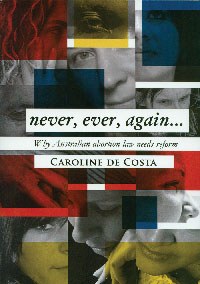
Never, ever, again . . . Why Australian abortion law needs reform.
Caroline de Costa. Brisbane: Boolarong Press, 2010 (168 pp) ISBN 978 1 921555510.
Caroline de Costa wrote her new book because of her belief that it is inappropriate to punish a woman for making the decision that she is unable to become a mother at this point in her life.
The material has been carefully researched by the author, who is Professor of Obstetrics and Gynaecology at James Cook University, in Cairns, Queensland. It brings together into a single clear record the often confused history of abortion law and relevant court cases in both Queensland and elsewhere in Australia.
The chapter on the long history of the family planning and abortion information service “Children by Choice” and its remarkable contribution to Queenslanders is enlightening.
The book records gruesome personal stories of barbaric pre-1970 illegal abortions. They highlight the dangers to life and health to which Australian women, especially the poor and isolated, were exposed before court rulings that made some abortions lawful.
The documentation of the history of the emergency contraceptive mifepristone (RU-486), which can be used for medical (non-surgical) abortion in early pregnancy or in the second trimester, is also valuable. The author knows the process well — she and her colleague were the first two doctors who were permitted by the Therapeutic Goods Administration to prescribe mifepristone in Australia.
The book describes in detail the build-up to criminal action against Tegan Leach and her partner in Cairns, who were sent mifepristone from overseas. Leach appears to be the first Australian woman charged with procuring an abortion for herself. De Costa will publish an account of the court case on her website.
De Costa’s book highlights the unclear and inconsistent abortion laws throughout Australia and the need for uniform and just laws as a first step in providing equitable access to abortion, including for mifepristone.
This book documents how Australia continues to fail women who conceive but feel unable to raise a child at the time. I would strongly recommend this book to all obstetricians and gynaecologists, as well as others interested in women’s health. It adds to de Costa’s proud record as an advocate for women’s health.
Forty Years in the Making: Reporting on the Co-Creation of a National Roadmap for Birthing on Country Services for the Best Start to Life
Res McCalman, Anneka J. Bowman, Roianne West, Kristie Watego, Jyai Allen, Claire Clack, Sue Kildea, Sue Kruske, Melanie Briggs, Cleone Wellington, Rebecca Coddington, Yu Gao, Isabella Garti, Sascha Kowalenko, Sarah Ireland, Catherine Austin, John D. Boffa, Marah Prior, Kelsie Kahl, Bettina Chaseling, Sarah Khaw, Emily Armstrong, Donna Hartz, Yvette Roe
Temporal Trends in Preterm Birth Associated With Hypertensive Disorders of Pregnancy in Victoria, Australia: A Population-Based Interrupted Time-Series Study
Melvin Marzan, Heng Jiang, Daniel Lorber Rolnik, Joanne M. Said, Lisa Hui
Linguistic Manoeuvres: Obstetric Violence Camouflages Harm and Loss of Consent From Birth
Liz Sutton, Harsha Ananthram, Rebecca Matthews
Linguistic Manoeuvres: Obstetric Violence Camouflages Harm and Loss of Consent From Birth
Bashi Kumar-Hazard, Andrew M. Bisits, Sharon L. Settecasse, Jenny Gamble, Hazel Keedle, Hannah G. Dahlen
Linguistic Manoeuvres: Obstetric Violence Camouflages Harm and Loss of Consent From Birth
Wendy Pollock, Alissa Fleming, Ensieh Fooladi, Joy Kloester, Anne Tremayne, Yasmin Zisin, Bethany Carr, Kym Davey, Suzanne Willey, Jenny Gamble
Getting on the Same Page: Why Australia Needs a National Maternity Early Warning System (MEWS) Chart
Briony A. Cutts, Lucy Bowyer, Nisha Khot, Sandra Lowe, Stefan C. Kane